

3.2 Changes in Land Use and Crop Rotations
At a finer scale, the changes in land use and agricultural practices have been
documented since the 1970s (the ARSeine database [12]). The specialisation in a
stockless cropping system in the centre of the watershed went together with a strong
reduction of permanent grassland surfaces (Fig. 4a), which are now restricted to the
Eastern and Western fringes of the basin.
A significant reduction of the length and diversity of arable crop rotations has also
occurred during the same period. Grain and forage legumes, which were basic
components of crop rotations in the middle of the twentieth-century agriculture,
were abandoned in many places (Fig. 4a). A sharp drop in the frequency of spring
crops (Fig. 4b), such as spring barley and grain maize, is also observed, while
rapeseed has gained ground.
3.3 Yield-Fertilisation Relationship
While the variations of crop productivity during the second half of the nineteenth
century closely followed those of livestock density and the resulting availability of
manure, the rapid yield rise observed after 1950 is the direct consequence of the
increased use of mineral fertilisers (Fig. 2b). The historical trajectory followed until
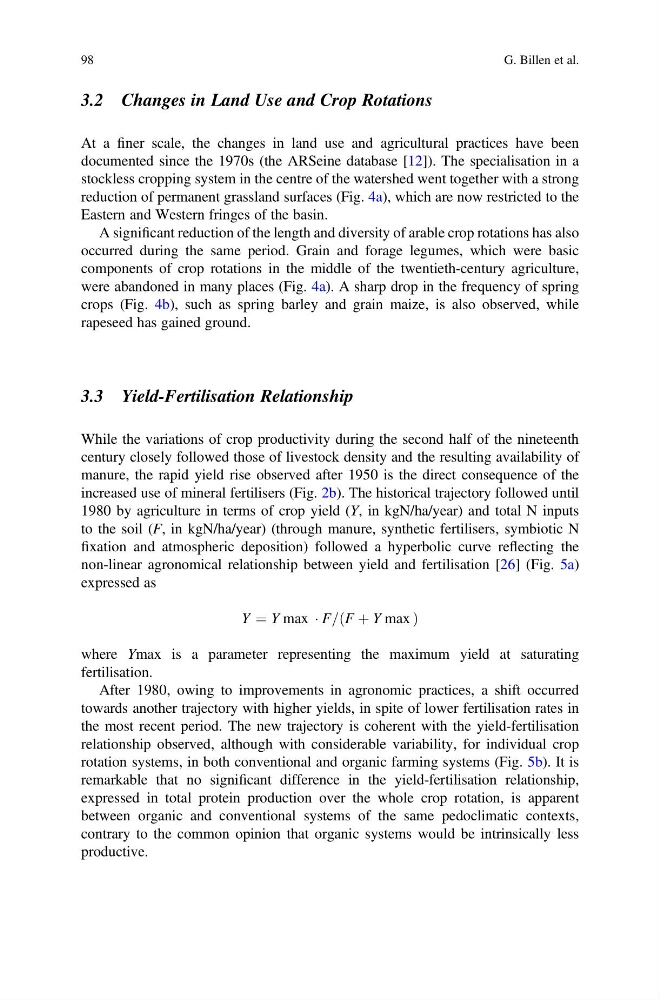
1980 by agriculture in terms of crop yield (Y, in kgN/ha/year) and total N inputs
to the soil (F, in kgN/ha/year) (through manure, synthetic fertilisers, symbiotic N
fixation and atmospheric deposition) followed a hyperbolic curve reflecting the
non-linear agronomical relationship between yield and fertilisation [26] (Fig. 5a)
expressed as
Y ¼ Y max Á F= F þ Y max
ð
Þ
where Ymax is a parameter representing the maximum yield at saturating
fertilisation.
After 1980, owing to improvements in agronomic practices, a shift occurred
towards another trajectory with higher yields, in spite of lower fertilisation rates in
the most recent period. The new trajectory is coherent with the yield-fertilisation
relationship observed, although with considerable variability, for individual crop
rotation systems, in both conventional and organic farming systems (Fig. 5b). It is
remarkable that no significant difference in the yield-fertilisation relationship,
expressed in total protein production over the whole crop rotation, is apparent
between organic and conventional systems of the same pedoclimatic contexts,
contrary to the common opinion that organic systems would be intrinsically less
productive.
98
G. Billen et al.
At a finer scale, the changes in land use and agricultural practices have been
documented since the 1970s (the ARSeine database [12]). The specialisation in a
stockless cropping system in the centre of the watershed went together with a strong
reduction of permanent grassland surfaces (Fig. 4a), which are now restricted to the
Eastern and Western fringes of the basin.
A significant reduction of the length and diversity of arable crop rotations has also
occurred during the same period. Grain and forage legumes, which were basic
components of crop rotations in the middle of the twentieth-century agriculture,
were abandoned in many places (Fig. 4a). A sharp drop in the frequency of spring
crops (Fig. 4b), such as spring barley and grain maize, is also observed, while
rapeseed has gained ground.
3.3 Yield-Fertilisation Relationship
While the variations of crop productivity during the second half of the nineteenth
century closely followed those of livestock density and the resulting availability of
manure, the rapid yield rise observed after 1950 is the direct consequence of the
increased use of mineral fertilisers (Fig. 2b). The historical trajectory followed until
1980 by agriculture in terms of crop yield (Y, in kgN/ha/year) and total N inputs
to the soil (F, in kgN/ha/year) (through manure, synthetic fertilisers, symbiotic N
fixation and atmospheric deposition) followed a hyperbolic curve reflecting the
non-linear agronomical relationship between yield and fertilisation [26] (Fig. 5a)
expressed as
Y ¼ Y max Á F= F þ Y max
ð
Þ
where Ymax is a parameter representing the maximum yield at saturating
fertilisation.
After 1980, owing to improvements in agronomic practices, a shift occurred
towards another trajectory with higher yields, in spite of lower fertilisation rates in
the most recent period. The new trajectory is coherent with the yield-fertilisation
relationship observed, although with considerable variability, for individual crop
rotation systems, in both conventional and organic farming systems (Fig. 5b). It is
remarkable that no significant difference in the yield-fertilisation relationship,
expressed in total protein production over the whole crop rotation, is apparent
between organic and conventional systems of the same pedoclimatic contexts,
contrary to the common opinion that organic systems would be intrinsically less
productive.
98
G. Billen et al.