

processes. For example, Uzu et al. (2011a) compared PM emission from three
different working places from a lead smelter: refining, furnace, and emission. They
reported that PM < 2.5 was mainly emitted from emission area, while PM 2.5–100 was
mainly emitted from both refining and furnace areas. Using X-ray diffraction (XRD),
they also reported that different types of minerals of metal are emitted from different
working place origins (refining, furnace, and emission).
Goix et al. (2014) carried out the environmental scanning electron microscopy
(ESEM-EDX) analysis of atmospheric fallouts of a Pb recycling factory to understand the variation in the attachment of heavy metal(loid)s with two size fractions of
PM (PM 2.5 and PM 10 ). They reported that numerous Pb-rich nanoballs were
observed in PM 2.5 compared to the PM 10 .
Vehicle emission is considered as the main source of heavy metal(loid) introduction into the atmosphere (Duong and Lee 2011; Zheng et al. 2010). A study
conducted by Park and Kim (2005) showed that major contributors of the ambient
atmospheric contamination of the urban atmosphere are soil dust (13%), vehicle
exhaust (26%), and field burning (4%). Automobile emissions release toxic metals
into the atmosphere like Pb, Zn, and Cd (Viard et al. 2004). Similarly, the highest
airborne heavy metal(loid)s concentration was found in streets with heavy traffic in
Germany. Road traffic emissions are usually classified as exhaust and non-exhaust
emissions. The brake and asphalt wears are considered among the most important
sources of some metal(loid)s. Significant amounts of heavy metal(loid) particles such
as Zn, Cd, Co, Cr, Cu, Hg, Mo, Ni, and Pb are also associated with dust from tire
wear (Adamiec et al. 2016). Lough et al. (2005) calculated fine (2.5 μm) and coarse
(10 μm) PM contributions from vehicle emissions at tunnel entrances and exits.
2.2 Concentration Range of PM-Bound Metal(loid)s
Atmospheric contamination by fine metal-PM is considered a serious health risk for
people living in industrial areas and megalopolises (Goix et al. 2014; Juda-Rezler
et al. 2011; Xiong et al. 2014a; Zhang et al. 2018b). Several national, regional, and
international environmental and health organizations have reported threshold levels
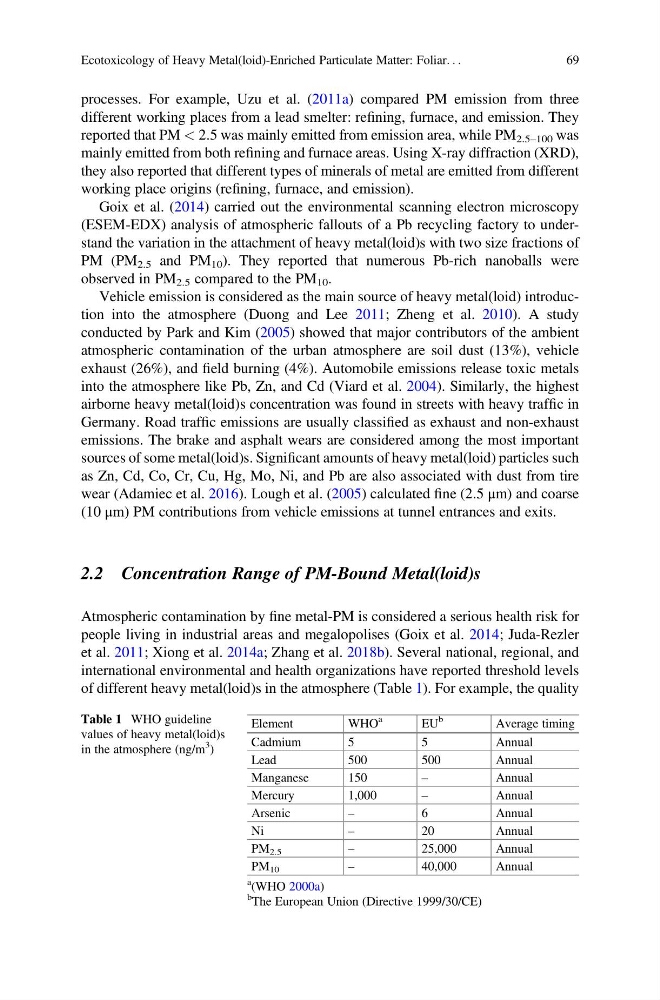
of different heavy metal(loid)s in the atmosphere (Table 1). For example, the quality
Table 1 WHO guideline
values of heavy metal(loid)s
in the atmosphere (ng/m
3
)
Element
WHO
a
EU
b
Average timing
Cadmium
5
5
Annual
Lead
500
500
Annual
Manganese
150
–
Annual
Mercury
1,000
–
Annual
Arsenic
–
6
Annual
Ni
–
20
Annual
PM 2.5
–
25,000
Annual
PM 10
–
40,000
Annual
a (WHO 2000a)
b
The European Union (Directive 1999/30/CE)
Ecotoxicology of Heavy Metal(loid)-Enriched Particulate Matter: Foliar. . .
69
different working places from a lead smelter: refining, furnace, and emission. They
reported that PM < 2.5 was mainly emitted from emission area, while PM 2.5–100 was
mainly emitted from both refining and furnace areas. Using X-ray diffraction (XRD),
they also reported that different types of minerals of metal are emitted from different
working place origins (refining, furnace, and emission).
Goix et al. (2014) carried out the environmental scanning electron microscopy
(ESEM-EDX) analysis of atmospheric fallouts of a Pb recycling factory to understand the variation in the attachment of heavy metal(loid)s with two size fractions of
PM (PM 2.5 and PM 10 ). They reported that numerous Pb-rich nanoballs were
observed in PM 2.5 compared to the PM 10 .
Vehicle emission is considered as the main source of heavy metal(loid) introduction into the atmosphere (Duong and Lee 2011; Zheng et al. 2010). A study
conducted by Park and Kim (2005) showed that major contributors of the ambient
atmospheric contamination of the urban atmosphere are soil dust (13%), vehicle
exhaust (26%), and field burning (4%). Automobile emissions release toxic metals
into the atmosphere like Pb, Zn, and Cd (Viard et al. 2004). Similarly, the highest
airborne heavy metal(loid)s concentration was found in streets with heavy traffic in
Germany. Road traffic emissions are usually classified as exhaust and non-exhaust
emissions. The brake and asphalt wears are considered among the most important
sources of some metal(loid)s. Significant amounts of heavy metal(loid) particles such
as Zn, Cd, Co, Cr, Cu, Hg, Mo, Ni, and Pb are also associated with dust from tire
wear (Adamiec et al. 2016). Lough et al. (2005) calculated fine (2.5 μm) and coarse
(10 μm) PM contributions from vehicle emissions at tunnel entrances and exits.
2.2 Concentration Range of PM-Bound Metal(loid)s
Atmospheric contamination by fine metal-PM is considered a serious health risk for
people living in industrial areas and megalopolises (Goix et al. 2014; Juda-Rezler
et al. 2011; Xiong et al. 2014a; Zhang et al. 2018b). Several national, regional, and
international environmental and health organizations have reported threshold levels
of different heavy metal(loid)s in the atmosphere (Table 1). For example, the quality
Table 1 WHO guideline
values of heavy metal(loid)s
in the atmosphere (ng/m
3
)
Element
WHO
a
EU
b
Average timing
Cadmium
5
5
Annual
Lead
500
500
Annual
Manganese
150
–
Annual
Mercury
1,000
–
Annual
Arsenic
–
6
Annual
Ni
–
20
Annual
PM 2.5
–
25,000
Annual
PM 10
–
40,000
Annual
a (WHO 2000a)
b
The European Union (Directive 1999/30/CE)
Ecotoxicology of Heavy Metal(loid)-Enriched Particulate Matter: Foliar. . .
69