

Ce IV
ð Þ þ X red
2
! Ce III
ð Þ þ X ox
ð9Þ
Ce III
ð Þ þ O 2 ! Ce IV
ð Þ þ O 2
ÁÀ
ð10Þ
2H
þ
þ 2O 2
ÁÀ
!
1 O 2 þ H 2 O 2
ð11Þ
H 2 O 2 þ Ce III
ð Þ ! Ce IV
ð Þ þ OH
À
þ
Á OH
ð12Þ
LOOH þ Ce III
ð Þ ! Ce IV
ð Þ þ LO
Á
þ
Á OH
ð13Þ
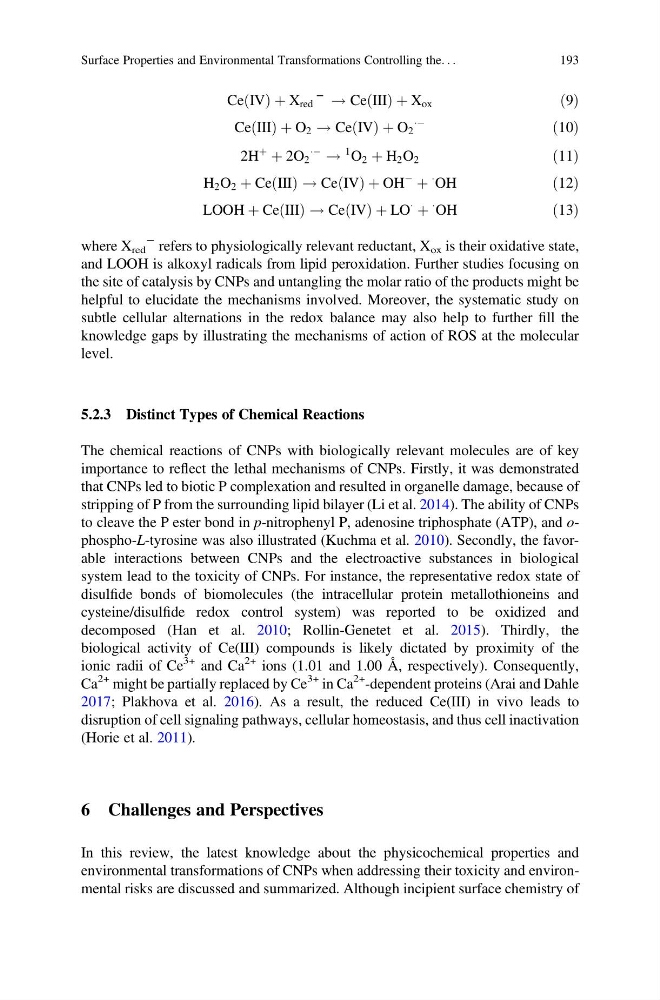
where X red
2 refers to physiologically relevant reductant, X ox is their oxidative state,
and LOOH is alkoxyl radicals from lipid peroxidation. Further studies focusing on
the site of catalysis by CNPs and untangling the molar ratio of the products might be
helpful to elucidate the mechanisms involved. Moreover, the systematic study on
subtle cellular alternations in the redox balance may also help to further fill the
knowledge gaps by illustrating the mechanisms of action of ROS at the molecular
level.
5.2.3 Distinct Types of Chemical Reactions
The chemical reactions of CNPs with biologically relevant molecules are of key
importance to reflect the lethal mechanisms of CNPs. Firstly, it was demonstrated
that CNPs led to biotic P complexation and resulted in organelle damage, because of
stripping of P from the surrounding lipid bilayer (Li et al. 2014). The ability of CNPs
to cleave the P ester bond in p-nitrophenyl P, adenosine triphosphate (ATP), and ophospho-L-tyrosine was also illustrated (Kuchma et al. 2010). Secondly, the favorable interactions between CNPs and the electroactive substances in biological
system lead to the toxicity of CNPs. For instance, the representative redox state of
disulfide bonds of biomolecules (the intracellular protein metallothioneins and
cysteine/disulfide redox control system) was reported to be oxidized and
decomposed (Han et al. 2010; Rollin-Genetet et al. 2015). Thirdly, the
biological activity of Ce(III) compounds is likely dictated by proximity of the
ionic radii of Ce
3+ and Ca
2+ ions (1.01 and 1.00 Å, respectively). Consequently,
Ca
2+ might be partially replaced by Ce
3+ in Ca
2+ -dependent proteins (Arai and Dahle
2017; Plakhova et al. 2016). As a result, the reduced Ce(III) in vivo leads to
disruption of cell signaling pathways, cellular homeostasis, and thus cell inactivation
(Horie et al. 2011).
6 Challenges and Perspectives
In this review, the latest knowledge about the physicochemical properties and
environmental transformations of CNPs when addressing their toxicity and environmental risks are discussed and summarized. Although incipient surface chemistry of
Surface Properties and Environmental Transformations Controlling the. . .
193
ð Þ þ X red
2
! Ce III
ð Þ þ X ox
ð9Þ
Ce III
ð Þ þ O 2 ! Ce IV
ð Þ þ O 2
ÁÀ
ð10Þ
2H
þ
þ 2O 2
ÁÀ
!
1 O 2 þ H 2 O 2
ð11Þ
H 2 O 2 þ Ce III
ð Þ ! Ce IV
ð Þ þ OH
À
þ
Á OH
ð12Þ
LOOH þ Ce III
ð Þ ! Ce IV
ð Þ þ LO
Á
þ
Á OH
ð13Þ
where X red
2 refers to physiologically relevant reductant, X ox is their oxidative state,
and LOOH is alkoxyl radicals from lipid peroxidation. Further studies focusing on
the site of catalysis by CNPs and untangling the molar ratio of the products might be
helpful to elucidate the mechanisms involved. Moreover, the systematic study on
subtle cellular alternations in the redox balance may also help to further fill the
knowledge gaps by illustrating the mechanisms of action of ROS at the molecular
level.
5.2.3 Distinct Types of Chemical Reactions
The chemical reactions of CNPs with biologically relevant molecules are of key
importance to reflect the lethal mechanisms of CNPs. Firstly, it was demonstrated
that CNPs led to biotic P complexation and resulted in organelle damage, because of
stripping of P from the surrounding lipid bilayer (Li et al. 2014). The ability of CNPs
to cleave the P ester bond in p-nitrophenyl P, adenosine triphosphate (ATP), and ophospho-L-tyrosine was also illustrated (Kuchma et al. 2010). Secondly, the favorable interactions between CNPs and the electroactive substances in biological
system lead to the toxicity of CNPs. For instance, the representative redox state of
disulfide bonds of biomolecules (the intracellular protein metallothioneins and
cysteine/disulfide redox control system) was reported to be oxidized and
decomposed (Han et al. 2010; Rollin-Genetet et al. 2015). Thirdly, the
biological activity of Ce(III) compounds is likely dictated by proximity of the
ionic radii of Ce
3+ and Ca
2+ ions (1.01 and 1.00 Å, respectively). Consequently,
Ca
2+ might be partially replaced by Ce
3+ in Ca
2+ -dependent proteins (Arai and Dahle
2017; Plakhova et al. 2016). As a result, the reduced Ce(III) in vivo leads to
disruption of cell signaling pathways, cellular homeostasis, and thus cell inactivation
(Horie et al. 2011).
6 Challenges and Perspectives
In this review, the latest knowledge about the physicochemical properties and
environmental transformations of CNPs when addressing their toxicity and environmental risks are discussed and summarized. Although incipient surface chemistry of
Surface Properties and Environmental Transformations Controlling the. . .
193