

CNPs has a profound influence on their toxicity, environmental transformations
might decrease the effects of initial chemical conditions and render lower or higher
toxic. Though knowledge about how CNPs transformations influence their toxicity
are expanding, several research gaps and challenges important for better predicting
the environmental fate and effects of CNPs need to be addressed. Specially, several
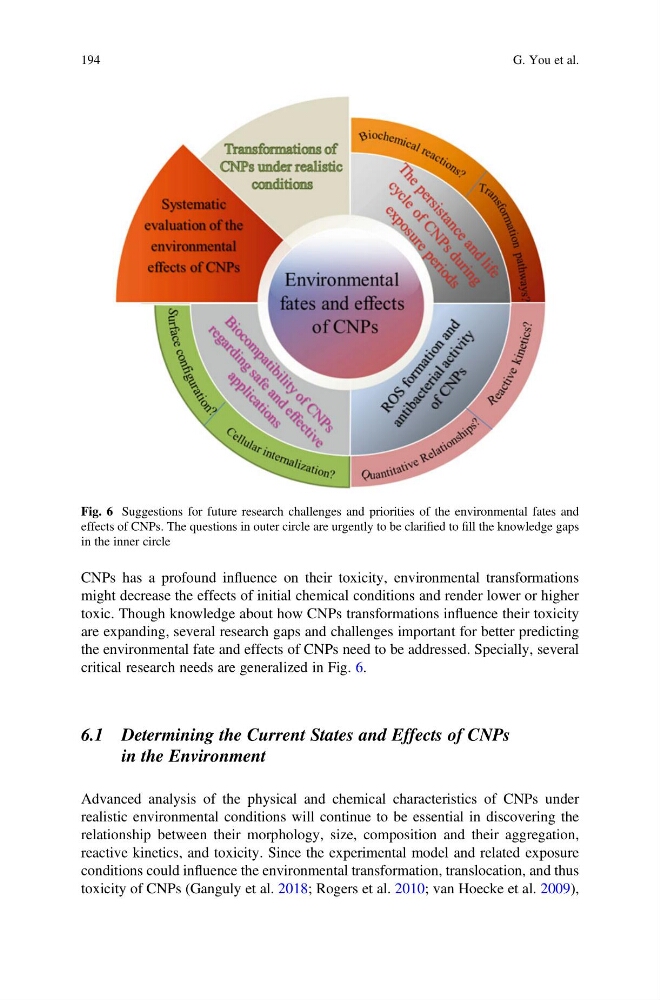
critical research needs are generalized in Fig. 6.
6.1 Determining the Current States and Effects of CNPs
in the Environment
Advanced analysis of the physical and chemical characteristics of CNPs under
realistic environmental conditions will continue to be essential in discovering the
relationship between their morphology, size, composition and their aggregation,
reactive kinetics, and toxicity. Since the experimental model and related exposure
conditions could influence the environmental transformation, translocation, and thus
toxicity of CNPs (Ganguly et al. 2018; Rogers et al. 2010; van Hoecke et al. 2009),
Fig. 6 Suggestions for future research challenges and priorities of the environmental fates and
effects of CNPs. The questions in outer circle are urgently to be clarified to fill the knowledge gaps
in the inner circle
194
G. You et al.
might decrease the effects of initial chemical conditions and render lower or higher
toxic. Though knowledge about how CNPs transformations influence their toxicity
are expanding, several research gaps and challenges important for better predicting
the environmental fate and effects of CNPs need to be addressed. Specially, several
critical research needs are generalized in Fig. 6.
6.1 Determining the Current States and Effects of CNPs
in the Environment
Advanced analysis of the physical and chemical characteristics of CNPs under
realistic environmental conditions will continue to be essential in discovering the
relationship between their morphology, size, composition and their aggregation,
reactive kinetics, and toxicity. Since the experimental model and related exposure
conditions could influence the environmental transformation, translocation, and thus
toxicity of CNPs (Ganguly et al. 2018; Rogers et al. 2010; van Hoecke et al. 2009),
Fig. 6 Suggestions for future research challenges and priorities of the environmental fates and
effects of CNPs. The questions in outer circle are urgently to be clarified to fill the knowledge gaps
in the inner circle
194
G. You et al.