

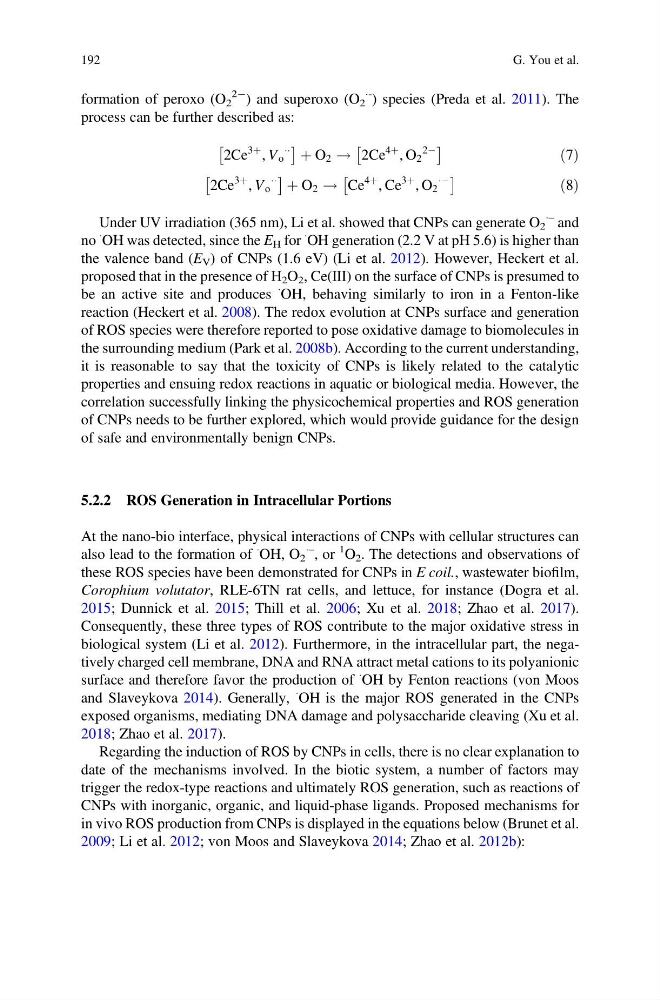
formation of peroxo (O 2
2À
) and superoxo (O 2
Á- ) species (Preda et al. 2011). The
process can be further described as:
2Ce
3þ , V o
ÁÁ
Â
à þ O 2 ! 2Ce
4þ , O 2
2À
Â
Ã
ð7Þ
2Ce
3þ , V o
ÁÁ
Â
à þ O 2 ! Ce
4þ , Ce
3þ , O 2
ÁÀ
Â
Ã
ð8Þ
Under UV irradiation (365 nm), Li et al. showed that CNPs can generate O 2
Á– and
no
Á OH was detected, since the E H for
Á
OH generation (2.2 V at pH 5.6) is higher than
the valence band (E V ) of CNPs (1.6 eV) (Li et al. 2012). However, Heckert et al.
proposed that in the presence of H 2 O 2 , Ce(III) on the surface of CNPs is presumed to
be an active site and produces
Á OH, behaving similarly to iron in a Fenton-like
reaction (Heckert et al. 2008). The redox evolution at CNPs surface and generation
of ROS species were therefore reported to pose oxidative damage to biomolecules in
the surrounding medium (Park et al. 2008b). According to the current understanding,
it is reasonable to say that the toxicity of CNPs is likely related to the catalytic
properties and ensuing redox reactions in aquatic or biological media. However, the
correlation successfully linking the physicochemical properties and ROS generation
of CNPs needs to be further explored, which would provide guidance for the design
of safe and environmentally benign CNPs.
5.2.2 ROS Generation in Intracellular Portions
At the nano-bio interface, physical interactions of CNPs with cellular structures can
also lead to the formation of
Á OH, O 2
Á– , or
1 O 2 . The detections and observations of
these ROS species have been demonstrated for CNPs in E coil., wastewater biofilm,
Corophium volutator, RLE-6TN rat cells, and lettuce, for instance (Dogra et al.
2015; Dunnick et al. 2015; Thill et al. 2006; Xu et al. 2018; Zhao et al. 2017).
Consequently, these three types of ROS contribute to the major oxidative stress in
biological system (Li et al. 2012). Furthermore, in the intracellular part, the negatively charged cell membrane, DNA and RNA attract metal cations to its polyanionic
surface and therefore favor the production of
Á
OH by Fenton reactions (von Moos
and Slaveykova 2014). Generally,
Á OH is the major ROS generated in the CNPs
exposed organisms, mediating DNA damage and polysaccharide cleaving (Xu et al.
2018; Zhao et al. 2017).
Regarding the induction of ROS by CNPs in cells, there is no clear explanation to
date of the mechanisms involved. In the biotic system, a number of factors may
trigger the redox-type reactions and ultimately ROS generation, such as reactions of
CNPs with inorganic, organic, and liquid-phase ligands. Proposed mechanisms for
in vivo ROS production from CNPs is displayed in the equations below (Brunet et al.
2009; Li et al. 2012; von Moos and Slaveykova 2014; Zhao et al. 2012b):
192
G. You et al.
2À
) and superoxo (O 2
Á- ) species (Preda et al. 2011). The
process can be further described as:
2Ce
3þ , V o
ÁÁ
Â
à þ O 2 ! 2Ce
4þ , O 2
2À
Â
Ã
ð7Þ
2Ce
3þ , V o
ÁÁ
Â
à þ O 2 ! Ce
4þ , Ce
3þ , O 2
ÁÀ
Â
Ã
ð8Þ
Under UV irradiation (365 nm), Li et al. showed that CNPs can generate O 2
Á– and
no
Á OH was detected, since the E H for
Á
OH generation (2.2 V at pH 5.6) is higher than
the valence band (E V ) of CNPs (1.6 eV) (Li et al. 2012). However, Heckert et al.
proposed that in the presence of H 2 O 2 , Ce(III) on the surface of CNPs is presumed to
be an active site and produces
Á OH, behaving similarly to iron in a Fenton-like
reaction (Heckert et al. 2008). The redox evolution at CNPs surface and generation
of ROS species were therefore reported to pose oxidative damage to biomolecules in
the surrounding medium (Park et al. 2008b). According to the current understanding,
it is reasonable to say that the toxicity of CNPs is likely related to the catalytic
properties and ensuing redox reactions in aquatic or biological media. However, the
correlation successfully linking the physicochemical properties and ROS generation
of CNPs needs to be further explored, which would provide guidance for the design
of safe and environmentally benign CNPs.
5.2.2 ROS Generation in Intracellular Portions
At the nano-bio interface, physical interactions of CNPs with cellular structures can
also lead to the formation of
Á OH, O 2
Á– , or
1 O 2 . The detections and observations of
these ROS species have been demonstrated for CNPs in E coil., wastewater biofilm,
Corophium volutator, RLE-6TN rat cells, and lettuce, for instance (Dogra et al.
2015; Dunnick et al. 2015; Thill et al. 2006; Xu et al. 2018; Zhao et al. 2017).
Consequently, these three types of ROS contribute to the major oxidative stress in
biological system (Li et al. 2012). Furthermore, in the intracellular part, the negatively charged cell membrane, DNA and RNA attract metal cations to its polyanionic
surface and therefore favor the production of
Á
OH by Fenton reactions (von Moos
and Slaveykova 2014). Generally,
Á OH is the major ROS generated in the CNPs
exposed organisms, mediating DNA damage and polysaccharide cleaving (Xu et al.
2018; Zhao et al. 2017).
Regarding the induction of ROS by CNPs in cells, there is no clear explanation to
date of the mechanisms involved. In the biotic system, a number of factors may
trigger the redox-type reactions and ultimately ROS generation, such as reactions of
CNPs with inorganic, organic, and liquid-phase ligands. Proposed mechanisms for
in vivo ROS production from CNPs is displayed in the equations below (Brunet et al.
2009; Li et al. 2012; von Moos and Slaveykova 2014; Zhao et al. 2012b):
192
G. You et al.