

Also, the presence of P notably lowered the retention (K r ) values of CNPs, since P
significantly decreased the charge of natural colloids. The multiple linear regression
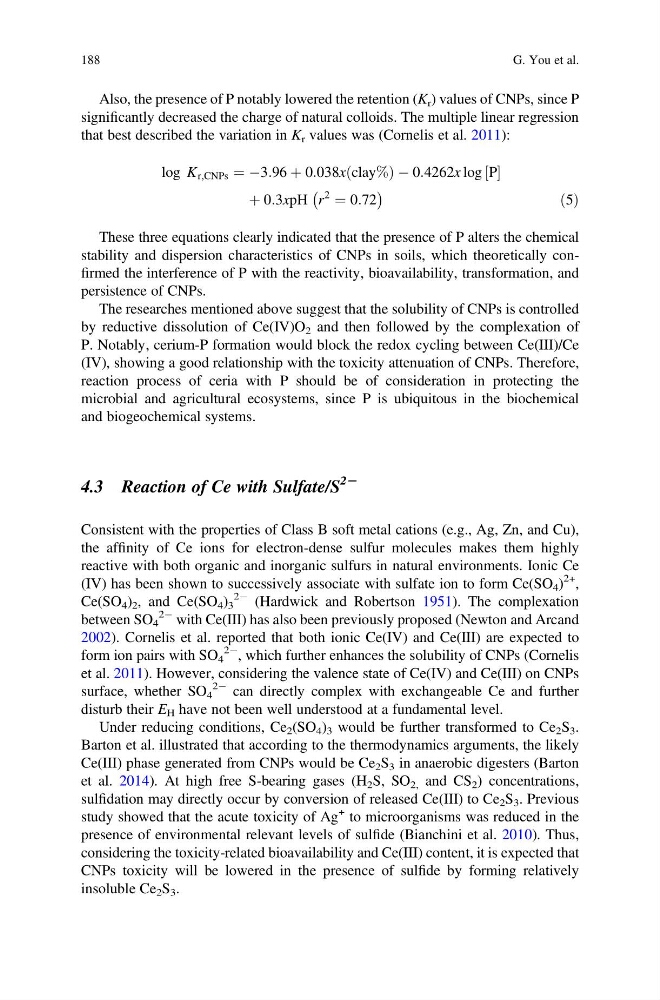
that best described the variation in K r values was (Cornelis et al. 2011):
log K r,CNPs ¼ À3:96 þ 0:038x clay%
ð
ÞÀ0:4262x log P
½
þ 0:3xpH r
2
¼ 0:72
À
Á
ð5Þ
These three equations clearly indicated that the presence of P alters the chemical
stability and dispersion characteristics of CNPs in soils, which theoretically confirmed the interference of P with the reactivity, bioavailability, transformation, and
persistence of CNPs.
The researches mentioned above suggest that the solubility of CNPs is controlled
by reductive dissolution of Ce(IV)O 2 and then followed by the complexation of
P. Notably, cerium-P formation would block the redox cycling between Ce(III)/Ce
(IV), showing a good relationship with the toxicity attenuation of CNPs. Therefore,
reaction process of ceria with P should be of consideration in protecting the
microbial and agricultural ecosystems, since P is ubiquitous in the biochemical
and biogeochemical systems.
4.3 Reaction of Ce with Sulfate/S
22
Consistent with the properties of Class B soft metal cations (e.g., Ag, Zn, and Cu),
the affinity of Ce ions for electron-dense sulfur molecules makes them highly
reactive with both organic and inorganic sulfurs in natural environments. Ionic Ce
(IV) has been shown to successively associate with sulfate ion to form Ce(SO 4 )
2+ ,
Ce(SO 4 ) 2 , and Ce(SO 4 ) 3
2À (Hardwick and Robertson 1951). The complexation
between SO 4
2À with Ce(III) has also been previously proposed (Newton and Arcand
2002). Cornelis et al. reported that both ionic Ce(IV) and Ce(III) are expected to
form ion pairs with SO 4
2À
, which further enhances the solubility of CNPs (Cornelis
et al. 2011). However, considering the valence state of Ce(IV) and Ce(III) on CNPs
surface, whether SO 4
2À can directly complex with exchangeable Ce and further
disturb their E H have not been well understood at a fundamental level.
Under reducing conditions, Ce 2 (SO 4 ) 3 would be further transformed to Ce 2 S 3 .
Barton et al. illustrated that according to the thermodynamics arguments, the likely
Ce(III) phase generated from CNPs would be Ce 2 S 3 in anaerobic digesters (Barton
et al. 2014). At high free S-bearing gases (H 2 S, SO 2, and CS 2 ) concentrations,
sulfidation may directly occur by conversion of released Ce(III) to Ce 2 S 3 . Previous
study showed that the acute toxicity of Ag
+ to microorganisms was reduced in the
presence of environmental relevant levels of sulfide (Bianchini et al. 2010). Thus,
considering the toxicity-related bioavailability and Ce(III) content, it is expected that
CNPs toxicity will be lowered in the presence of sulfide by forming relatively
insoluble Ce 2 S 3 .
188
G. You et al.
significantly decreased the charge of natural colloids. The multiple linear regression
that best described the variation in K r values was (Cornelis et al. 2011):
log K r,CNPs ¼ À3:96 þ 0:038x clay%
ð
ÞÀ0:4262x log P
½
þ 0:3xpH r
2
¼ 0:72
À
Á
ð5Þ
These three equations clearly indicated that the presence of P alters the chemical
stability and dispersion characteristics of CNPs in soils, which theoretically confirmed the interference of P with the reactivity, bioavailability, transformation, and
persistence of CNPs.
The researches mentioned above suggest that the solubility of CNPs is controlled
by reductive dissolution of Ce(IV)O 2 and then followed by the complexation of
P. Notably, cerium-P formation would block the redox cycling between Ce(III)/Ce
(IV), showing a good relationship with the toxicity attenuation of CNPs. Therefore,
reaction process of ceria with P should be of consideration in protecting the
microbial and agricultural ecosystems, since P is ubiquitous in the biochemical
and biogeochemical systems.
4.3 Reaction of Ce with Sulfate/S
22
Consistent with the properties of Class B soft metal cations (e.g., Ag, Zn, and Cu),
the affinity of Ce ions for electron-dense sulfur molecules makes them highly
reactive with both organic and inorganic sulfurs in natural environments. Ionic Ce
(IV) has been shown to successively associate with sulfate ion to form Ce(SO 4 )
2+ ,
Ce(SO 4 ) 2 , and Ce(SO 4 ) 3
2À (Hardwick and Robertson 1951). The complexation
between SO 4
2À with Ce(III) has also been previously proposed (Newton and Arcand
2002). Cornelis et al. reported that both ionic Ce(IV) and Ce(III) are expected to
form ion pairs with SO 4
2À
, which further enhances the solubility of CNPs (Cornelis
et al. 2011). However, considering the valence state of Ce(IV) and Ce(III) on CNPs
surface, whether SO 4
2À can directly complex with exchangeable Ce and further
disturb their E H have not been well understood at a fundamental level.
Under reducing conditions, Ce 2 (SO 4 ) 3 would be further transformed to Ce 2 S 3 .
Barton et al. illustrated that according to the thermodynamics arguments, the likely
Ce(III) phase generated from CNPs would be Ce 2 S 3 in anaerobic digesters (Barton
et al. 2014). At high free S-bearing gases (H 2 S, SO 2, and CS 2 ) concentrations,
sulfidation may directly occur by conversion of released Ce(III) to Ce 2 S 3 . Previous
study showed that the acute toxicity of Ag
+ to microorganisms was reduced in the
presence of environmental relevant levels of sulfide (Bianchini et al. 2010). Thus,
considering the toxicity-related bioavailability and Ce(III) content, it is expected that
CNPs toxicity will be lowered in the presence of sulfide by forming relatively
insoluble Ce 2 S 3 .
188
G. You et al.