

4.2 Reaction of Ce with Phosphate
Several researchers have also put forward that the thermodynamically favorable
reactions of Ce(IV) and Ce(III) with various (in)organic ligands should be considered, which might interfere with their intrinsic and toxic properties. The high binding
affinity of released or exchangeable Ce(III) to P groups has been observed in
different contexts, such as formation of cerium phosphate at CNPs surface (Singh
et al. 2011), in plants roots (Rui et al. 2015; Zhang et al. 2012), algal cells (van
Hoecke et al. 2009), and activated sludge (Barton et al. 2014). Cerium phosphate
nucleation on CNPs {111} surface was shown to preferentially affect their surface
properties (van Hoecke et al. 2009), redox reactivity (Singh et al. 2011), dissolution
rate (Dahle et al. 2015), and further partitioning and retention in soil (Cornelis et al.
2011).
Wang et al. exhibited that DNA, lipids, and various P species (including orthoP,
pyroP, sodium trip/trimetaP, and polyP) could tightly adsorb on CNPs surface
(Wang et al. 2018a). Li et al. and Jiang et al. also stated that Ce(III) could strip P
from lipid bilayer (Li et al. 2014) or react with P released from inside the yeast cells
(Jiang et al. 2010), while pretreatment of CNPs with P prevented their biotransformation and thus toxicity (Li et al. 2014). In plants, Ce(III) speciation mostly
exhibited as CePO 4 in roots, since roots were completely immersed in the nutrient
solution and abundant in P (Rui et al. 2015; Zhang et al. 2012, 2017). As most of the
released Ce(III) was precipitated as insoluble CePO 4 and immobilized in roots, only
a small part of Ce(III) may be transported to the other tissues, which directly reduced
the bioavailability of CNPs.
Following incubation with phosphate buffer (50 mM), the strong association of
Ce(III) with P at the surface of CNPs led to the changes of surface chemistry and thus
the redox behavior of CNPs (Singh et al. 2011). Moreover, the readily occurred
complexation of P with Ce(III) at the ceria-water interface induced the formation of
insoluble surface precipitates, which would effectively suppress the electron transfer
reaction and/or further ligand-promoted dissolution (Arai and Dahle 2017; Cornelis
et al. 2011). Dahle et al. also illustrated that the chelation of P with exchangeable Ce
(III) on CNPs surface in a binary model system could inhibit the dissolution of CNPs
(Dahle et al. 2015).
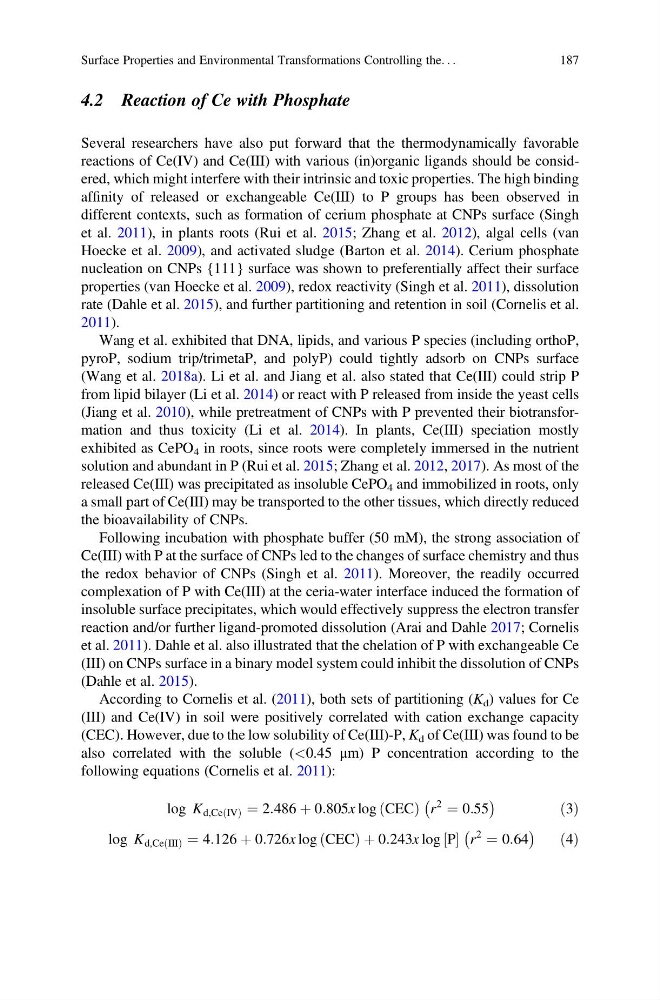
According to Cornelis et al. (2011), both sets of partitioning (K d ) values for Ce
(III) and Ce(IV) in soil were positively correlated with cation exchange capacity
(CEC). However, due to the low solubility of Ce(III)-P, K d of Ce(III) was found to be
also correlated with the soluble (<0.45 μm) P concentration according to the
following equations (Cornelis et al. 2011):
log K d,Ce IV
ð Þ ¼ 2:486 þ 0:805x log CEC
ð
Þ r
2
¼ 0:55
À
Á
ð3Þ
log K d,Ce III
ð Þ ¼ 4:126 þ 0:726x log CEC
ð
Þþ0:243x log P
½ r
2
¼ 0:64
À
Á
ð4Þ
Surface Properties and Environmental Transformations Controlling the. . .
187
Several researchers have also put forward that the thermodynamically favorable
reactions of Ce(IV) and Ce(III) with various (in)organic ligands should be considered, which might interfere with their intrinsic and toxic properties. The high binding
affinity of released or exchangeable Ce(III) to P groups has been observed in
different contexts, such as formation of cerium phosphate at CNPs surface (Singh
et al. 2011), in plants roots (Rui et al. 2015; Zhang et al. 2012), algal cells (van
Hoecke et al. 2009), and activated sludge (Barton et al. 2014). Cerium phosphate
nucleation on CNPs {111} surface was shown to preferentially affect their surface
properties (van Hoecke et al. 2009), redox reactivity (Singh et al. 2011), dissolution
rate (Dahle et al. 2015), and further partitioning and retention in soil (Cornelis et al.
2011).
Wang et al. exhibited that DNA, lipids, and various P species (including orthoP,
pyroP, sodium trip/trimetaP, and polyP) could tightly adsorb on CNPs surface
(Wang et al. 2018a). Li et al. and Jiang et al. also stated that Ce(III) could strip P
from lipid bilayer (Li et al. 2014) or react with P released from inside the yeast cells
(Jiang et al. 2010), while pretreatment of CNPs with P prevented their biotransformation and thus toxicity (Li et al. 2014). In plants, Ce(III) speciation mostly
exhibited as CePO 4 in roots, since roots were completely immersed in the nutrient
solution and abundant in P (Rui et al. 2015; Zhang et al. 2012, 2017). As most of the
released Ce(III) was precipitated as insoluble CePO 4 and immobilized in roots, only
a small part of Ce(III) may be transported to the other tissues, which directly reduced
the bioavailability of CNPs.
Following incubation with phosphate buffer (50 mM), the strong association of
Ce(III) with P at the surface of CNPs led to the changes of surface chemistry and thus
the redox behavior of CNPs (Singh et al. 2011). Moreover, the readily occurred
complexation of P with Ce(III) at the ceria-water interface induced the formation of
insoluble surface precipitates, which would effectively suppress the electron transfer
reaction and/or further ligand-promoted dissolution (Arai and Dahle 2017; Cornelis
et al. 2011). Dahle et al. also illustrated that the chelation of P with exchangeable Ce
(III) on CNPs surface in a binary model system could inhibit the dissolution of CNPs
(Dahle et al. 2015).
According to Cornelis et al. (2011), both sets of partitioning (K d ) values for Ce
(III) and Ce(IV) in soil were positively correlated with cation exchange capacity
(CEC). However, due to the low solubility of Ce(III)-P, K d of Ce(III) was found to be
also correlated with the soluble (<0.45 μm) P concentration according to the
following equations (Cornelis et al. 2011):
log K d,Ce IV
ð Þ ¼ 2:486 þ 0:805x log CEC
ð
Þ r
2
¼ 0:55
À
Á
ð3Þ
log K d,Ce III
ð Þ ¼ 4:126 þ 0:726x log CEC
ð
Þþ0:243x log P
½ r
2
¼ 0:64
À
Á
ð4Þ
Surface Properties and Environmental Transformations Controlling the. . .
187