

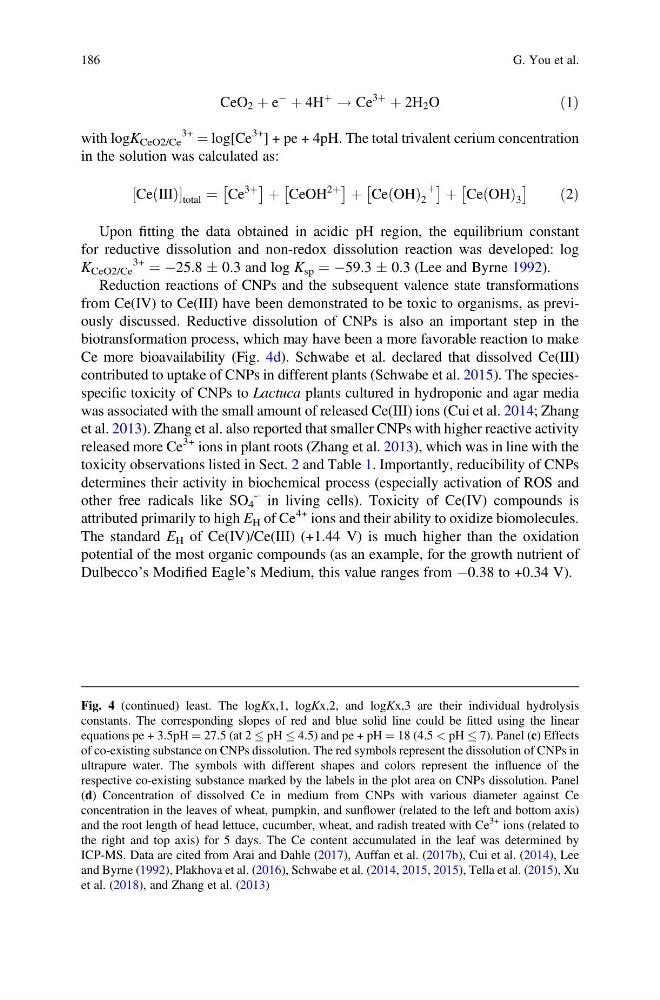
CeO 2 þ e
À
þ 4H
þ
! Ce
3þ
þ 2H 2 O
ð1Þ
with logK CeO2/Ce
3+
¼ log[Ce
3+ ] + pe + 4pH. The total trivalent cerium concentration
in the solution was calculated as:
Ce III
ð Þ
½
total ¼ Ce
3þ
Â
à þ CeOH
2þ
Â
à þ Ce OH
ð Þ 2
þ
Â
à þ Ce OH
ð Þ 3
Â
Ã
ð2Þ
Upon fitting the data obtained in acidic pH region, the equilibrium constant
for reductive dissolution and non-redox dissolution reaction was developed: log
K CeO2/Ce
3+
¼ À25.8 Æ 0.3 and log K sp ¼ À59.3 Æ 0.3 (Lee and Byrne 1992).
Reduction reactions of CNPs and the subsequent valence state transformations
from Ce(IV) to Ce(III) have been demonstrated to be toxic to organisms, as previously discussed. Reductive dissolution of CNPs is also an important step in the
biotransformation process, which may have been a more favorable reaction to make
Ce more bioavailability (Fig. 4d). Schwabe et al. declared that dissolved Ce(III)
contributed to uptake of CNPs in different plants (Schwabe et al. 2015). The speciesspecific toxicity of CNPs to Lactuca plants cultured in hydroponic and agar media
was associated with the small amount of released Ce(III) ions (Cui et al. 2014; Zhang
et al. 2013). Zhang et al. also reported that smaller CNPs with higher reactive activity
released more Ce
3+ ions in plant roots (Zhang et al. 2013), which was in line with the
toxicity observations listed in Sect. 2 and Table 1. Importantly, reducibility of CNPs
determines their activity in biochemical process (especially activation of ROS and
other free radicals like SO 4
-Á in living cells). Toxicity of Ce(IV) compounds is
attributed primarily to high E H of Ce
4+ ions and their ability to oxidize biomolecules.
The standard E H of Ce(IV)/Ce(III) (+1.44 V) is much higher than the oxidation
potential of the most organic compounds (as an example, for the growth nutrient of
Dulbecco’s Modified Eagle’s Medium, this value ranges from À0.38 to +0.34 V).
Fig. 4 (continued) least. The logKx,1, logKx,2, and logKx,3 are their individual hydrolysis
constants. The corresponding slopes of red and blue solid line could be fitted using the linear
equations pe + 3.5pH ¼ 27.5 (at 2 pH 4.5) and pe + pH ¼ 18 (4.5 < pH 7). Panel (c) Effects
of co-existing substance on CNPs dissolution. The red symbols represent the dissolution of CNPs in
ultrapure water. The symbols with different shapes and colors represent the influence of the
respective co-existing substance marked by the labels in the plot area on CNPs dissolution. Panel
(d) Concentration of dissolved Ce in medium from CNPs with various diameter against Ce
concentration in the leaves of wheat, pumpkin, and sunflower (related to the left and bottom axis)
and the root length of head lettuce, cucumber, wheat, and radish treated with Ce
3+ ions (related to
the right and top axis) for 5 days. The Ce content accumulated in the leaf was determined by
ICP-MS. Data are cited from Arai and Dahle (2017), Auffan et al. (2017b), Cui et al. (2014), Lee
and Byrne (1992), Plakhova et al. (2016), Schwabe et al. (2014, 2015, 2015), Tella et al. (2015), Xu
et al. (2018), and Zhang et al. (2013)
186
G. You et al.
À
þ 4H
þ
! Ce
3þ
þ 2H 2 O
ð1Þ
with logK CeO2/Ce
3+
¼ log[Ce
3+ ] + pe + 4pH. The total trivalent cerium concentration
in the solution was calculated as:
Ce III
ð Þ
½
total ¼ Ce
3þ
Â
à þ CeOH
2þ
Â
à þ Ce OH
ð Þ 2
þ
Â
à þ Ce OH
ð Þ 3
Â
Ã
ð2Þ
Upon fitting the data obtained in acidic pH region, the equilibrium constant
for reductive dissolution and non-redox dissolution reaction was developed: log
K CeO2/Ce
3+
¼ À25.8 Æ 0.3 and log K sp ¼ À59.3 Æ 0.3 (Lee and Byrne 1992).
Reduction reactions of CNPs and the subsequent valence state transformations
from Ce(IV) to Ce(III) have been demonstrated to be toxic to organisms, as previously discussed. Reductive dissolution of CNPs is also an important step in the
biotransformation process, which may have been a more favorable reaction to make
Ce more bioavailability (Fig. 4d). Schwabe et al. declared that dissolved Ce(III)
contributed to uptake of CNPs in different plants (Schwabe et al. 2015). The speciesspecific toxicity of CNPs to Lactuca plants cultured in hydroponic and agar media
was associated with the small amount of released Ce(III) ions (Cui et al. 2014; Zhang
et al. 2013). Zhang et al. also reported that smaller CNPs with higher reactive activity
released more Ce
3+ ions in plant roots (Zhang et al. 2013), which was in line with the
toxicity observations listed in Sect. 2 and Table 1. Importantly, reducibility of CNPs
determines their activity in biochemical process (especially activation of ROS and
other free radicals like SO 4
-Á in living cells). Toxicity of Ce(IV) compounds is
attributed primarily to high E H of Ce
4+ ions and their ability to oxidize biomolecules.
The standard E H of Ce(IV)/Ce(III) (+1.44 V) is much higher than the oxidation
potential of the most organic compounds (as an example, for the growth nutrient of
Dulbecco’s Modified Eagle’s Medium, this value ranges from À0.38 to +0.34 V).
Fig. 4 (continued) least. The logKx,1, logKx,2, and logKx,3 are their individual hydrolysis
constants. The corresponding slopes of red and blue solid line could be fitted using the linear
equations pe + 3.5pH ¼ 27.5 (at 2 pH 4.5) and pe + pH ¼ 18 (4.5 < pH 7). Panel (c) Effects
of co-existing substance on CNPs dissolution. The red symbols represent the dissolution of CNPs in
ultrapure water. The symbols with different shapes and colors represent the influence of the
respective co-existing substance marked by the labels in the plot area on CNPs dissolution. Panel
(d) Concentration of dissolved Ce in medium from CNPs with various diameter against Ce
concentration in the leaves of wheat, pumpkin, and sunflower (related to the left and bottom axis)
and the root length of head lettuce, cucumber, wheat, and radish treated with Ce
3+ ions (related to
the right and top axis) for 5 days. The Ce content accumulated in the leaf was determined by
ICP-MS. Data are cited from Arai and Dahle (2017), Auffan et al. (2017b), Cui et al. (2014), Lee
and Byrne (1992), Plakhova et al. (2016), Schwabe et al. (2014, 2015, 2015), Tella et al. (2015), Xu
et al. (2018), and Zhang et al. (2013)
186
G. You et al.