

Importantly, Ce ions can also bind strongly with organosulfur compounds, with
the greatest affinity for thiol-containing ligands. For example, Rollin-Genetet et al.
and Han et al. concluded that Ce(IV) atoms present at the surface of CNPs could be
reduced to Ce(III) to form stable Ce(III)-disulfide complex following interactions
with thiol groups of cysteine (Han et al. 2010; Rollin-Genetet et al. 2015). Similarly,
the redox reaction between Ce(IV) and glutathione (GSH) oxidized thiol group to its
disulfide counterparts, leading to the formation of Ce(III)GSH (Han and Liu 2010).
Moreover, due to the oxidation-reduction potential of Ce(IV)/Ce(III), the formation
of Ce(III)-disulfide fluorescent complex would create an oxygen vacancy based on
the previously advocated mechanism. Thus, the disulfide bridge formation for thiolcontaining biomacromolecules could induce the toxicity of CNPs.
In short, CNPs and their released Ce species would undergo the process of
sulfidation. Notably, the sources of sulfur might be wide-ranging, from sulfate to
sulfur-bearing gas to organic species and even to metal sulfide minerals having a
lower stability than Ce 2 S 3 (e.g., ZnS, FeS, CuS, and Ag 2 S). Thus, the process of
sulfidation in the life cycle of CNPs is of great importance to evaluate their ultimate
toxicity and environmental risk.
4.4 Reaction of Ce with Ferrous Ions
Several researchers have demonstrated the thermodynamically favorable reduction
of Ce(IV) (aq) by Fe(II) (aq), with the standard E H of Ce(IV)/Ce(III) being 1.44 V
and Fe(III)/Fe(II) being 0.77 V. The Gibbs free energy ranges from À118.5 to
À126.19 kJ/mol (Arai and Dahle 2017; Xu and Wang 2012). In Fe(II) solution,
the colloidal stability of CNPs was enhanced, due to the redox reactions between Fe
(II) and CNPs and thus highly increased zeta potential (Liu et al. 2015). Interfacial
redox reactions between CNPs and Fe(II) lead to the generation of six-line
ferrihydrite on the CNPs surface, while the dissolved Ce(III) is released from the
Ce(IV)O 2 surface into the solution (Liu et al. 2015). The adsorption of Fe(II) and
precipitation of Fe(III)(hydr)oxides could make CNPs surface more hydrophilic,
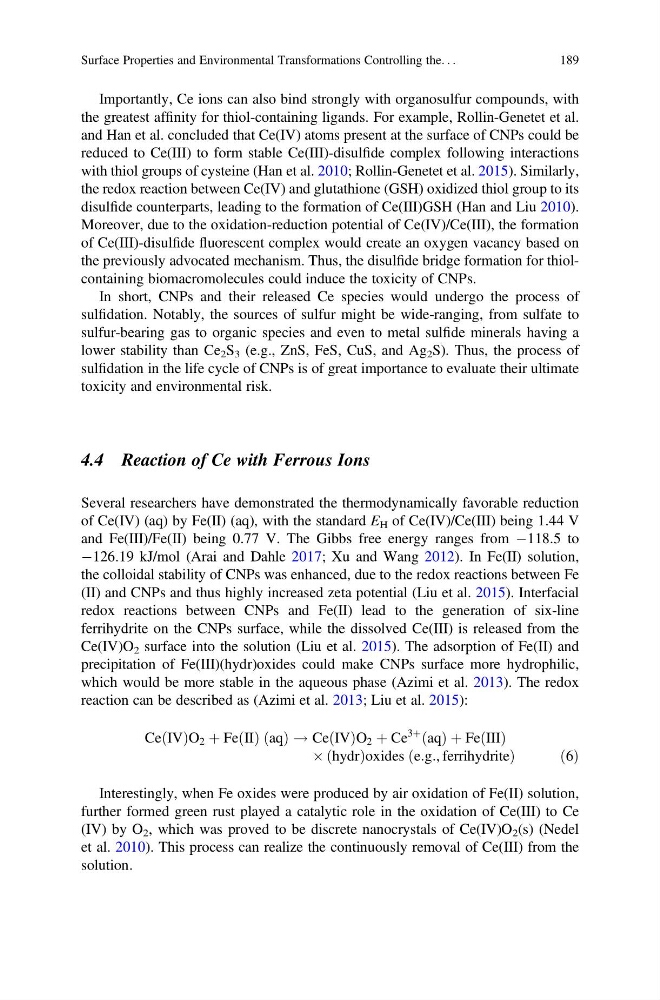
which would be more stable in the aqueous phase (Azimi et al. 2013). The redox
reaction can be described as (Azimi et al. 2013; Liu et al. 2015):
Ce IV
ð ÞO 2 þ Fe II
ð Þ aq
ð Þ ! Ce IV
ð ÞO 2 þ Ce
3þ aq
ð Þ þ Fe III
ð Þ
 hydr
ð
Þoxides e:g:, ferrihydrite
ð
Þ
ð 6Þ
Interestingly, when Fe oxides were produced by air oxidation of Fe(II) solution,
further formed green rust played a catalytic role in the oxidation of Ce(III) to Ce
(IV) by O 2 , which was proved to be discrete nanocrystals of Ce(IV)O 2 (s) (Nedel
et al. 2010). This process can realize the continuously removal of Ce(III) from the
solution.
Surface Properties and Environmental Transformations Controlling the. . .
189
the greatest affinity for thiol-containing ligands. For example, Rollin-Genetet et al.
and Han et al. concluded that Ce(IV) atoms present at the surface of CNPs could be
reduced to Ce(III) to form stable Ce(III)-disulfide complex following interactions
with thiol groups of cysteine (Han et al. 2010; Rollin-Genetet et al. 2015). Similarly,
the redox reaction between Ce(IV) and glutathione (GSH) oxidized thiol group to its
disulfide counterparts, leading to the formation of Ce(III)GSH (Han and Liu 2010).
Moreover, due to the oxidation-reduction potential of Ce(IV)/Ce(III), the formation
of Ce(III)-disulfide fluorescent complex would create an oxygen vacancy based on
the previously advocated mechanism. Thus, the disulfide bridge formation for thiolcontaining biomacromolecules could induce the toxicity of CNPs.
In short, CNPs and their released Ce species would undergo the process of
sulfidation. Notably, the sources of sulfur might be wide-ranging, from sulfate to
sulfur-bearing gas to organic species and even to metal sulfide minerals having a
lower stability than Ce 2 S 3 (e.g., ZnS, FeS, CuS, and Ag 2 S). Thus, the process of
sulfidation in the life cycle of CNPs is of great importance to evaluate their ultimate
toxicity and environmental risk.
4.4 Reaction of Ce with Ferrous Ions
Several researchers have demonstrated the thermodynamically favorable reduction
of Ce(IV) (aq) by Fe(II) (aq), with the standard E H of Ce(IV)/Ce(III) being 1.44 V
and Fe(III)/Fe(II) being 0.77 V. The Gibbs free energy ranges from À118.5 to
À126.19 kJ/mol (Arai and Dahle 2017; Xu and Wang 2012). In Fe(II) solution,
the colloidal stability of CNPs was enhanced, due to the redox reactions between Fe
(II) and CNPs and thus highly increased zeta potential (Liu et al. 2015). Interfacial
redox reactions between CNPs and Fe(II) lead to the generation of six-line
ferrihydrite on the CNPs surface, while the dissolved Ce(III) is released from the
Ce(IV)O 2 surface into the solution (Liu et al. 2015). The adsorption of Fe(II) and
precipitation of Fe(III)(hydr)oxides could make CNPs surface more hydrophilic,
which would be more stable in the aqueous phase (Azimi et al. 2013). The redox
reaction can be described as (Azimi et al. 2013; Liu et al. 2015):
Ce IV
ð ÞO 2 þ Fe II
ð Þ aq
ð Þ ! Ce IV
ð ÞO 2 þ Ce
3þ aq
ð Þ þ Fe III
ð Þ
 hydr
ð
Þoxides e:g:, ferrihydrite
ð
Þ
ð 6Þ
Interestingly, when Fe oxides were produced by air oxidation of Fe(II) solution,
further formed green rust played a catalytic role in the oxidation of Ce(III) to Ce
(IV) by O 2 , which was proved to be discrete nanocrystals of Ce(IV)O 2 (s) (Nedel
et al. 2010). This process can realize the continuously removal of Ce(III) from the
solution.
Surface Properties and Environmental Transformations Controlling the. . .
189