

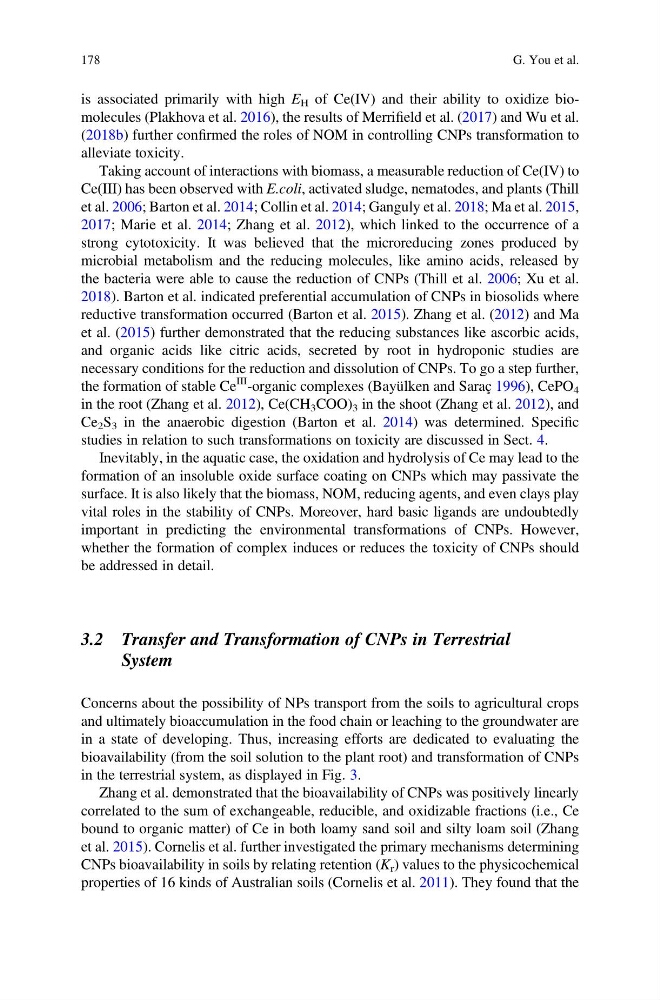
is associated primarily with high E H of Ce(IV) and their ability to oxidize biomolecules (Plakhova et al. 2016), the results of Merrifield et al. (2017) and Wu et al.
(2018b) further confirmed the roles of NOM in controlling CNPs transformation to
alleviate toxicity.
Taking account of interactions with biomass, a measurable reduction of Ce(IV) to
Ce(III) has been observed with E.coli, activated sludge, nematodes, and plants (Thill
et al. 2006; Barton et al. 2014; Collin et al. 2014; Ganguly et al. 2018; Ma et al. 2015,
2017; Marie et al. 2014; Zhang et al. 2012), which linked to the occurrence of a
strong cytotoxicity. It was believed that the microreducing zones produced by
microbial metabolism and the reducing molecules, like amino acids, released by
the bacteria were able to cause the reduction of CNPs (Thill et al. 2006; Xu et al.
2018). Barton et al. indicated preferential accumulation of CNPs in biosolids where
reductive transformation occurred (Barton et al. 2015). Zhang et al. (2012) and Ma
et al. (2015) further demonstrated that the reducing substances like ascorbic acids,
and organic acids like citric acids, secreted by root in hydroponic studies are
necessary conditions for the reduction and dissolution of CNPs. To go a step further,
the formation of stable Ce
III -organic complexes (Bayülken and Saraç 1996), CePO 4
in the root (Zhang et al. 2012), Ce(CH 3 COO) 3 in the shoot (Zhang et al. 2012), and
Ce 2 S 3 in the anaerobic digestion (Barton et al. 2014) was determined. Specific
studies in relation to such transformations on toxicity are discussed in Sect. 4.
Inevitably, in the aquatic case, the oxidation and hydrolysis of Ce may lead to the
formation of an insoluble oxide surface coating on CNPs which may passivate the
surface. It is also likely that the biomass, NOM, reducing agents, and even clays play
vital roles in the stability of CNPs. Moreover, hard basic ligands are undoubtedly
important in predicting the environmental transformations of CNPs. However,
whether the formation of complex induces or reduces the toxicity of CNPs should
be addressed in detail.
3.2 Transfer and Transformation of CNPs in Terrestrial
System
Concerns about the possibility of NPs transport from the soils to agricultural crops
and ultimately bioaccumulation in the food chain or leaching to the groundwater are
in a state of developing. Thus, increasing efforts are dedicated to evaluating the
bioavailability (from the soil solution to the plant root) and transformation of CNPs
in the terrestrial system, as displayed in Fig. 3.
Zhang et al. demonstrated that the bioavailability of CNPs was positively linearly
correlated to the sum of exchangeable, reducible, and oxidizable fractions (i.e., Ce
bound to organic matter) of Ce in both loamy sand soil and silty loam soil (Zhang
et al. 2015). Cornelis et al. further investigated the primary mechanisms determining
CNPs bioavailability in soils by relating retention (K r ) values to the physicochemical
properties of 16 kinds of Australian soils (Cornelis et al. 2011). They found that the
178
G. You et al.
(2018b) further confirmed the roles of NOM in controlling CNPs transformation to
alleviate toxicity.
Taking account of interactions with biomass, a measurable reduction of Ce(IV) to
Ce(III) has been observed with E.coli, activated sludge, nematodes, and plants (Thill
et al. 2006; Barton et al. 2014; Collin et al. 2014; Ganguly et al. 2018; Ma et al. 2015,
2017; Marie et al. 2014; Zhang et al. 2012), which linked to the occurrence of a
strong cytotoxicity. It was believed that the microreducing zones produced by
microbial metabolism and the reducing molecules, like amino acids, released by
the bacteria were able to cause the reduction of CNPs (Thill et al. 2006; Xu et al.
2018). Barton et al. indicated preferential accumulation of CNPs in biosolids where
reductive transformation occurred (Barton et al. 2015). Zhang et al. (2012) and Ma
et al. (2015) further demonstrated that the reducing substances like ascorbic acids,
and organic acids like citric acids, secreted by root in hydroponic studies are
necessary conditions for the reduction and dissolution of CNPs. To go a step further,
the formation of stable Ce
III -organic complexes (Bayülken and Saraç 1996), CePO 4
in the root (Zhang et al. 2012), Ce(CH 3 COO) 3 in the shoot (Zhang et al. 2012), and
Ce 2 S 3 in the anaerobic digestion (Barton et al. 2014) was determined. Specific
studies in relation to such transformations on toxicity are discussed in Sect. 4.
Inevitably, in the aquatic case, the oxidation and hydrolysis of Ce may lead to the
formation of an insoluble oxide surface coating on CNPs which may passivate the
surface. It is also likely that the biomass, NOM, reducing agents, and even clays play
vital roles in the stability of CNPs. Moreover, hard basic ligands are undoubtedly
important in predicting the environmental transformations of CNPs. However,
whether the formation of complex induces or reduces the toxicity of CNPs should
be addressed in detail.
3.2 Transfer and Transformation of CNPs in Terrestrial
System
Concerns about the possibility of NPs transport from the soils to agricultural crops
and ultimately bioaccumulation in the food chain or leaching to the groundwater are
in a state of developing. Thus, increasing efforts are dedicated to evaluating the
bioavailability (from the soil solution to the plant root) and transformation of CNPs
in the terrestrial system, as displayed in Fig. 3.
Zhang et al. demonstrated that the bioavailability of CNPs was positively linearly
correlated to the sum of exchangeable, reducible, and oxidizable fractions (i.e., Ce
bound to organic matter) of Ce in both loamy sand soil and silty loam soil (Zhang
et al. 2015). Cornelis et al. further investigated the primary mechanisms determining
CNPs bioavailability in soils by relating retention (K r ) values to the physicochemical
properties of 16 kinds of Australian soils (Cornelis et al. 2011). They found that the
178
G. You et al.