

fraction of clay was the main physicochemical driver determining K r values ahead of
the concentration of P or the pH of the soil (52% of the total sum of squares was
caused by the percentage of clay, 14% by P concentration, and 6% by pH) (Cornelis
et al. 2011). Layet et al. (2017) developed ISO-standardized RHIZOtest to comprehensively decipher the factors determining CNPs phytoavailability, and they
reported that the clay colloids reduced Ce uptake, which was consistent with
Cornelis et al. (2011). Surprisingly, this work combined with other studies provided
new evidence that NOM enhanced the phytoavailability of CNPs (Layet et al. 2017;
Majumdar et al. 2016a, b; Zhao et al. 2012a, b). The authors suggested that NOM
tended to coat CNPs, limiting their homo(hetero)aggregation and therefore rendering
CNPs more phytoavailable. Moreover, both CA and Alg coatings were observed to
facilitate CNPs phytoavailability relating to the increased mobility, whereas the
enhancing effects depend on soil type and NOM content (Layet et al. 2017; Zhao
et al. 2012a). This phenomenon could also explain the limited effects of CA coating
on the bioavailability of CNPs in Cornelis et al. (2011).
Another intriguing observation is that the disparity of roots and shoots with
regard to CNPs accumulation is controlled by the properties of soils. Recent studies
demonstrated that the presence of NOM and negatively charged colloids in soil
could complex with positively charged CNPs and reduce their mobility. As a result,
the upward transport of CNPs from roots to shoots will be limited in the kidney bean
plants, Raphanus sativus L., and corn plants (Majumdar et al. 2016a, b; Zhang et al.
2015; Zhao et al. 2012a). Additionally, the extent of CNPs translocation in soil
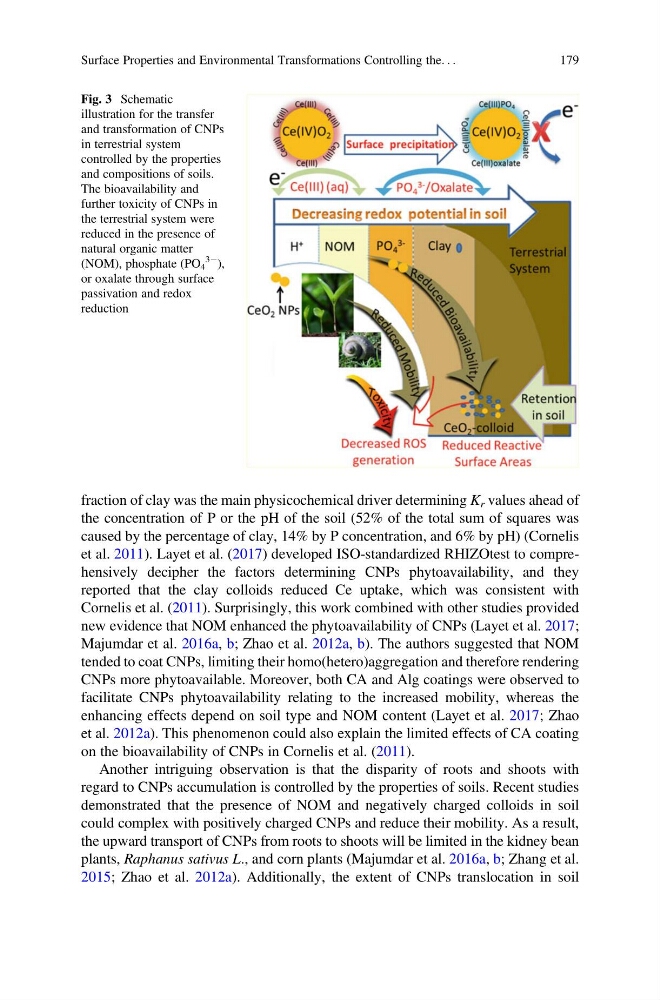
Fig. 3 Schematic
illustration for the transfer
and transformation of CNPs
in terrestrial system
controlled by the properties
and compositions of soils.
The bioavailability and
further toxicity of CNPs in
the terrestrial system were
reduced in the presence of
natural organic matter
(NOM), phosphate (PO 4
3À
),
or oxalate through surface
passivation and redox
reduction
Surface Properties and Environmental Transformations Controlling the. . .
179
the concentration of P or the pH of the soil (52% of the total sum of squares was
caused by the percentage of clay, 14% by P concentration, and 6% by pH) (Cornelis
et al. 2011). Layet et al. (2017) developed ISO-standardized RHIZOtest to comprehensively decipher the factors determining CNPs phytoavailability, and they
reported that the clay colloids reduced Ce uptake, which was consistent with
Cornelis et al. (2011). Surprisingly, this work combined with other studies provided
new evidence that NOM enhanced the phytoavailability of CNPs (Layet et al. 2017;
Majumdar et al. 2016a, b; Zhao et al. 2012a, b). The authors suggested that NOM
tended to coat CNPs, limiting their homo(hetero)aggregation and therefore rendering
CNPs more phytoavailable. Moreover, both CA and Alg coatings were observed to
facilitate CNPs phytoavailability relating to the increased mobility, whereas the
enhancing effects depend on soil type and NOM content (Layet et al. 2017; Zhao
et al. 2012a). This phenomenon could also explain the limited effects of CA coating
on the bioavailability of CNPs in Cornelis et al. (2011).
Another intriguing observation is that the disparity of roots and shoots with
regard to CNPs accumulation is controlled by the properties of soils. Recent studies
demonstrated that the presence of NOM and negatively charged colloids in soil
could complex with positively charged CNPs and reduce their mobility. As a result,
the upward transport of CNPs from roots to shoots will be limited in the kidney bean
plants, Raphanus sativus L., and corn plants (Majumdar et al. 2016a, b; Zhang et al.
2015; Zhao et al. 2012a). Additionally, the extent of CNPs translocation in soil
Fig. 3 Schematic
illustration for the transfer
and transformation of CNPs
in terrestrial system
controlled by the properties
and compositions of soils.
The bioavailability and
further toxicity of CNPs in
the terrestrial system were
reduced in the presence of
natural organic matter
(NOM), phosphate (PO 4
3À
),
or oxalate through surface
passivation and redox
reduction
Surface Properties and Environmental Transformations Controlling the. . .
179