

(s) and Ce(OH) 4 (gel) as the pH progresses toward neutral. Ce(OH) 2
+ and Ce(OH) 3
are not formed since their predominance fields do not adjoin that of Ce
3+ (Channei
et al. 2017). Correspondingly, the electrochemical potential required for redox
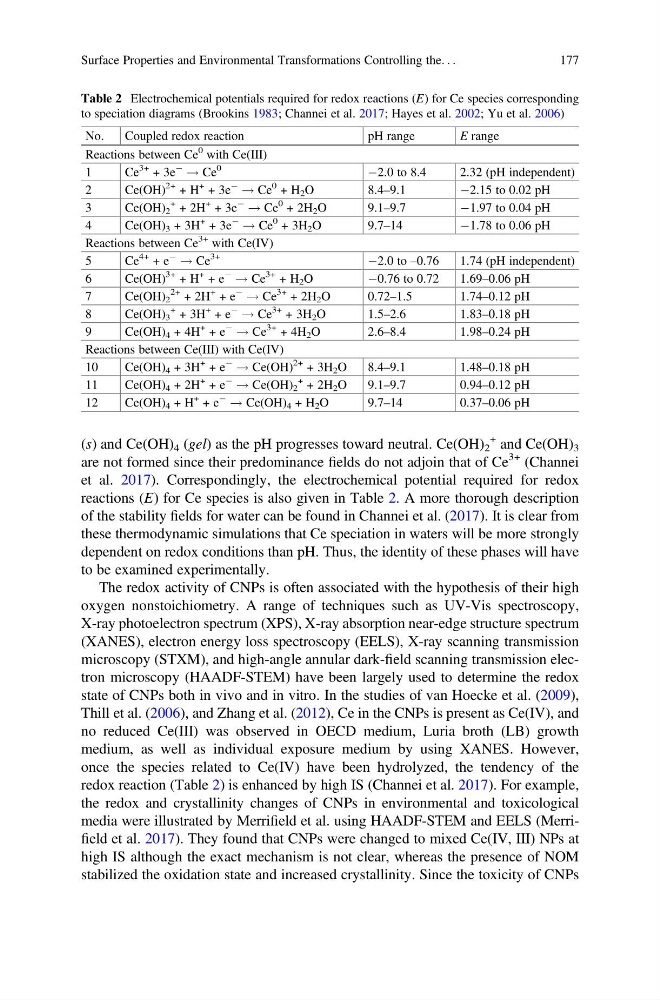
reactions (E) for Ce species is also given in Table 2. A more thorough description
of the stability fields for water can be found in Channei et al. (2017). It is clear from
these thermodynamic simulations that Ce speciation in waters will be more strongly
dependent on redox conditions than pH. Thus, the identity of these phases will have
to be examined experimentally.
The redox activity of CNPs is often associated with the hypothesis of their high
oxygen nonstoichiometry. A range of techniques such as UV-Vis spectroscopy,
X-ray photoelectron spectrum (XPS), X-ray absorption near-edge structure spectrum
(XANES), electron energy loss spectroscopy (EELS), X-ray scanning transmission
microscopy (STXM), and high-angle annular dark-field scanning transmission electron microscopy (HAADF-STEM) have been largely used to determine the redox
state of CNPs both in vivo and in vitro. In the studies of van Hoecke et al. (2009),
Thill et al. (2006), and Zhang et al. (2012), Ce in the CNPs is present as Ce(IV), and
no reduced Ce(III) was observed in OECD medium, Luria broth (LB) growth
medium, as well as individual exposure medium by using XANES. However,
once the species related to Ce(IV) have been hydrolyzed, the tendency of the
redox reaction (Table 2) is enhanced by high IS (Channei et al. 2017). For example,
the redox and crystallinity changes of CNPs in environmental and toxicological
media were illustrated by Merrifield et al. using HAADF-STEM and EELS (Merrifield et al. 2017). They found that CNPs were changed to mixed Ce(IV, III) NPs at
high IS although the exact mechanism is not clear, whereas the presence of NOM
stabilized the oxidation state and increased crystallinity. Since the toxicity of CNPs
Table 2 Electrochemical potentials required for redox reactions (E) for Ce species corresponding
to speciation diagrams (Brookins 1983; Channei et al. 2017; Hayes et al. 2002; Yu et al. 2006)
No.
Coupled redox reaction
pH range
E range
Reactions between Ce
0 with Ce(III)
1
C e
3+ + 3e
À ! Ce
0
À2.0 to 8.4
2.32 (pH independent)
2
Ce(OH)
2+ + H
+ + 3e
À ! Ce
0 + H 2 O
8.4–9.1
À2.15 to 0.02 pH
3
Ce(OH) 2
+ + 2H
+ + 3e
À ! Ce
0 + 2H 2 O
9.1–9.7
À1.97 to 0.04 pH
4
Ce(OH) 3 + 3H
+ + 3e
À ! Ce
0 + 3H 2 O
9.7–14
À1.78 to 0.06 pH
Reactions between Ce
3+ with Ce(IV)
5
C e
4+ + e
À ! Ce
3+
À2.0 to –0.76
1.74 (pH independent)
6
Ce(OH)
3+ + H
+ + e
À ! Ce
3+ + H 2 O
À0.76 to 0.72
1.69–0.06 pH
7
Ce(OH) 2
2+ + 2H
+ + e
À ! Ce
3+ + 2H 2 O
0.72–1.5
1.74–0.12 pH
8
Ce(OH) 3
+ + 3H
+ + e
À ! Ce
3+ + 3H 2 O
1.5–2.6
1.83–0.18 pH
9
Ce(OH) 4 + 4H
+ + e
À ! Ce
3+ + 4H 2 O
2.6–8.4
1.98–0.24 pH
Reactions between Ce(III) with Ce(IV)
10
Ce(OH) 4 + 3H
+ + e
À ! Ce(OH)
2+ + 3H 2 O
8.4–9.1
1.48–0.18 pH
11
Ce(OH) 4 + 2H
+ + e
À ! Ce(OH) 2
+ + 2H 2 O
9.1–9.7
0.94–0.12 pH
12
Ce(OH) 4 + H
+ + e
À ! Ce(OH) 4 + H 2 O
9.7–14
0.37–0.06 pH
Surface Properties and Environmental Transformations Controlling the. . .
177
+ and Ce(OH) 3
are not formed since their predominance fields do not adjoin that of Ce
3+ (Channei
et al. 2017). Correspondingly, the electrochemical potential required for redox
reactions (E) for Ce species is also given in Table 2. A more thorough description
of the stability fields for water can be found in Channei et al. (2017). It is clear from
these thermodynamic simulations that Ce speciation in waters will be more strongly
dependent on redox conditions than pH. Thus, the identity of these phases will have
to be examined experimentally.
The redox activity of CNPs is often associated with the hypothesis of their high
oxygen nonstoichiometry. A range of techniques such as UV-Vis spectroscopy,
X-ray photoelectron spectrum (XPS), X-ray absorption near-edge structure spectrum
(XANES), electron energy loss spectroscopy (EELS), X-ray scanning transmission
microscopy (STXM), and high-angle annular dark-field scanning transmission electron microscopy (HAADF-STEM) have been largely used to determine the redox
state of CNPs both in vivo and in vitro. In the studies of van Hoecke et al. (2009),
Thill et al. (2006), and Zhang et al. (2012), Ce in the CNPs is present as Ce(IV), and
no reduced Ce(III) was observed in OECD medium, Luria broth (LB) growth
medium, as well as individual exposure medium by using XANES. However,
once the species related to Ce(IV) have been hydrolyzed, the tendency of the
redox reaction (Table 2) is enhanced by high IS (Channei et al. 2017). For example,
the redox and crystallinity changes of CNPs in environmental and toxicological
media were illustrated by Merrifield et al. using HAADF-STEM and EELS (Merrifield et al. 2017). They found that CNPs were changed to mixed Ce(IV, III) NPs at
high IS although the exact mechanism is not clear, whereas the presence of NOM
stabilized the oxidation state and increased crystallinity. Since the toxicity of CNPs
Table 2 Electrochemical potentials required for redox reactions (E) for Ce species corresponding
to speciation diagrams (Brookins 1983; Channei et al. 2017; Hayes et al. 2002; Yu et al. 2006)
No.
Coupled redox reaction
pH range
E range
Reactions between Ce
0 with Ce(III)
1
C e
3+ + 3e
À ! Ce
0
À2.0 to 8.4
2.32 (pH independent)
2
Ce(OH)
2+ + H
+ + 3e
À ! Ce
0 + H 2 O
8.4–9.1
À2.15 to 0.02 pH
3
Ce(OH) 2
+ + 2H
+ + 3e
À ! Ce
0 + 2H 2 O
9.1–9.7
À1.97 to 0.04 pH
4
Ce(OH) 3 + 3H
+ + 3e
À ! Ce
0 + 3H 2 O
9.7–14
À1.78 to 0.06 pH
Reactions between Ce
3+ with Ce(IV)
5
C e
4+ + e
À ! Ce
3+
À2.0 to –0.76
1.74 (pH independent)
6
Ce(OH)
3+ + H
+ + e
À ! Ce
3+ + H 2 O
À0.76 to 0.72
1.69–0.06 pH
7
Ce(OH) 2
2+ + 2H
+ + e
À ! Ce
3+ + 2H 2 O
0.72–1.5
1.74–0.12 pH
8
Ce(OH) 3
+ + 3H
+ + e
À ! Ce
3+ + 3H 2 O
1.5–2.6
1.83–0.18 pH
9
Ce(OH) 4 + 4H
+ + e
À ! Ce
3+ + 4H 2 O
2.6–8.4
1.98–0.24 pH
Reactions between Ce(III) with Ce(IV)
10
Ce(OH) 4 + 3H
+ + e
À ! Ce(OH)
2+ + 3H 2 O
8.4–9.1
1.48–0.18 pH
11
Ce(OH) 4 + 2H
+ + e
À ! Ce(OH) 2
+ + 2H 2 O
9.1–9.7
0.94–0.12 pH
12
Ce(OH) 4 + H
+ + e
À ! Ce(OH) 4 + H 2 O
9.7–14
0.37–0.06 pH
Surface Properties and Environmental Transformations Controlling the. . .
177