

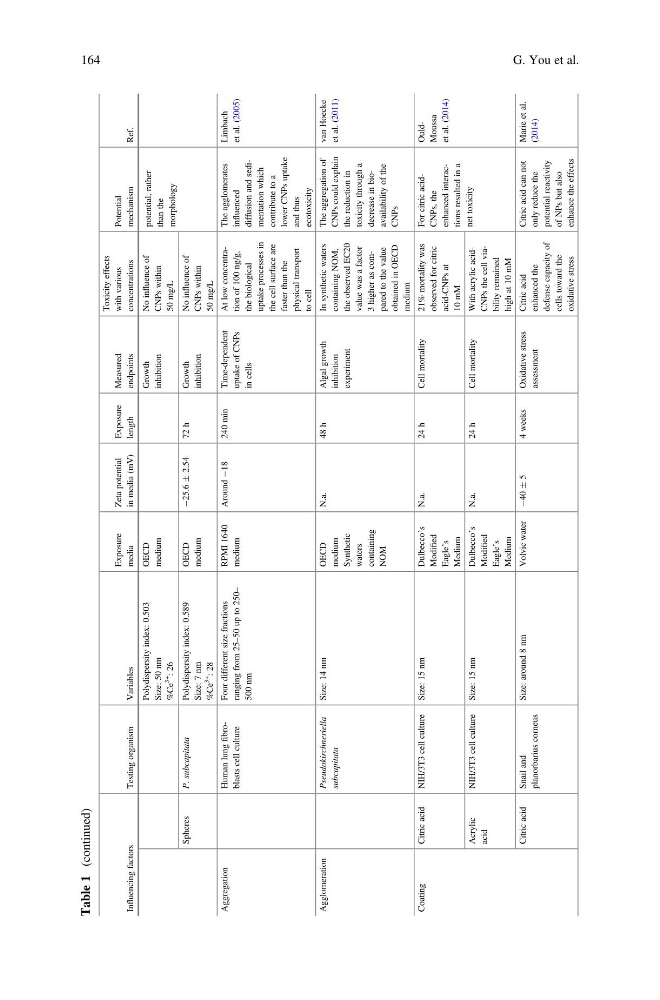
Table 1
(continued)
Influencing factors
Testing organism
Variables
Exposure
media
Zeta potential
in media (mV)
Exposure
length
Measured
endpoints
Toxicity effects
with various
concentrations
Potential
mechanism
Ref.
potential, rather
than the
morphology
Polydispersity index: 0.503
Size: 50 nm
%Ce
3+
: 26
OECD
medium
Growth
inhibition
No influence of
CNPs within
50 mg/L
Spheres
P. subcapitata
Polydispersity index: 0.589
Size: 7 nm
%Ce
3+
: 28
OECD
medium
À25.6 Æ 2.54
72 h
Growth
inhibition
No influence of
CNPs within
50 mg/L
Aggregation
Human lung
fibroblasts cell culture
Four different size fractions
ranging from 25–50 up to 250–
500 nm
RPMI 1640
medium
Around
À18
240 min
Time-dependent
uptake of CNPs
in cells
At low concentration of 100 ng/g,
the biological
uptake processes in
the cell surface are
faster than the
physical transport
to cell
The agglomerates
influenced
diffusion and sedimentation which
contribute to a
lower CNPs uptake
and thus
ecotoxicity
Limbach
et al. (2005)
Agglomeration
Pseudokirchneriella
subcapitata
Size: 14 nm
OECD
medium
Synthetic
waters
containing
NOM
N.a.
48 h
Algal growth
inhibition
experiment
In synthetic waters
containing NOM,
the observed EC20
value was a factor
3 higher as compared to the value
obtained in OECD
medium
The aggregation of
CNPs could explain
the reduction in
toxicity through a
decrease in bioavailability of the
CNPs
van Hoecke
et al. (2011)
Coating
Citric acid
NIH/3T3 cell culture
Size: 15 nm
Dulbecco’s
Modified
Eagle’s
Medium
N.a.
24 h
Cell mortality
21% mortality was
observed for citric
acid-CNPs at
10 mM
For citric acidCNPs, the
enhanced interactions resulted in a
net toxicity
OuldMoussa
et al. (2014)
Acrylic
acid
NIH/3T3 cell culture
Size: 15 nm
Dulbecco’s
Modified
Eagle’s
Medium
N.a.
24 h
Cell mortality
With acrylic acidCNPs the cell viability remained
high at 10 mM
Citric acid
Snail and
planorbarius corneus
Size: around 8 nm
Volvic water
À40 Æ 5
4 weeks
Oxidative stress
assessment
Citric acid
enhanced the
defense capacity of
cells toward the
oxidative stress
Citric acid can not
only reduce the
potential reactivity
of NPs but also
enhance the effects
Marie et al.
(2014)
164
G. You et al.
(continued)
Influencing factors
Testing organism
Variables
Exposure
media
Zeta potential
in media (mV)
Exposure
length
Measured
endpoints
Toxicity effects
with various
concentrations
Potential
mechanism
Ref.
potential, rather
than the
morphology
Polydispersity index: 0.503
Size: 50 nm
%Ce
3+
: 26
OECD
medium
Growth
inhibition
No influence of
CNPs within
50 mg/L
Spheres
P. subcapitata
Polydispersity index: 0.589
Size: 7 nm
%Ce
3+
: 28
OECD
medium
À25.6 Æ 2.54
72 h
Growth
inhibition
No influence of
CNPs within
50 mg/L
Aggregation
Human lung
fibroblasts cell culture
Four different size fractions
ranging from 25–50 up to 250–
500 nm
RPMI 1640
medium
Around
À18
240 min
Time-dependent
uptake of CNPs
in cells
At low concentration of 100 ng/g,
the biological
uptake processes in
the cell surface are
faster than the
physical transport
to cell
The agglomerates
influenced
diffusion and sedimentation which
contribute to a
lower CNPs uptake
and thus
ecotoxicity
Limbach
et al. (2005)
Agglomeration
Pseudokirchneriella
subcapitata
Size: 14 nm
OECD
medium
Synthetic
waters
containing
NOM
N.a.
48 h
Algal growth
inhibition
experiment
In synthetic waters
containing NOM,
the observed EC20
value was a factor
3 higher as compared to the value
obtained in OECD
medium
The aggregation of
CNPs could explain
the reduction in
toxicity through a
decrease in bioavailability of the
CNPs
van Hoecke
et al. (2011)
Coating
Citric acid
NIH/3T3 cell culture
Size: 15 nm
Dulbecco’s
Modified
Eagle’s
Medium
N.a.
24 h
Cell mortality
21% mortality was
observed for citric
acid-CNPs at
10 mM
For citric acidCNPs, the
enhanced interactions resulted in a
net toxicity
OuldMoussa
et al. (2014)
Acrylic
acid
NIH/3T3 cell culture
Size: 15 nm
Dulbecco’s
Modified
Eagle’s
Medium
N.a.
24 h
Cell mortality
With acrylic acidCNPs the cell viability remained
high at 10 mM
Citric acid
Snail and
planorbarius corneus
Size: around 8 nm
Volvic water
À40 Æ 5
4 weeks
Oxidative stress
assessment
Citric acid
enhanced the
defense capacity of
cells toward the
oxidative stress
Citric acid can not
only reduce the
potential reactivity
of NPs but also
enhance the effects
Marie et al.
(2014)
164
G. You et al.