

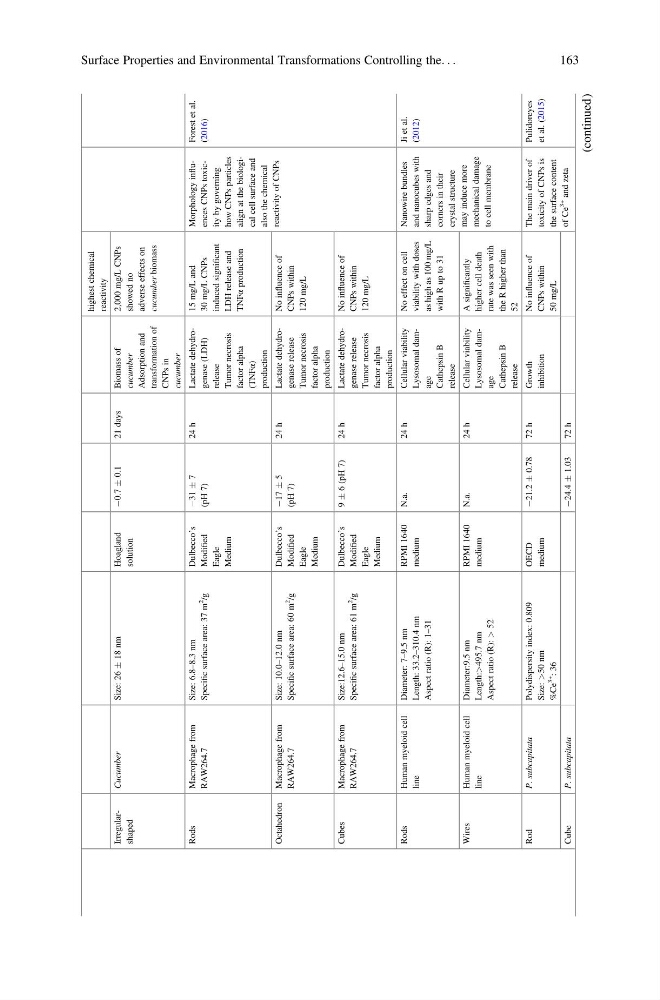
highest chemical
reactivity
Irregularshaped
Cucumber
Size: 26
Æ 18 nm
Hoagland
solution
À0.7 Æ 0.1
21 days
Biomass of
cucumber
Adsorption and
transformation of
CNPs in
cucumber
2,000 mg/L CNPs
showed no
adverse effects on
cucumber
biomass
Rods
Macrophage from
RAW264.7
Size: 6.8–8.3 nm
Specific surface area: 37 m
2
/g
Dulbecco’s
Modified
Eagle
Medium
À31 Æ 7
(pH 7)
24 h
Lactate dehydrogenase (LDH)
release
Tumor necrosis
factor alpha
(TNFα)
production
15 mg/L and
30 mg/L CNPs
induced significant
LDH release and
TNFα production
Morphology influences CNPs toxicity by governing
how CNPs particles
align at the biological cell surface and
also the chemical
reactivity of CNPs
Forest et al.
(2016)
Octahedron
Macrophage from
RAW264.7
Size: 10.0–12.0 nm
Specific surface area: 60 m
2
/g
Dulbecco’s
Modified
Eagle
Medium
À17 Æ 5
(pH 7)
24 h
Lactate dehydrogenase release
Tumor necrosis
factor alpha
production
No influence of
CNPs within
120 mg/L
Cubes
Macrophage from
RAW264.7
Size:12.6–15.0 nm
Specific surface area: 61 m
2
/g
Dulbecco’s
Modified
Eagle
Medium
9
Æ 6 (pH 7)
24 h
Lactate dehydrogenase release
Tumor necrosis
factor alpha
production
No influence of
CNPs within
120 mg/L
Rods
Human myeloid cell
line
Diameter: 7–9.5 nm
Length: 33.2–310.4 nm
Aspect ratio (R): 1–31
RPMI 1640
medium
N.a.
24 h
Cellular viability
Lysosomal damage
Cathepsin B
release
No effect on cell
viability with doses
as high as 100 mg/L
with R up to 31
Nanowire bundles
and nanocubes with
sharp edges and
corners in their
crystal structure
may induce more
mechanical damage
to cell membrane
Ji et al.
(2012)
Wires
Human myeloid cell
line
Diameter:9.5 nm
Length:>495.7 nm
Aspect ratio (R):
> 52
RPMI 1640
medium
N.a.
24 h
Cellular viability
Lysosomal damage
Cathepsin B
release
A significantly
higher cell death
rate was seen with
the R higher than
52
Rod
P. subcapitata
Polydispersity index: 0.809
Size:
>50 nm
%Ce
3+
: 36
OECD
medium
À21.2 Æ 0.78
72 h
Growth
inhibition
No influence of
CNPs within
50 mg/L
The main driver of
toxicity of CNPs is
the surface content
of Ce
3+
and zeta
Pulidoreyes
et al. (2015)
Cube
P. subcapitata
À24.4 Æ 1.03
72 h
(continued)
Surface Properties and Environmental Transformations Controlling the. . .
163
reactivity
Irregularshaped
Cucumber
Size: 26
Æ 18 nm
Hoagland
solution
À0.7 Æ 0.1
21 days
Biomass of
cucumber
Adsorption and
transformation of
CNPs in
cucumber
2,000 mg/L CNPs
showed no
adverse effects on
cucumber
biomass
Rods
Macrophage from
RAW264.7
Size: 6.8–8.3 nm
Specific surface area: 37 m
2
/g
Dulbecco’s
Modified
Eagle
Medium
À31 Æ 7
(pH 7)
24 h
Lactate dehydrogenase (LDH)
release
Tumor necrosis
factor alpha
(TNFα)
production
15 mg/L and
30 mg/L CNPs
induced significant
LDH release and
TNFα production
Morphology influences CNPs toxicity by governing
how CNPs particles
align at the biological cell surface and
also the chemical
reactivity of CNPs
Forest et al.
(2016)
Octahedron
Macrophage from
RAW264.7
Size: 10.0–12.0 nm
Specific surface area: 60 m
2
/g
Dulbecco’s
Modified
Eagle
Medium
À17 Æ 5
(pH 7)
24 h
Lactate dehydrogenase release
Tumor necrosis
factor alpha
production
No influence of
CNPs within
120 mg/L
Cubes
Macrophage from
RAW264.7
Size:12.6–15.0 nm
Specific surface area: 61 m
2
/g
Dulbecco’s
Modified
Eagle
Medium
9
Æ 6 (pH 7)
24 h
Lactate dehydrogenase release
Tumor necrosis
factor alpha
production
No influence of
CNPs within
120 mg/L
Rods
Human myeloid cell
line
Diameter: 7–9.5 nm
Length: 33.2–310.4 nm
Aspect ratio (R): 1–31
RPMI 1640
medium
N.a.
24 h
Cellular viability
Lysosomal damage
Cathepsin B
release
No effect on cell
viability with doses
as high as 100 mg/L
with R up to 31
Nanowire bundles
and nanocubes with
sharp edges and
corners in their
crystal structure
may induce more
mechanical damage
to cell membrane
Ji et al.
(2012)
Wires
Human myeloid cell
line
Diameter:9.5 nm
Length:>495.7 nm
Aspect ratio (R):
> 52
RPMI 1640
medium
N.a.
24 h
Cellular viability
Lysosomal damage
Cathepsin B
release
A significantly
higher cell death
rate was seen with
the R higher than
52
Rod
P. subcapitata
Polydispersity index: 0.809
Size:
>50 nm
%Ce
3+
: 36
OECD
medium
À21.2 Æ 0.78
72 h
Growth
inhibition
No influence of
CNPs within
50 mg/L
The main driver of
toxicity of CNPs is
the surface content
of Ce
3+
and zeta
Pulidoreyes
et al. (2015)
Cube
P. subcapitata
À24.4 Æ 1.03
72 h
(continued)
Surface Properties and Environmental Transformations Controlling the. . .
163