

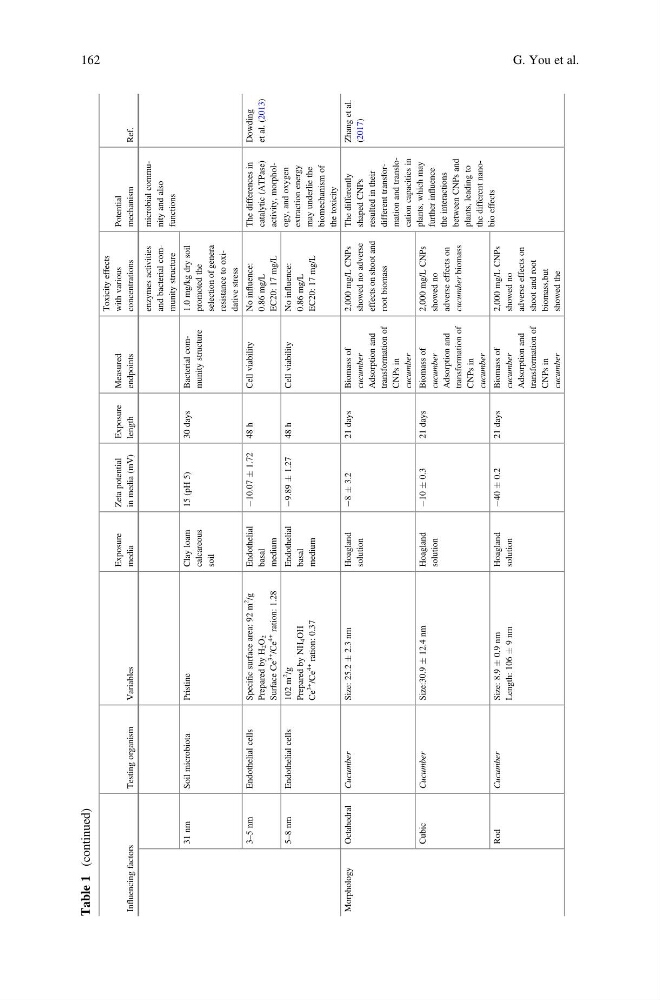
Table 1
(continued)
Influencing factors
Testing organism
Variables
Exposure
media
Zeta potential
in media (mV)
Exposure
length
Measured
endpoints
Toxicity effects
with various
concentrations
Potential
mechanism
Ref.
enzymes activities
and bacterial community structure
microbial community and also
functions
31 nm
Soil microbiota
Pristine
Clay loam
calcareous
soil
15 (pH 5)
30 days
Bacterial community structure
1.0 mg/kg dry soil
promoted the
selection of genera
resistance to oxidative stress
3–5 nm
Endothelial cells
Specific surface area: 92 m
2
/g
Prepared by H2O2
Surface Ce
3+
/Ce
4+
ration: 1.28
Endothelial
basal
medium
À10.07 Æ 1.72
48 h
Cell viability
No influence:
0.86 mg/L
EC20: 17 mg/L
The differences in
catalytic (ATPase)
activity, morphology, and oxygen
extraction energy
may underlie the
biomechanism of
the toxicity
Dowding
et al. (2013)
5–8 nm
Endothelial cells
102 m
2
/g
Prepared by NH
4 OH
Ce
3+
/Ce
4+
ration: 0.37
Endothelial
basal
medium
À9.89 Æ 1.27
48 h
Cell viability
No influence:
0.86 mg/L
EC20: 17 mg/L
Morphology
Octahedral
Cucumber
Size: 25.2
Æ 2.3 nm
Hoagland
solution
À8 Æ 3.2
21 days
Biomass of
cucumber
Adsorption and
transformation of
CNPs in
cucumber
2,000 mg/L CNPs
showed no adverse
effects on shoot and
root biomass
The differently
shaped CNPs
resulted in their
different transformation and translocation capacities in
plants, which may
further influence
the interactions
between CNPs and
plants, leading to
the different nanobio effects
Zhang et al.
(2017)
Cubic
Cucumber
Size:30.9
Æ 12.4 nm
Hoagland
solution
À10 Æ 0.3
21 days
Biomass of
cucumber
Adsorption and
transformation of
CNPs in
cucumber
2,000 mg/L CNPs
showed no
adverse effects on
cucumber
biomass
Rod
Cucumber
Size: 8.9
Æ 0.9 nm
Length: 106
Æ 9 nm
Hoagland
solution
À40 Æ 0.2
21 days
Biomass of
cucumber
Adsorption and
transformation of
CNPs in
cucumber
2,000 mg/L CNPs
showed no
adverse effects on
shoot and root
biomass,but
showed the
162
G. You et al.
(continued)
Influencing factors
Testing organism
Variables
Exposure
media
Zeta potential
in media (mV)
Exposure
length
Measured
endpoints
Toxicity effects
with various
concentrations
Potential
mechanism
Ref.
enzymes activities
and bacterial community structure
microbial community and also
functions
31 nm
Soil microbiota
Pristine
Clay loam
calcareous
soil
15 (pH 5)
30 days
Bacterial community structure
1.0 mg/kg dry soil
promoted the
selection of genera
resistance to oxidative stress
3–5 nm
Endothelial cells
Specific surface area: 92 m
2
/g
Prepared by H2O2
Surface Ce
3+
/Ce
4+
ration: 1.28
Endothelial
basal
medium
À10.07 Æ 1.72
48 h
Cell viability
No influence:
0.86 mg/L
EC20: 17 mg/L
The differences in
catalytic (ATPase)
activity, morphology, and oxygen
extraction energy
may underlie the
biomechanism of
the toxicity
Dowding
et al. (2013)
5–8 nm
Endothelial cells
102 m
2
/g
Prepared by NH
4 OH
Ce
3+
/Ce
4+
ration: 0.37
Endothelial
basal
medium
À9.89 Æ 1.27
48 h
Cell viability
No influence:
0.86 mg/L
EC20: 17 mg/L
Morphology
Octahedral
Cucumber
Size: 25.2
Æ 2.3 nm
Hoagland
solution
À8 Æ 3.2
21 days
Biomass of
cucumber
Adsorption and
transformation of
CNPs in
cucumber
2,000 mg/L CNPs
showed no adverse
effects on shoot and
root biomass
The differently
shaped CNPs
resulted in their
different transformation and translocation capacities in
plants, which may
further influence
the interactions
between CNPs and
plants, leading to
the different nanobio effects
Zhang et al.
(2017)
Cubic
Cucumber
Size:30.9
Æ 12.4 nm
Hoagland
solution
À10 Æ 0.3
21 days
Biomass of
cucumber
Adsorption and
transformation of
CNPs in
cucumber
2,000 mg/L CNPs
showed no
adverse effects on
cucumber
biomass
Rod
Cucumber
Size: 8.9
Æ 0.9 nm
Length: 106
Æ 9 nm
Hoagland
solution
À40 Æ 0.2
21 days
Biomass of
cucumber
Adsorption and
transformation of
CNPs in
cucumber
2,000 mg/L CNPs
showed no
adverse effects on
shoot and root
biomass,but
showed the
162
G. You et al.