

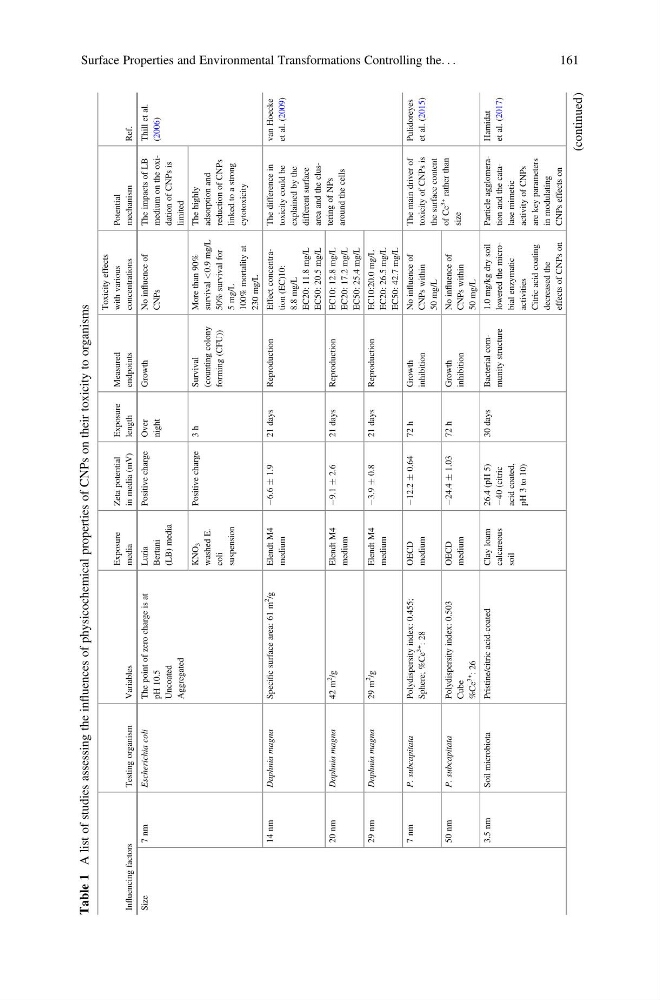
Table 1
A list of studies assessing the influences of physicochemical properties of CNPs on their toxicity to organisms
Influencing factors
Testing organism
Variables
Exposure
media
Zeta potential
in media (mV)
Exposure
length
Measured
endpoints
Toxicity effects
with various
concentrations
Potential
mechanism
Ref.
Size
7 nm
Escherichia coli
The point of zero charge is at
pH 10.5
Uncoated
Aggregated
Luria
Bertani
(LB) media
Positive charge
Over
night
Growth
No influence of
CNPs
The impacts of LB
medium on the oxidation of CNPs is
limited
Thill et al.
(2006)
KNO3
washed E.
coli
suspension
Positive charge
3 h
Survival
(counting colony
forming (CFU))
More than 90%
survival
<0.9 mg/L
50% survival for
5 mg/L
100% mortality at
230 mg/L
The highly
adsorption and
reduction of CNPs
linked to a strong
cytotoxicity
14 nm
Daphnia magna
Specific surface area: 61 m
2
/g
Elendt M4
medium
À6.6 Æ 1.9
21 days
Reproduction
Effect concentration (EC)10:
8.8 mg/L
EC20: 11.8 mg/L
EC50: 20.5 mg/L
The difference in
toxicity could be
explained by the
different surface
area and the clustering of NPs
around the cells
van Hoecke
et al. (2009)
20 nm
Daphnia magna
42 m
2
/g
Elendt M4
medium
À9.1 Æ 2.6
21 days
Reproduction
EC10: 12.8 mg/L
EC20: 17.2 mg/L
EC50: 25.4 mg/L
29 nm
Daphnia magna
29 m
2
/g
Elendt M4
medium
À3.9 Æ 0.8
21 days
Reproduction
EC10:20.0 mg/L
EC20: 26.5 mg/L
EC50: 42.7 mg/L
7 nm
P. subcapitata
Polydispersity index: 0.455;
Sphere; %Ce
3+
: 28
OECD
medium
À12.2 Æ 0.64
72 h
Growth
inhibition
No influence of
CNPs within
50 mg/L
The main driver of
toxicity of CNPs is
the surface content
of Ce
3+
rather than
size
Pulidoreyes
et al. (2015)
50 nm
P. subcapitata
Polydispersity index: 0.503
Cube
%Ce
3+
: 26
OECD
medium
À24.4 Æ 1.03
72 h
Growth
inhibition
No influence of
CNPs within
50 mg/L
3.5 nm
Soil microbiota
Pristine/citric acid-coated
Clay loam
calcareous
soil
26.4 (pH 5)
À40 (citric
acid coated,
pH 3 to 10)
30 days
Bacterial community structure
1.0 mg/kg dry soil
lowered the microbial enzymatic
activities
Citric acid coating
decreased the
effects of CNPs on
Particle agglomeration and the catalase mimetic
activity of CNPs
are key parameters
in modulating
CNPs effects on
Hamidat
et al. (2017)
(continued)
Surface Properties and Environmental Transformations Controlling the. . .
161
A list of studies assessing the influences of physicochemical properties of CNPs on their toxicity to organisms
Influencing factors
Testing organism
Variables
Exposure
media
Zeta potential
in media (mV)
Exposure
length
Measured
endpoints
Toxicity effects
with various
concentrations
Potential
mechanism
Ref.
Size
7 nm
Escherichia coli
The point of zero charge is at
pH 10.5
Uncoated
Aggregated
Luria
Bertani
(LB) media
Positive charge
Over
night
Growth
No influence of
CNPs
The impacts of LB
medium on the oxidation of CNPs is
limited
Thill et al.
(2006)
KNO3
washed E.
coli
suspension
Positive charge
3 h
Survival
(counting colony
forming (CFU))
More than 90%
survival
<0.9 mg/L
50% survival for
5 mg/L
100% mortality at
230 mg/L
The highly
adsorption and
reduction of CNPs
linked to a strong
cytotoxicity
14 nm
Daphnia magna
Specific surface area: 61 m
2
/g
Elendt M4
medium
À6.6 Æ 1.9
21 days
Reproduction
Effect concentration (EC)10:
8.8 mg/L
EC20: 11.8 mg/L
EC50: 20.5 mg/L
The difference in
toxicity could be
explained by the
different surface
area and the clustering of NPs
around the cells
van Hoecke
et al. (2009)
20 nm
Daphnia magna
42 m
2
/g
Elendt M4
medium
À9.1 Æ 2.6
21 days
Reproduction
EC10: 12.8 mg/L
EC20: 17.2 mg/L
EC50: 25.4 mg/L
29 nm
Daphnia magna
29 m
2
/g
Elendt M4
medium
À3.9 Æ 0.8
21 days
Reproduction
EC10:20.0 mg/L
EC20: 26.5 mg/L
EC50: 42.7 mg/L
7 nm
P. subcapitata
Polydispersity index: 0.455;
Sphere; %Ce
3+
: 28
OECD
medium
À12.2 Æ 0.64
72 h
Growth
inhibition
No influence of
CNPs within
50 mg/L
The main driver of
toxicity of CNPs is
the surface content
of Ce
3+
rather than
size
Pulidoreyes
et al. (2015)
50 nm
P. subcapitata
Polydispersity index: 0.503
Cube
%Ce
3+
: 26
OECD
medium
À24.4 Æ 1.03
72 h
Growth
inhibition
No influence of
CNPs within
50 mg/L
3.5 nm
Soil microbiota
Pristine/citric acid-coated
Clay loam
calcareous
soil
26.4 (pH 5)
À40 (citric
acid coated,
pH 3 to 10)
30 days
Bacterial community structure
1.0 mg/kg dry soil
lowered the microbial enzymatic
activities
Citric acid coating
decreased the
effects of CNPs on
Particle agglomeration and the catalase mimetic
activity of CNPs
are key parameters
in modulating
CNPs effects on
Hamidat
et al. (2017)
(continued)
Surface Properties and Environmental Transformations Controlling the. . .
161