

2 Physicochemical Properties of CNPs: Impact
on Biosorption and Toxicity
The toxicity of CNPs reported in the literatures is in conflict with either being lower
(Collin et al. 2017) or higher (Merrifield et al. 2017; Thill et al. 2006) even with the
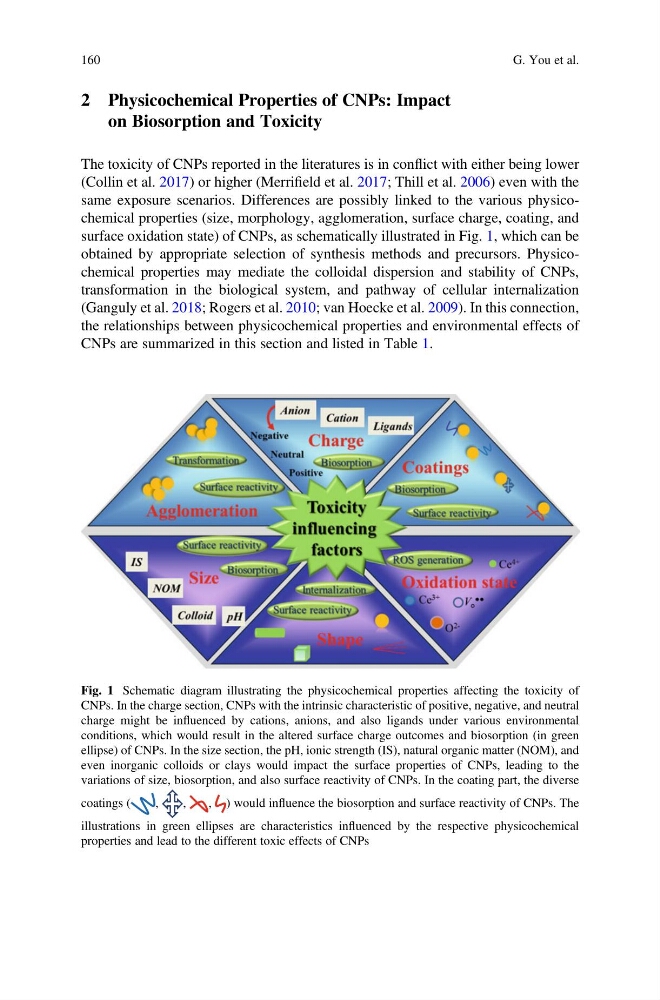
same exposure scenarios. Differences are possibly linked to the various physicochemical properties (size, morphology, agglomeration, surface charge, coating, and
surface oxidation state) of CNPs, as schematically illustrated in Fig. 1, which can be
obtained by appropriate selection of synthesis methods and precursors. Physicochemical properties may mediate the colloidal dispersion and stability of CNPs,
transformation in the biological system, and pathway of cellular internalization
(Ganguly et al. 2018; Rogers et al. 2010; van Hoecke et al. 2009). In this connection,
the relationships between physicochemical properties and environmental effects of
CNPs are summarized in this section and listed in Table 1.
Fig. 1 Schematic diagram illustrating the physicochemical properties affecting the toxicity of
CNPs. In the charge section, CNPs with the intrinsic characteristic of positive, negative, and neutral
charge might be influenced by cations, anions, and also ligands under various environmental
conditions, which would result in the altered surface charge outcomes and biosorption (in green
ellipse) of CNPs. In the size section, the pH, ionic strength (IS), natural organic matter (NOM), and
even inorganic colloids or clays would impact the surface properties of CNPs, leading to the
variations of size, biosorption, and also surface reactivity of CNPs. In the coating part, the diverse
coatings (
,
,
, ) would influence the biosorption and surface reactivity of CNPs. The
illustrations in green ellipses are characteristics influenced by the respective physicochemical
properties and lead to the different toxic effects of CNPs
160
G. You et al.
on Biosorption and Toxicity
The toxicity of CNPs reported in the literatures is in conflict with either being lower
(Collin et al. 2017) or higher (Merrifield et al. 2017; Thill et al. 2006) even with the
same exposure scenarios. Differences are possibly linked to the various physicochemical properties (size, morphology, agglomeration, surface charge, coating, and
surface oxidation state) of CNPs, as schematically illustrated in Fig. 1, which can be
obtained by appropriate selection of synthesis methods and precursors. Physicochemical properties may mediate the colloidal dispersion and stability of CNPs,
transformation in the biological system, and pathway of cellular internalization
(Ganguly et al. 2018; Rogers et al. 2010; van Hoecke et al. 2009). In this connection,
the relationships between physicochemical properties and environmental effects of
CNPs are summarized in this section and listed in Table 1.
Fig. 1 Schematic diagram illustrating the physicochemical properties affecting the toxicity of
CNPs. In the charge section, CNPs with the intrinsic characteristic of positive, negative, and neutral
charge might be influenced by cations, anions, and also ligands under various environmental
conditions, which would result in the altered surface charge outcomes and biosorption (in green
ellipse) of CNPs. In the size section, the pH, ionic strength (IS), natural organic matter (NOM), and
even inorganic colloids or clays would impact the surface properties of CNPs, leading to the
variations of size, biosorption, and also surface reactivity of CNPs. In the coating part, the diverse
coatings (
,
,
, ) would influence the biosorption and surface reactivity of CNPs. The
illustrations in green ellipses are characteristics influenced by the respective physicochemical
properties and lead to the different toxic effects of CNPs
160
G. You et al.