

children are exposed to metals via ingestion of contaminated dust (Dimitriou and
Kassomenos 2017). After ingestion, metal-PM can induce a range of toxic effects in
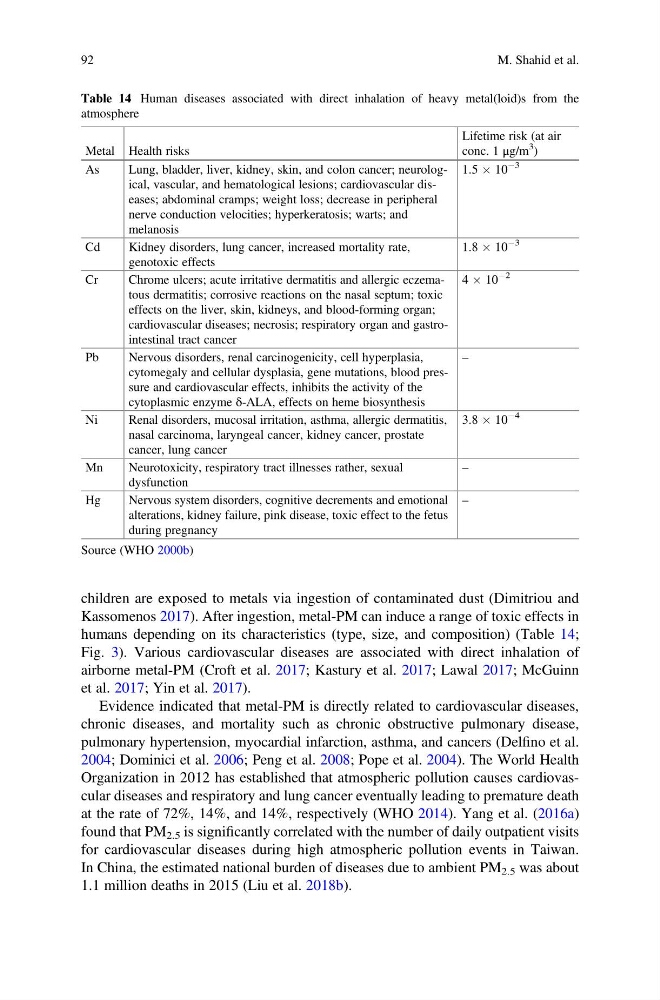
humans depending on its characteristics (type, size, and composition) (Table 14;
Fig. 3). Various cardiovascular diseases are associated with direct inhalation of
airborne metal-PM (Croft et al. 2017; Kastury et al. 2017; Lawal 2017; McGuinn
et al. 2017; Yin et al. 2017).
Evidence indicated that metal-PM is directly related to cardiovascular diseases,
chronic diseases, and mortality such as chronic obstructive pulmonary disease,
pulmonary hypertension, myocardial infarction, asthma, and cancers (Delfino et al.
2004; Dominici et al. 2006; Peng et al. 2008; Pope et al. 2004). The World Health
Organization in 2012 has established that atmospheric pollution causes cardiovascular diseases and respiratory and lung cancer eventually leading to premature death
at the rate of 72%, 14%, and 14%, respectively (WHO 2014). Yang et al. (2016a)
found that PM 2.5 is significantly correlated with the number of daily outpatient visits
for cardiovascular diseases during high atmospheric pollution events in Taiwan.
In China, the estimated national burden of diseases due to ambient PM 2.5 was about
1.1 million deaths in 2015 (Liu et al. 2018b).
Table 14 Human diseases associated with direct inhalation of heavy metal(loid)s from the
atmosphere
Metal Health risks
Lifetime risk (at air
conc. 1 μg/m
3
)
As
Lung, bladder, liver, kidney, skin, and colon cancer; neurological, vascular, and hematological lesions; cardiovascular diseases; abdominal cramps; weight loss; decrease in peripheral
nerve conduction velocities; hyperkeratosis; warts; and
melanosis
1.5 Â 10
À3
Cd
Kidney disorders, lung cancer, increased mortality rate,
genotoxic effects
1.8 Â 10
À3
Cr
Chrome ulcers; acute irritative dermatitis and allergic eczematous dermatitis; corrosive reactions on the nasal septum; toxic
effects on the liver, skin, kidneys, and blood-forming organ;
cardiovascular diseases; necrosis; respiratory organ and gastrointestinal tract cancer
4 Â 10
À2
Pb
Nervous disorders, renal carcinogenicity, cell hyperplasia,
cytomegaly and cellular dysplasia, gene mutations, blood pressure and cardiovascular effects, inhibits the activity of the
cytoplasmic enzyme δ-ALA, effects on heme biosynthesis
–
Ni
Renal disorders, mucosal irritation, asthma, allergic dermatitis,
nasal carcinoma, laryngeal cancer, kidney cancer, prostate
cancer, lung cancer
3.8 Â 10
À4
Mn
Neurotoxicity, respiratory tract illnesses rather, sexual
dysfunction
–
Hg
Nervous system disorders, cognitive decrements and emotional
alterations, kidney failure, pink disease, toxic effect to the fetus
during pregnancy
–
Source (WHO 2000b)
92
M. Shahid et al.
Kassomenos 2017). After ingestion, metal-PM can induce a range of toxic effects in
humans depending on its characteristics (type, size, and composition) (Table 14;
Fig. 3). Various cardiovascular diseases are associated with direct inhalation of
airborne metal-PM (Croft et al. 2017; Kastury et al. 2017; Lawal 2017; McGuinn
et al. 2017; Yin et al. 2017).
Evidence indicated that metal-PM is directly related to cardiovascular diseases,
chronic diseases, and mortality such as chronic obstructive pulmonary disease,
pulmonary hypertension, myocardial infarction, asthma, and cancers (Delfino et al.
2004; Dominici et al. 2006; Peng et al. 2008; Pope et al. 2004). The World Health
Organization in 2012 has established that atmospheric pollution causes cardiovascular diseases and respiratory and lung cancer eventually leading to premature death
at the rate of 72%, 14%, and 14%, respectively (WHO 2014). Yang et al. (2016a)
found that PM 2.5 is significantly correlated with the number of daily outpatient visits
for cardiovascular diseases during high atmospheric pollution events in Taiwan.
In China, the estimated national burden of diseases due to ambient PM 2.5 was about
1.1 million deaths in 2015 (Liu et al. 2018b).
Table 14 Human diseases associated with direct inhalation of heavy metal(loid)s from the
atmosphere
Metal Health risks
Lifetime risk (at air
conc. 1 μg/m
3
)
As
Lung, bladder, liver, kidney, skin, and colon cancer; neurological, vascular, and hematological lesions; cardiovascular diseases; abdominal cramps; weight loss; decrease in peripheral
nerve conduction velocities; hyperkeratosis; warts; and
melanosis
1.5 Â 10
À3
Cd
Kidney disorders, lung cancer, increased mortality rate,
genotoxic effects
1.8 Â 10
À3
Cr
Chrome ulcers; acute irritative dermatitis and allergic eczematous dermatitis; corrosive reactions on the nasal septum; toxic
effects on the liver, skin, kidneys, and blood-forming organ;
cardiovascular diseases; necrosis; respiratory organ and gastrointestinal tract cancer
4 Â 10
À2
Pb
Nervous disorders, renal carcinogenicity, cell hyperplasia,
cytomegaly and cellular dysplasia, gene mutations, blood pressure and cardiovascular effects, inhibits the activity of the
cytoplasmic enzyme δ-ALA, effects on heme biosynthesis
–
Ni
Renal disorders, mucosal irritation, asthma, allergic dermatitis,
nasal carcinoma, laryngeal cancer, kidney cancer, prostate
cancer, lung cancer
3.8 Â 10
À4
Mn
Neurotoxicity, respiratory tract illnesses rather, sexual
dysfunction
–
Hg
Nervous system disorders, cognitive decrements and emotional
alterations, kidney failure, pink disease, toxic effect to the fetus
during pregnancy
–
Source (WHO 2000b)
92
M. Shahid et al.