

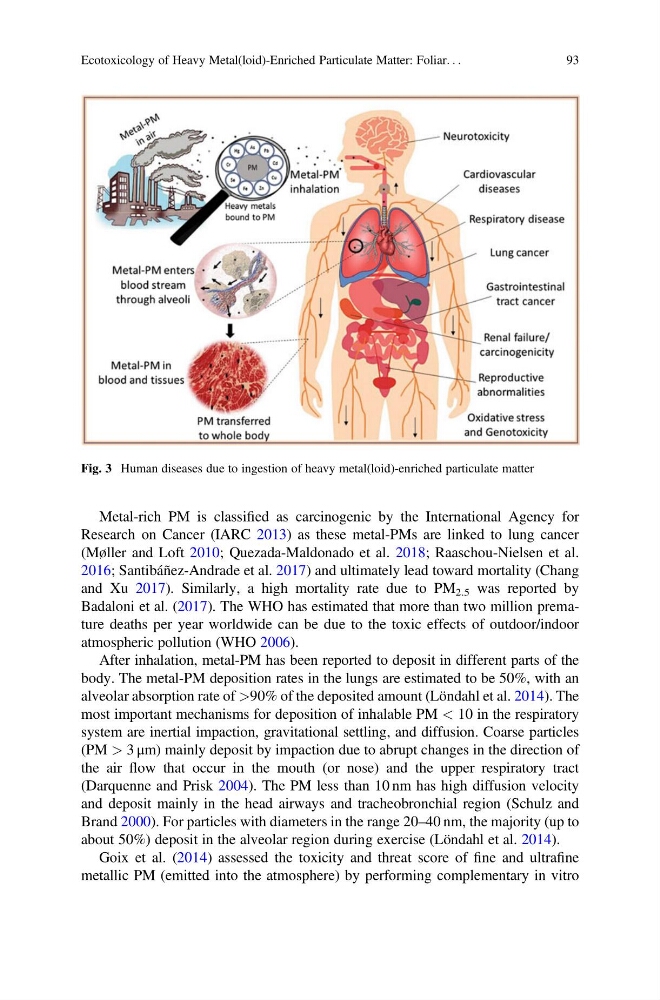
Metal-rich PM is classified as carcinogenic by the International Agency for
Research on Cancer (IARC 2013) as these metal-PMs are linked to lung cancer
(Møller and Loft 2010; Quezada-Maldonado et al. 2018; Raaschou-Nielsen et al.
2016; Santibáñez-Andrade et al. 2017) and ultimately lead toward mortality (Chang
and Xu 2017). Similarly, a high mortality rate due to PM 2.5 was reported by
Badaloni et al. (2017). The WHO has estimated that more than two million premature deaths per year worldwide can be due to the toxic effects of outdoor/indoor
atmospheric pollution (WHO 2006).
After inhalation, metal-PM has been reported to deposit in different parts of the
body. The metal-PM deposition rates in the lungs are estimated to be 50%, with an
alveolar absorption rate of >90% of the deposited amount (Löndahl et al. 2014). The
most important mechanisms for deposition of inhalable PM < 10 in the respiratory
system are inertial impaction, gravitational settling, and diffusion. Coarse particles
(PM > 3 μm) mainly deposit by impaction due to abrupt changes in the direction of
the air flow that occur in the mouth (or nose) and the upper respiratory tract
(Darquenne and Prisk 2004). The PM less than 10 nm has high diffusion velocity
and deposit mainly in the head airways and tracheobronchial region (Schulz and
Brand 2000). For particles with diameters in the range 20–40 nm, the majority (up to
about 50%) deposit in the alveolar region during exercise (Löndahl et al. 2014).
Goix et al. (2014) assessed the toxicity and threat score of fine and ultrafine
metallic PM (emitted into the atmosphere) by performing complementary in vitro
Fig. 3 Human diseases due to ingestion of heavy metal(loid)-enriched particulate matter
Ecotoxicology of Heavy Metal(loid)-Enriched Particulate Matter: Foliar. . .
93
Research on Cancer (IARC 2013) as these metal-PMs are linked to lung cancer
(Møller and Loft 2010; Quezada-Maldonado et al. 2018; Raaschou-Nielsen et al.
2016; Santibáñez-Andrade et al. 2017) and ultimately lead toward mortality (Chang
and Xu 2017). Similarly, a high mortality rate due to PM 2.5 was reported by
Badaloni et al. (2017). The WHO has estimated that more than two million premature deaths per year worldwide can be due to the toxic effects of outdoor/indoor
atmospheric pollution (WHO 2006).
After inhalation, metal-PM has been reported to deposit in different parts of the
body. The metal-PM deposition rates in the lungs are estimated to be 50%, with an
alveolar absorption rate of >90% of the deposited amount (Löndahl et al. 2014). The
most important mechanisms for deposition of inhalable PM < 10 in the respiratory
system are inertial impaction, gravitational settling, and diffusion. Coarse particles
(PM > 3 μm) mainly deposit by impaction due to abrupt changes in the direction of
the air flow that occur in the mouth (or nose) and the upper respiratory tract
(Darquenne and Prisk 2004). The PM less than 10 nm has high diffusion velocity
and deposit mainly in the head airways and tracheobronchial region (Schulz and
Brand 2000). For particles with diameters in the range 20–40 nm, the majority (up to
about 50%) deposit in the alveolar region during exercise (Löndahl et al. 2014).
Goix et al. (2014) assessed the toxicity and threat score of fine and ultrafine
metallic PM (emitted into the atmosphere) by performing complementary in vitro
Fig. 3 Human diseases due to ingestion of heavy metal(loid)-enriched particulate matter
Ecotoxicology of Heavy Metal(loid)-Enriched Particulate Matter: Foliar. . .
93