

70
aqueous complexes generating a local surface charge that can be negative, neutral,
or positive as a function of the solution pH, as illustrated in the Eq. 3.1.
M OH
OH
M OH H O
M O H O
pka
pka
−
−
−
2
2
2
1
2
+
≡
+
≡
+
−
−
(3.1)
The symbol ≡M indicates that the metal is attached to a solid surface. The chemical form of the surface groups in the metal oxyhydroxides depends strongly on the
solution pH and the chemical nature of the metal cation. A useful indicator for the
transition between a positive surface charge and a negative surface charge in a metal
oxyhydroxide is the pH of the point of zero charge. This is the pH at which the net
charge of the metal oxyhydroxides is zero. The point of zero charge of selected
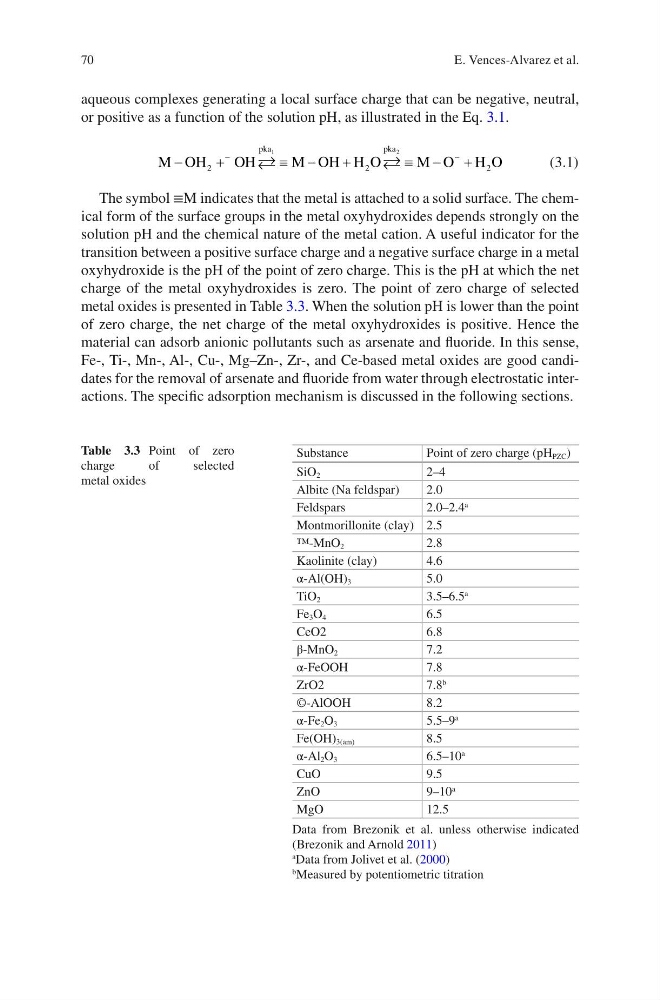
metal oxides is presented in Table 3.3. When the solution pH is lower than the point
of zero charge, the net charge of the metal oxyhydroxides is positive. Hence the
material can adsorb anionic pollutants such as arsenate and fluoride. In this sense,
Fe-, Ti-, Mn-, Al-, Cu-, Mg–Zn-, Zr-, and Ce-based metal oxides are good candidates for the removal of arsenate and fluoride from water through electrostatic interactions. The specific adsorption mechanism is discussed in the following sections.
Table 3.3 Point of zero
charge
of
selected
metal oxides
Substance
Point of zero charge (pH PZC )
SiO 2
2–4
Albite (Na feldspar)
2.0
Feldspars
2.0–2.4
a
Montmorillonite (clay) 2.5
™-MnO 2
2.8
Kaolinite (clay)
4.6
α-Al(OH) 3
5.0
TiO 2
3.5–6.5
a
Fe 3 O 4
6.5
CeO2
6.8
β-MnO 2
7.2
α-FeOOH
7.8
ZrO2
7.8
b
©-AlOOH
8.2
α-Fe 2 O 3
5.5–9
a
Fe(OH) 3(am)
8.5
α-Al 2 O 3
6.5–10
a
CuO
9.5
ZnO
9–10
a
MgO
12.5
Data from Brezonik et al. unless otherwise indicated
(Brezonik and Arnold 2011)
a
Data from Jolivet et al. (2000)
b Measured by potentiometric titration
E. Vences-Alvarez et al.
aqueous complexes generating a local surface charge that can be negative, neutral,
or positive as a function of the solution pH, as illustrated in the Eq. 3.1.
M OH
OH
M OH H O
M O H O
pka
pka
−
−
−
2
2
2
1
2
+
≡
+
≡
+
−
−
(3.1)
The symbol ≡M indicates that the metal is attached to a solid surface. The chemical form of the surface groups in the metal oxyhydroxides depends strongly on the
solution pH and the chemical nature of the metal cation. A useful indicator for the
transition between a positive surface charge and a negative surface charge in a metal
oxyhydroxide is the pH of the point of zero charge. This is the pH at which the net
charge of the metal oxyhydroxides is zero. The point of zero charge of selected
metal oxides is presented in Table 3.3. When the solution pH is lower than the point
of zero charge, the net charge of the metal oxyhydroxides is positive. Hence the
material can adsorb anionic pollutants such as arsenate and fluoride. In this sense,
Fe-, Ti-, Mn-, Al-, Cu-, Mg–Zn-, Zr-, and Ce-based metal oxides are good candidates for the removal of arsenate and fluoride from water through electrostatic interactions. The specific adsorption mechanism is discussed in the following sections.
Table 3.3 Point of zero
charge
of
selected
metal oxides
Substance
Point of zero charge (pH PZC )
SiO 2
2–4
Albite (Na feldspar)
2.0
Feldspars
2.0–2.4
a
Montmorillonite (clay) 2.5
™-MnO 2
2.8
Kaolinite (clay)
4.6
α-Al(OH) 3
5.0
TiO 2
3.5–6.5
a
Fe 3 O 4
6.5
CeO2
6.8
β-MnO 2
7.2
α-FeOOH
7.8
ZrO2
7.8
b
©-AlOOH
8.2
α-Fe 2 O 3
5.5–9
a
Fe(OH) 3(am)
8.5
α-Al 2 O 3
6.5–10
a
CuO
9.5
ZnO
9–10
a
MgO
12.5
Data from Brezonik et al. unless otherwise indicated
(Brezonik and Arnold 2011)
a
Data from Jolivet et al. (2000)
b Measured by potentiometric titration
E. Vences-Alvarez et al.