

71
Many of the chemical properties of the metal oxides depend on the crystallographic structure, related to atom arrangement, and the crystal habit which is the
characteristic external shape of a crystal group. Not all the crystalline planes offer
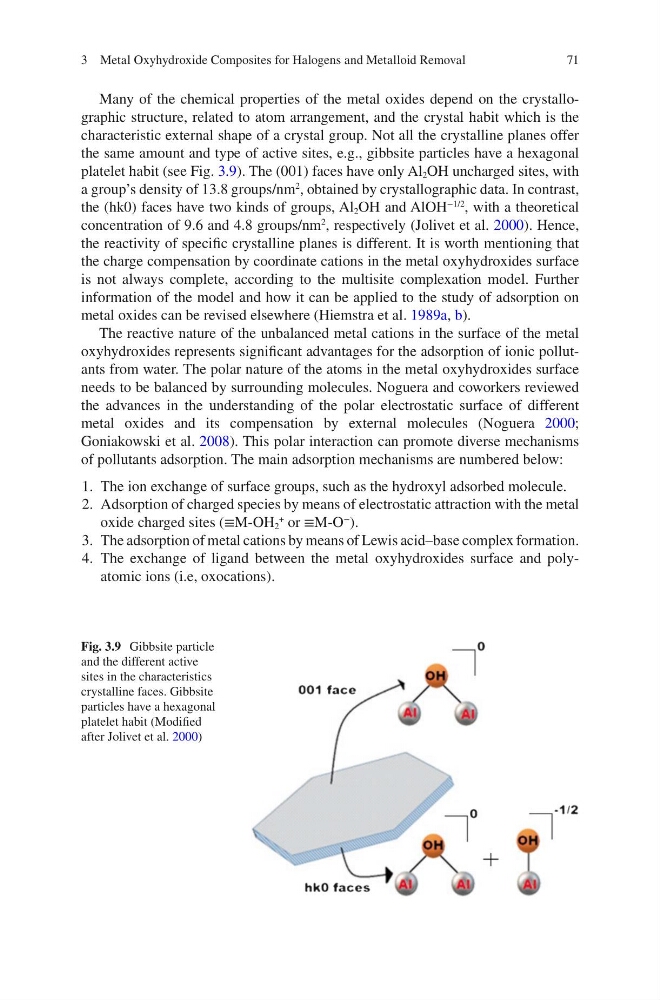
the same amount and type of active sites, e.g., gibbsite particles have a hexagonal
platelet habit (see Fig. 3.9). The (001) faces have only Al 2 OH uncharged sites, with
a group’s density of 13.8 groups/nm
2
, obtained by crystallographic data. In contrast,
the (hk0) faces have two kinds of groups, Al 2 OH and AlOH
−1/2
, with a theoretical
concentration of 9.6 and 4.8 groups/nm
2
, respectively (Jolivet et al. 2000). Hence,
the reactivity of specific crystalline planes is different. It is worth mentioning that
the charge compensation by coordinate cations in the metal oxyhydroxides surface
is not always complete, according to the multisite complexation model. Further
information of the model and how it can be applied to the study of adsorption on
metal oxides can be revised elsewhere (Hiemstra et al. 1989a, b).
The reactive nature of the unbalanced metal cations in the surface of the metal
oxyhydroxides represents significant advantages for the adsorption of ionic pollutants from water. The polar nature of the atoms in the metal oxyhydroxides surface
needs to be balanced by surrounding molecules. Noguera and coworkers reviewed
the advances in the understanding of the polar electrostatic surface of different
metal oxides and its compensation by external molecules (Noguera 2000;
Goniakowski et al. 2008). This polar interaction can promote diverse mechanisms
of pollutants adsorption. The main adsorption mechanisms are numbered below:
1. The ion exchange of surface groups, such as the hydroxyl adsorbed molecule.
2. Adsorption of charged species by means of electrostatic attraction with the metal
oxide charged sites (≡M-OH 2
+
or ≡M-O
−
).
3. The adsorption of metal cations by means of Lewis acid–base complex formation.
4. The exchange of ligand between the metal oxyhydroxides surface and polyatomic ions (i.e, oxocations).
Fig. 3.9 Gibbsite particle
and the different active
sites in the characteristics
crystalline faces. Gibbsite
particles have a hexagonal
platelet habit (Modified
after Jolivet et al. 2000)
3 Metal Oxyhydroxide Composites for Halogens and Metalloid Removal
Many of the chemical properties of the metal oxides depend on the crystallographic structure, related to atom arrangement, and the crystal habit which is the
characteristic external shape of a crystal group. Not all the crystalline planes offer
the same amount and type of active sites, e.g., gibbsite particles have a hexagonal
platelet habit (see Fig. 3.9). The (001) faces have only Al 2 OH uncharged sites, with
a group’s density of 13.8 groups/nm
2
, obtained by crystallographic data. In contrast,
the (hk0) faces have two kinds of groups, Al 2 OH and AlOH
−1/2
, with a theoretical
concentration of 9.6 and 4.8 groups/nm
2
, respectively (Jolivet et al. 2000). Hence,
the reactivity of specific crystalline planes is different. It is worth mentioning that
the charge compensation by coordinate cations in the metal oxyhydroxides surface
is not always complete, according to the multisite complexation model. Further
information of the model and how it can be applied to the study of adsorption on
metal oxides can be revised elsewhere (Hiemstra et al. 1989a, b).
The reactive nature of the unbalanced metal cations in the surface of the metal
oxyhydroxides represents significant advantages for the adsorption of ionic pollutants from water. The polar nature of the atoms in the metal oxyhydroxides surface
needs to be balanced by surrounding molecules. Noguera and coworkers reviewed
the advances in the understanding of the polar electrostatic surface of different
metal oxides and its compensation by external molecules (Noguera 2000;
Goniakowski et al. 2008). This polar interaction can promote diverse mechanisms
of pollutants adsorption. The main adsorption mechanisms are numbered below:
1. The ion exchange of surface groups, such as the hydroxyl adsorbed molecule.
2. Adsorption of charged species by means of electrostatic attraction with the metal
oxide charged sites (≡M-OH 2
+
or ≡M-O
−
).
3. The adsorption of metal cations by means of Lewis acid–base complex formation.
4. The exchange of ligand between the metal oxyhydroxides surface and polyatomic ions (i.e, oxocations).
Fig. 3.9 Gibbsite particle
and the different active
sites in the characteristics
crystalline faces. Gibbsite
particles have a hexagonal
platelet habit (Modified
after Jolivet et al. 2000)
3 Metal Oxyhydroxide Composites for Halogens and Metalloid Removal