

69
Finally, the majority of the current research in arsenic and fluorine adsorption is
directed towards the development of new adsorbent materials with advanced characteristics. High adsorption capacity or high selectivity is a valuable characteristic
presented by the new developed adsorbent materials. Particularly, the adsorbent
materials with the most elevated adsorption capacities of arsenic and fluorine are
based on metal oxyhydroxides (Jadhav et al. 2015), which is described in the following sections.
3.3 Metal Oxyhydroxides for Adsorption
The metal oxides are solid materials with a chemical structure formed by the alternation of metal cations and oxygen or hydroxide anions. The cohesion between the
metal and oxygen or hydroxide is achieved by electrostatic interactions that generate covalent bonds with different levels of cohesion depending on the metal electronegativity (Pawelec 2005). In the surface of the metal oxide, the coordination of the
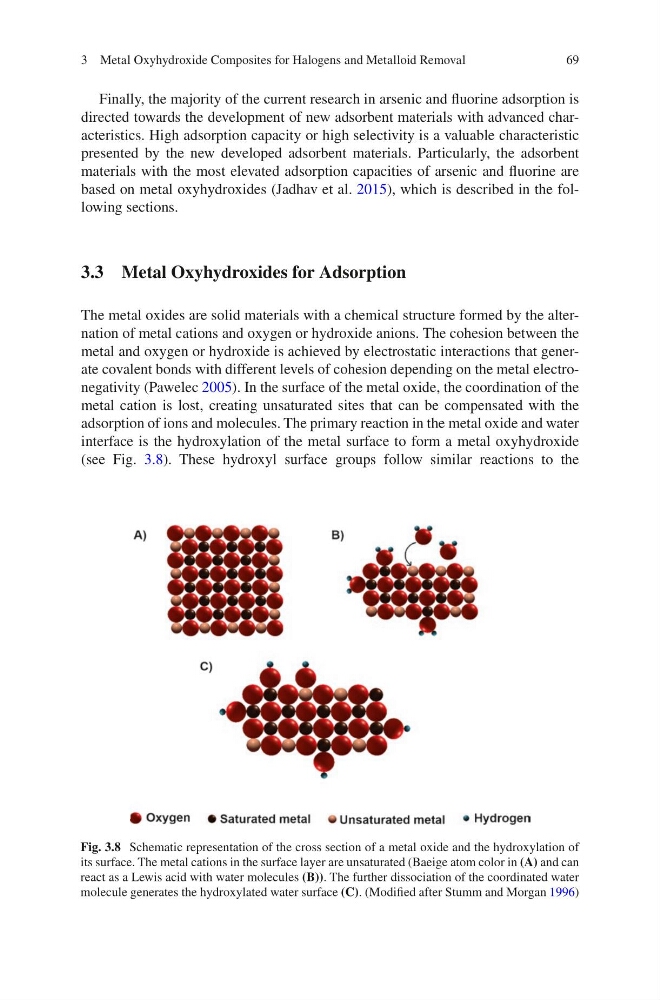
metal cation is lost, creating unsaturated sites that can be compensated with the
adsorption of ions and molecules. The primary reaction in the metal oxide and water
interface is the hydroxylation of the metal surface to form a metal oxyhydroxide
(see Fig. 3.8). These hydroxyl surface groups follow similar reactions to the
Fig. 3.8 Schematic representation of the cross section of a metal oxide and the hydroxylation of
its surface. The metal cations in the surface layer are unsaturated (Baeige atom color in (A) and can
react as a Lewis acid with water molecules (B)). The further dissociation of the coordinated water
molecule generates the hydroxylated water surface (C). (Modified after Stumm and Morgan 1996)
3 Metal Oxyhydroxide Composites for Halogens and Metalloid Removal
Finally, the majority of the current research in arsenic and fluorine adsorption is
directed towards the development of new adsorbent materials with advanced characteristics. High adsorption capacity or high selectivity is a valuable characteristic
presented by the new developed adsorbent materials. Particularly, the adsorbent
materials with the most elevated adsorption capacities of arsenic and fluorine are
based on metal oxyhydroxides (Jadhav et al. 2015), which is described in the following sections.
3.3 Metal Oxyhydroxides for Adsorption
The metal oxides are solid materials with a chemical structure formed by the alternation of metal cations and oxygen or hydroxide anions. The cohesion between the
metal and oxygen or hydroxide is achieved by electrostatic interactions that generate covalent bonds with different levels of cohesion depending on the metal electronegativity (Pawelec 2005). In the surface of the metal oxide, the coordination of the
metal cation is lost, creating unsaturated sites that can be compensated with the
adsorption of ions and molecules. The primary reaction in the metal oxide and water
interface is the hydroxylation of the metal surface to form a metal oxyhydroxide
(see Fig. 3.8). These hydroxyl surface groups follow similar reactions to the
Fig. 3.8 Schematic representation of the cross section of a metal oxide and the hydroxylation of
its surface. The metal cations in the surface layer are unsaturated (Baeige atom color in (A) and can
react as a Lewis acid with water molecules (B)). The further dissociation of the coordinated water
molecule generates the hydroxylated water surface (C). (Modified after Stumm and Morgan 1996)
3 Metal Oxyhydroxide Composites for Halogens and Metalloid Removal