

66
3.2.4 Adsorption
Adsorption is an interfacial process that involves the attachement of molecules from
a gaseous or liquid phase onto the surface of a solid (see Fig. 3.6). This atraction
between the molecules (also known as adsorbate) and the solid (known as adsorbent) is caused by different forces. The main attraction forces in the adsorption
process are van der Waals-like and columbic forces, polar interactions, and specific
bond formation. Both shorter range that are often repulsive and more extended
range that are often attractive forces are balanced when the adsorption equilibrium
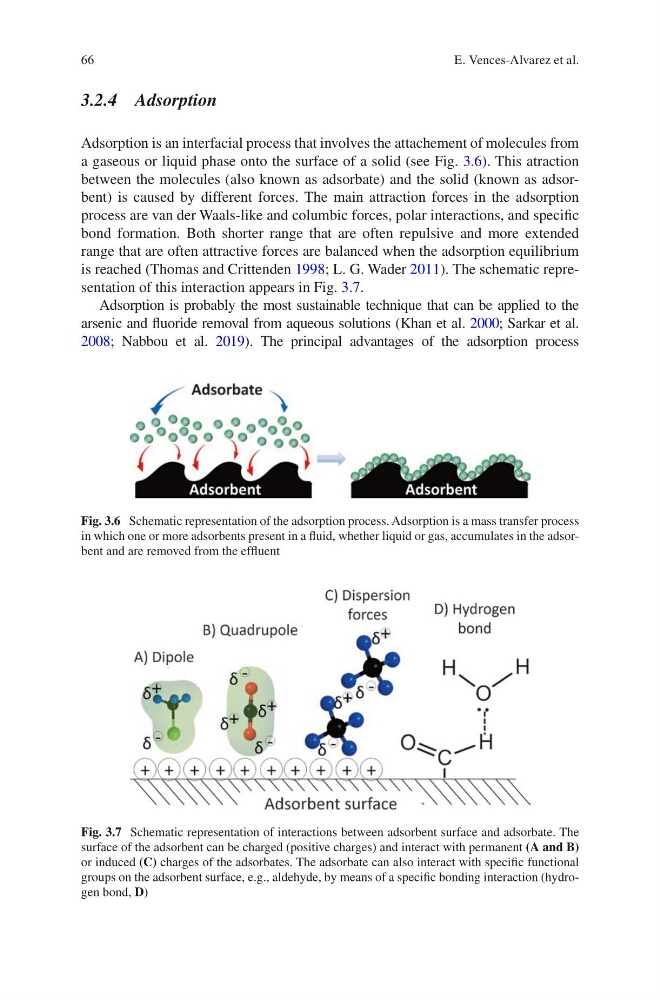
is reached (Thomas and Crittenden 1998; L. G. Wader 2011). The schematic representation of this interaction appears in Fig. 3.7.
Adsorption is probably the most sustainable technique that can be applied to the
arsenic and fluoride removal from aqueous solutions (Khan et al. 2000; Sarkar et al.
2008; Nabbou et al. 2019). The principal advantages of the adsorption process
Fig. 3.6 Schematic representation of the adsorption process. Adsorption is a mass transfer process
in which one or more adsorbents present in a fluid, whether liquid or gas, accumulates in the adsorbent and are removed from the effluent
Fig. 3.7 Schematic representation of interactions between adsorbent surface and adsorbate. The
surface of the adsorbent can be charged (positive charges) and interact with permanent (A and B)
or induced (C) charges of the adsorbates. The adsorbate can also interact with specific functional
groups on the adsorbent surface, e.g., aldehyde, by means of a specific bonding interaction (hydrogen bond, D)
E. Vences-Alvarez et al.
3.2.4 Adsorption
Adsorption is an interfacial process that involves the attachement of molecules from
a gaseous or liquid phase onto the surface of a solid (see Fig. 3.6). This atraction
between the molecules (also known as adsorbate) and the solid (known as adsorbent) is caused by different forces. The main attraction forces in the adsorption
process are van der Waals-like and columbic forces, polar interactions, and specific
bond formation. Both shorter range that are often repulsive and more extended
range that are often attractive forces are balanced when the adsorption equilibrium
is reached (Thomas and Crittenden 1998; L. G. Wader 2011). The schematic representation of this interaction appears in Fig. 3.7.
Adsorption is probably the most sustainable technique that can be applied to the
arsenic and fluoride removal from aqueous solutions (Khan et al. 2000; Sarkar et al.
2008; Nabbou et al. 2019). The principal advantages of the adsorption process
Fig. 3.6 Schematic representation of the adsorption process. Adsorption is a mass transfer process
in which one or more adsorbents present in a fluid, whether liquid or gas, accumulates in the adsorbent and are removed from the effluent
Fig. 3.7 Schematic representation of interactions between adsorbent surface and adsorbate. The
surface of the adsorbent can be charged (positive charges) and interact with permanent (A and B)
or induced (C) charges of the adsorbates. The adsorbate can also interact with specific functional
groups on the adsorbent surface, e.g., aldehyde, by means of a specific bonding interaction (hydrogen bond, D)
E. Vences-Alvarez et al.