

67
include the ability to remove the pollutants even at a very low concentration, low energy
consumption, and the availability of different adsorbent types (Ali 2012). Numerous
studies and reviews have reported the benefits of the adsorption process during arsenic
and fluoride removal (Bhatnagar et al. 2011; Gallegos-Garcia et al. 2012; VelazquezJimenez et al. 2015; Jadhav et al. 2015; Lata and Samadder 2016). This technology
offers satisfactory results at low cost with a simplicity of design and operation.
Adsorption is a highly efficient technique for arsenic removal due to its numerous advantages already mentioned, which also include relatively high arsenic
removal efficiencies (Singh and Pant 2004; Mohan and Pittman 2007). However,
arsenic adsorption capacity strongly depends on the concentration and pH of the
system. The pH of the solution changes the predominant chemical species in water.
At the same time, pH alters the activity of functional groups on the surface of adsorbents. According to the study conducted by Lenoble et al. (2002), arsenate adsorption is favored at low pH, whereas at pH between 4 and 9, maximum arsenite
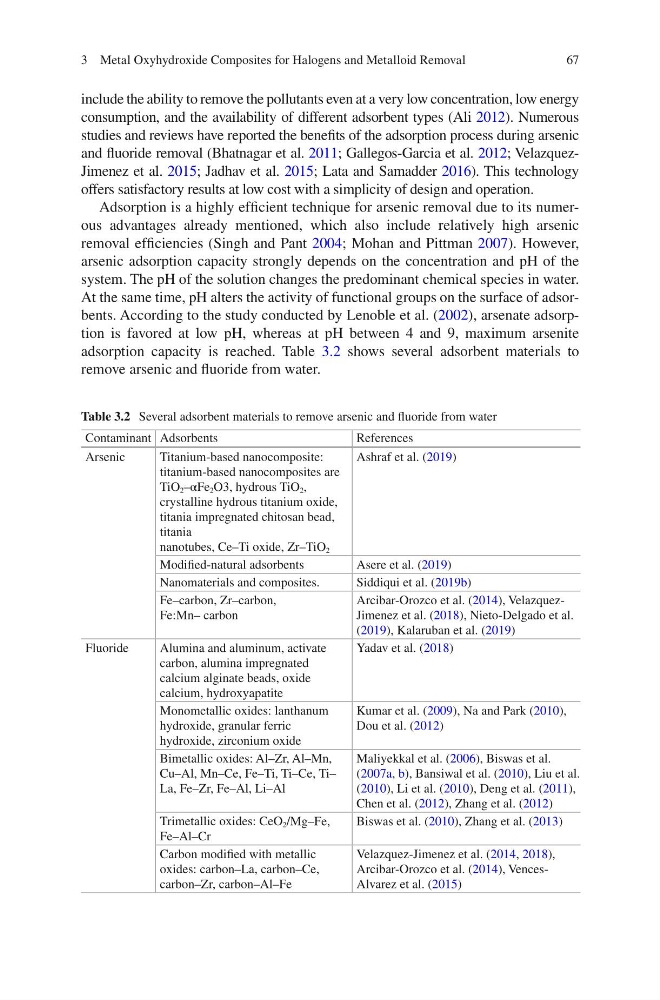
adsorption capacity is reached. Table 3.2 shows several adsorbent materials to
remove arsenic and fluoride from water.
Table 3.2 Several adsorbent materials to remove arsenic and fluoride from water
Contaminant Adsorbents
References
Arsenic
Titanium-based nanocomposite:
titanium-based nanocomposites are
TiO 2 –αFe 2 O3, hydrous TiO 2 ,
crystalline hydrous titanium oxide,
titania impregnated chitosan bead,
titania
nanotubes, Ce–Ti oxide, Zr–TiO 2
Ashraf et al. (2019)
Modified-natural adsorbents
Asere et al. (2019)
Nanomaterials and composites.
Siddiqui et al. (2019b)
Fe–carbon, Zr–carbon,
Fe:Mn– carbon
Arcibar-Orozco et al. (2014), VelazquezJimenez et al. (2018), Nieto-Delgado et al.
(2019), Kalaruban et al. (2019)
Fluoride
Alumina and aluminum, activate
carbon, alumina impregnated
calcium alginate beads, oxide
calcium, hydroxyapatite
Yadav et al. (2018)
Monometallic oxides: lanthanum
hydroxide, granular ferric
hydroxide, zirconium oxide
Kumar et al. (2009), Na and Park (2010),
Dou et al. (2012)
Bimetallic oxides: Al–Zr, Al–Mn,
Cu–Al, Mn–Ce, Fe–Ti, Ti–Ce, Ti–
La, Fe–Zr, Fe–Al, Li–Al
Maliyekkal et al. (2006), Biswas et al.
(2007a, b), Bansiwal et al. (2010), Liu et al.
(2010), Li et al. (2010), Deng et al. (2011),
Chen et al. (2012), Zhang et al. (2012)
Trimetallic oxides: CeO 2 /Mg–Fe,
Fe–Al–Cr
Biswas et al. (2010), Zhang et al. (2013)
Carbon modified with metallic
oxides: carbon–La, carbon–Ce,
carbon–Zr, carbon–Al–Fe
Velazquez-Jimenez et al. (2014, 2018),
Arcibar-Orozco et al. (2014), VencesAlvarez et al. (2015)
3 Metal Oxyhydroxide Composites for Halogens and Metalloid Removal
include the ability to remove the pollutants even at a very low concentration, low energy
consumption, and the availability of different adsorbent types (Ali 2012). Numerous
studies and reviews have reported the benefits of the adsorption process during arsenic
and fluoride removal (Bhatnagar et al. 2011; Gallegos-Garcia et al. 2012; VelazquezJimenez et al. 2015; Jadhav et al. 2015; Lata and Samadder 2016). This technology
offers satisfactory results at low cost with a simplicity of design and operation.
Adsorption is a highly efficient technique for arsenic removal due to its numerous advantages already mentioned, which also include relatively high arsenic
removal efficiencies (Singh and Pant 2004; Mohan and Pittman 2007). However,
arsenic adsorption capacity strongly depends on the concentration and pH of the
system. The pH of the solution changes the predominant chemical species in water.
At the same time, pH alters the activity of functional groups on the surface of adsorbents. According to the study conducted by Lenoble et al. (2002), arsenate adsorption is favored at low pH, whereas at pH between 4 and 9, maximum arsenite
adsorption capacity is reached. Table 3.2 shows several adsorbent materials to
remove arsenic and fluoride from water.
Table 3.2 Several adsorbent materials to remove arsenic and fluoride from water
Contaminant Adsorbents
References
Arsenic
Titanium-based nanocomposite:
titanium-based nanocomposites are
TiO 2 –αFe 2 O3, hydrous TiO 2 ,
crystalline hydrous titanium oxide,
titania impregnated chitosan bead,
titania
nanotubes, Ce–Ti oxide, Zr–TiO 2
Ashraf et al. (2019)
Modified-natural adsorbents
Asere et al. (2019)
Nanomaterials and composites.
Siddiqui et al. (2019b)
Fe–carbon, Zr–carbon,
Fe:Mn– carbon
Arcibar-Orozco et al. (2014), VelazquezJimenez et al. (2018), Nieto-Delgado et al.
(2019), Kalaruban et al. (2019)
Fluoride
Alumina and aluminum, activate
carbon, alumina impregnated
calcium alginate beads, oxide
calcium, hydroxyapatite
Yadav et al. (2018)
Monometallic oxides: lanthanum
hydroxide, granular ferric
hydroxide, zirconium oxide
Kumar et al. (2009), Na and Park (2010),
Dou et al. (2012)
Bimetallic oxides: Al–Zr, Al–Mn,
Cu–Al, Mn–Ce, Fe–Ti, Ti–Ce, Ti–
La, Fe–Zr, Fe–Al, Li–Al
Maliyekkal et al. (2006), Biswas et al.
(2007a, b), Bansiwal et al. (2010), Liu et al.
(2010), Li et al. (2010), Deng et al. (2011),
Chen et al. (2012), Zhang et al. (2012)
Trimetallic oxides: CeO 2 /Mg–Fe,
Fe–Al–Cr
Biswas et al. (2010), Zhang et al. (2013)
Carbon modified with metallic
oxides: carbon–La, carbon–Ce,
carbon–Zr, carbon–Al–Fe
Velazquez-Jimenez et al. (2014, 2018),
Arcibar-Orozco et al. (2014), VencesAlvarez et al. (2015)
3 Metal Oxyhydroxide Composites for Halogens and Metalloid Removal