

65
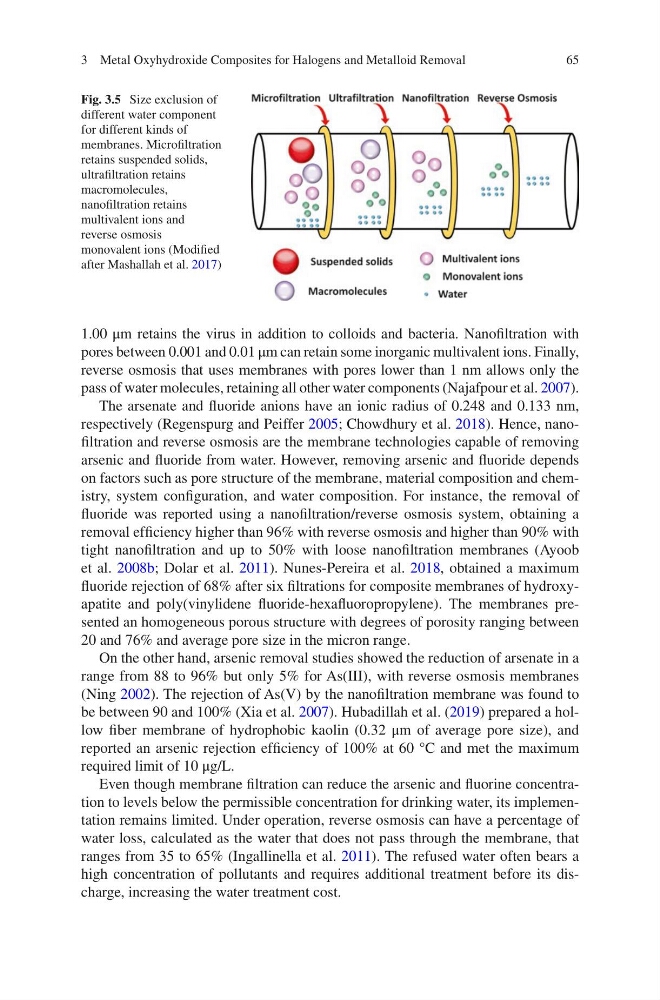
1.00 μm retains the virus in addition to colloids and bacteria. Nanofiltration with
pores between 0.001 and 0.01 μm can retain some inorganic multivalent ions. Finally,
reverse osmosis that uses membranes with pores lower than 1 nm allows only the
pass of water molecules, retaining all other water components (Najafpour et al. 2007).
The arsenate and fluoride anions have an ionic radius of 0.248 and 0.133 nm,
respectively (Regenspurg and Peiffer 2005; Chowdhury et al. 2018). Hence, nanofiltration and reverse osmosis are the membrane technologies capable of removing
arsenic and fluoride from water. However, removing arsenic and fluoride depends
on factors such as pore structure of the membrane, material composition and chemistry, system configuration, and water composition. For instance, the removal of
fluoride was reported using a nanofiltration/reverse osmosis system, obtaining a
removal efficiency higher than 96% with reverse osmosis and higher than 90% with
tight nanofiltration and up to 50% with loose nanofiltration membranes (Ayoob
et al. 2008b; Dolar et al. 2011). Nunes-Pereira et al. 2018, obtained a maximum
fluoride rejection of 68% after six filtrations for composite membranes of hydroxyapatite and poly(vinylidene fluoride-hexafluoropropylene). The membranes presented an homogeneous porous structure with degrees of porosity ranging between
20 and 76% and average pore size in the micron range.
On the other hand, arsenic removal studies showed the reduction of arsenate in a
range from 88 to 96% but only 5% for As(III), with reverse osmosis membranes
(Ning 2002). The rejection of As(V) by the nanofiltration membrane was found to
be between 90 and 100% (Xia et al. 2007). Hubadillah et al. (2019) prepared a hollow fiber membrane of hydrophobic kaolin (0.32 μm of average pore size), and
reported an arsenic rejection efficiency of 100% at 60 °C and met the maximum
required limit of 10 μg/L.
Even though membrane filtration can reduce the arsenic and fluorine concentration to levels below the permissible concentration for drinking water, its implementation remains limited. Under operation, reverse osmosis can have a percentage of
water loss, calculated as the water that does not pass through the membrane, that
ranges from 35 to 65% (Ingallinella et al. 2011). The refused water often bears a
high concentration of pollutants and requires additional treatment before its discharge, increasing the water treatment cost.
Fig. 3.5 Size exclusion of
different water component
for different kinds of
membranes. Microfiltration
retains suspended solids,
ultrafiltration retains
macromolecules,
nanofiltration retains
multivalent ions and
reverse osmosis
monovalent ions (Modified
after Mashallah et al. 2017)
3 Metal Oxyhydroxide Composites for Halogens and Metalloid Removal
1.00 μm retains the virus in addition to colloids and bacteria. Nanofiltration with
pores between 0.001 and 0.01 μm can retain some inorganic multivalent ions. Finally,
reverse osmosis that uses membranes with pores lower than 1 nm allows only the
pass of water molecules, retaining all other water components (Najafpour et al. 2007).
The arsenate and fluoride anions have an ionic radius of 0.248 and 0.133 nm,
respectively (Regenspurg and Peiffer 2005; Chowdhury et al. 2018). Hence, nanofiltration and reverse osmosis are the membrane technologies capable of removing
arsenic and fluoride from water. However, removing arsenic and fluoride depends
on factors such as pore structure of the membrane, material composition and chemistry, system configuration, and water composition. For instance, the removal of
fluoride was reported using a nanofiltration/reverse osmosis system, obtaining a
removal efficiency higher than 96% with reverse osmosis and higher than 90% with
tight nanofiltration and up to 50% with loose nanofiltration membranes (Ayoob
et al. 2008b; Dolar et al. 2011). Nunes-Pereira et al. 2018, obtained a maximum
fluoride rejection of 68% after six filtrations for composite membranes of hydroxyapatite and poly(vinylidene fluoride-hexafluoropropylene). The membranes presented an homogeneous porous structure with degrees of porosity ranging between
20 and 76% and average pore size in the micron range.
On the other hand, arsenic removal studies showed the reduction of arsenate in a
range from 88 to 96% but only 5% for As(III), with reverse osmosis membranes
(Ning 2002). The rejection of As(V) by the nanofiltration membrane was found to
be between 90 and 100% (Xia et al. 2007). Hubadillah et al. (2019) prepared a hollow fiber membrane of hydrophobic kaolin (0.32 μm of average pore size), and
reported an arsenic rejection efficiency of 100% at 60 °C and met the maximum
required limit of 10 μg/L.
Even though membrane filtration can reduce the arsenic and fluorine concentration to levels below the permissible concentration for drinking water, its implementation remains limited. Under operation, reverse osmosis can have a percentage of
water loss, calculated as the water that does not pass through the membrane, that
ranges from 35 to 65% (Ingallinella et al. 2011). The refused water often bears a
high concentration of pollutants and requires additional treatment before its discharge, increasing the water treatment cost.
Fig. 3.5 Size exclusion of
different water component
for different kinds of
membranes. Microfiltration
retains suspended solids,
ultrafiltration retains
macromolecules,
nanofiltration retains
multivalent ions and
reverse osmosis
monovalent ions (Modified
after Mashallah et al. 2017)
3 Metal Oxyhydroxide Composites for Halogens and Metalloid Removal