

64
Al
3+
or La
3+
in a low-valence zeolite site such as Na
+
site, the surface of the modified
zeolite acquires a positive charge and is able to remove fluoride from water (Onyango
et al. 2004). Regarding to polymeric resins, zirconium and alum have been successfully incorporated into the polymer matrix to generate hybrid resins (Pan et al. 2013;
Viswanathan and Meenakshi 2009). For example, the commercial resin (FR 10)
with Na
+
and Al
3+
increased the fluoride adsorption significantly to capacities around
450 mg F
−
/kg. Despite the efficiency of the ion-exchange resins for the removal of
arsenic and fluoride from water, the material cost and the disposition or regeneration
of exhausted resins make its application difficult. The economic factor is something
to take into consideration since most of the population exposed to arsenic and fluorine polluted water belongs to marginalized communities.
3.2.3 Membrane Filtration
Membrane filtration is a technology in which the water pollutants are removed from
water utilizing the size exclusion provided by a semipermeable thin layer of polymer,
known as membrane (Singh 2015). The membrane filtration is classified by the average pore size of the membrane, and hence, this establishes the pollutants that could
retain (Fig. 3.5). Microfiltration with a pore size between 0.1 and 1.0 μm is capable
of retaining colloids and bacteria. Ultrafiltration with a pore size between 0.01 and
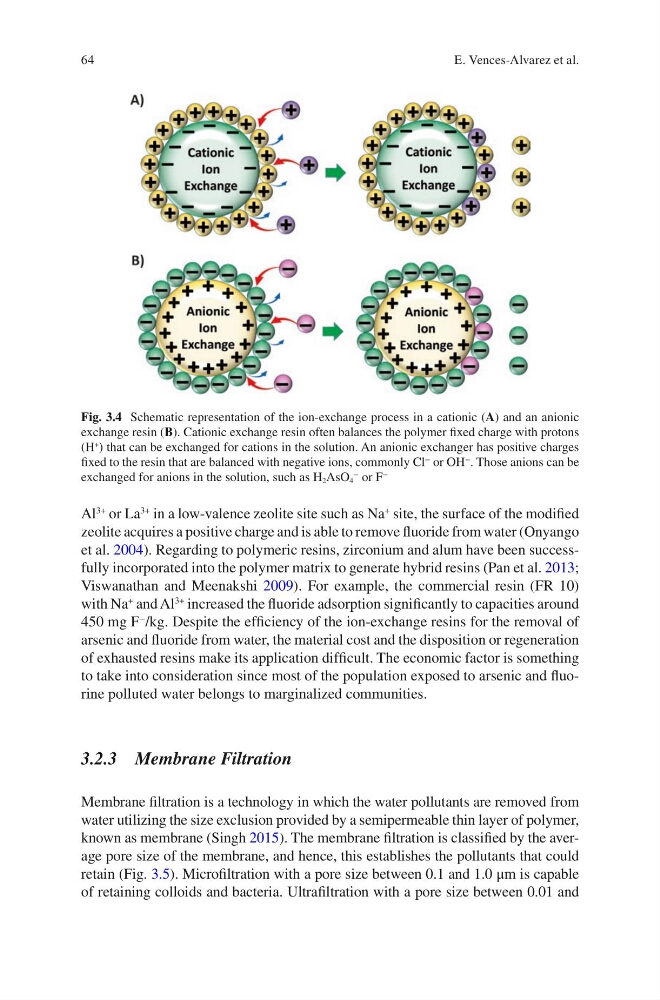
Fig. 3.4 Schematic representation of the ion-exchange process in a cationic (A) and an anionic
exchange resin (B). Cationic exchange resin often balances the polymer fixed charge with protons
(H
+ ) that can be exchanged for cations in the solution. An anionic exchanger has positive charges
fixed to the resin that are balanced with negative ions, commonly Cl
− or OH
−
. Those anions can be
exchanged for anions in the solution, such as H 2 AsO 4
− or F
−
E. Vences-Alvarez et al.
Al
3+
or La
3+
in a low-valence zeolite site such as Na
+
site, the surface of the modified
zeolite acquires a positive charge and is able to remove fluoride from water (Onyango
et al. 2004). Regarding to polymeric resins, zirconium and alum have been successfully incorporated into the polymer matrix to generate hybrid resins (Pan et al. 2013;
Viswanathan and Meenakshi 2009). For example, the commercial resin (FR 10)
with Na
+
and Al
3+
increased the fluoride adsorption significantly to capacities around
450 mg F
−
/kg. Despite the efficiency of the ion-exchange resins for the removal of
arsenic and fluoride from water, the material cost and the disposition or regeneration
of exhausted resins make its application difficult. The economic factor is something
to take into consideration since most of the population exposed to arsenic and fluorine polluted water belongs to marginalized communities.
3.2.3 Membrane Filtration
Membrane filtration is a technology in which the water pollutants are removed from
water utilizing the size exclusion provided by a semipermeable thin layer of polymer,
known as membrane (Singh 2015). The membrane filtration is classified by the average pore size of the membrane, and hence, this establishes the pollutants that could
retain (Fig. 3.5). Microfiltration with a pore size between 0.1 and 1.0 μm is capable
of retaining colloids and bacteria. Ultrafiltration with a pore size between 0.01 and
Fig. 3.4 Schematic representation of the ion-exchange process in a cationic (A) and an anionic
exchange resin (B). Cationic exchange resin often balances the polymer fixed charge with protons
(H
+ ) that can be exchanged for cations in the solution. An anionic exchanger has positive charges
fixed to the resin that are balanced with negative ions, commonly Cl
− or OH
−
. Those anions can be
exchanged for anions in the solution, such as H 2 AsO 4
− or F
−
E. Vences-Alvarez et al.