

422
In general, the adsorbents should have the following characteristics (Mahfoudhi
and Boufi 2017): (1) inexpensive, (2) good mechanical and structural properties to
overcome the flow of water for a long period of time, (3) high surface area, (4) high
adsorption capacities at high rates, and (5) easy recoverability and regeneration
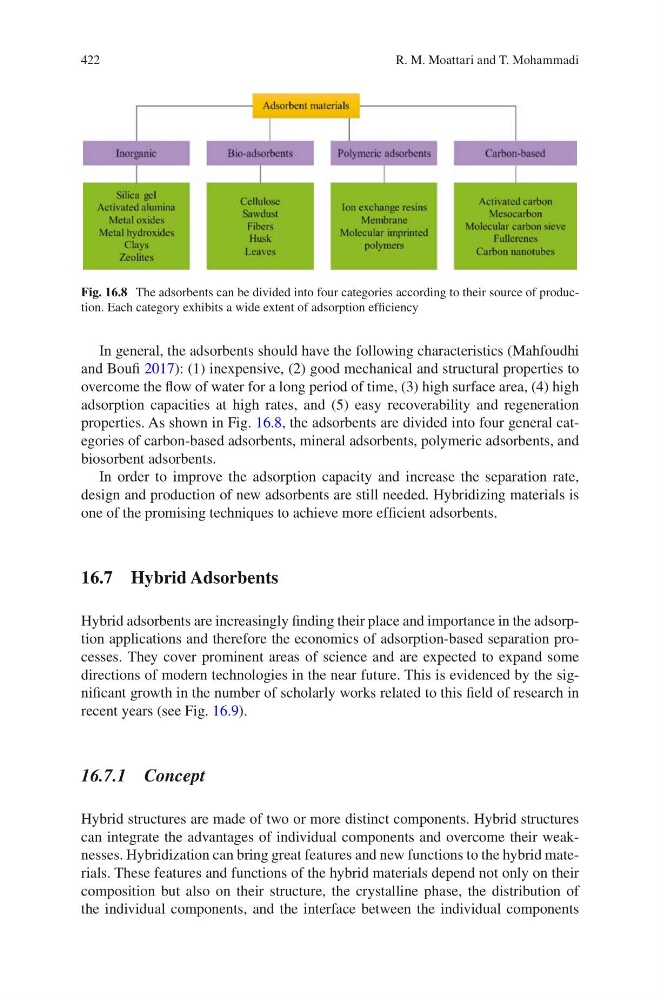
properties. As shown in Fig. 16.8, the adsorbents are divided into four general categories of carbon-based adsorbents, mineral adsorbents, polymeric adsorbents, and
biosorbent adsorbents.
In order to improve the adsorption capacity and increase the separation rate,
design and production of new adsorbents are still needed. Hybridizing materials is
one of the promising techniques to achieve more efficient adsorbents.
16.7 Hybrid Adsorbents
Hybrid adsorbents are increasingly finding their place and importance in the adsorption applications and therefore the economics of adsorption-based separation processes. They cover prominent areas of science and are expected to expand some
directions of modern technologies in the near future. This is evidenced by the significant growth in the number of scholarly works related to this field of research in
recent years (see Fig. 16.9).
16.7.1 Concept
Hybrid structures are made of two or more distinct components. Hybrid structures
can integrate the advantages of individual components and overcome their weaknesses. Hybridization can bring great features and new functions to the hybrid materials. These features and functions of the hybrid materials depend not only on their
composition but also on their structure, the crystalline phase, the distribution of
the individual components, and the interface between the individual components
Fig. 16.8 The adsorbents can be divided into four categories according to their source of production. Each category exhibits a wide extent of adsorption efficiency
R. M. Moattari and T. Mohammadi
In general, the adsorbents should have the following characteristics (Mahfoudhi
and Boufi 2017): (1) inexpensive, (2) good mechanical and structural properties to
overcome the flow of water for a long period of time, (3) high surface area, (4) high
adsorption capacities at high rates, and (5) easy recoverability and regeneration
properties. As shown in Fig. 16.8, the adsorbents are divided into four general categories of carbon-based adsorbents, mineral adsorbents, polymeric adsorbents, and
biosorbent adsorbents.
In order to improve the adsorption capacity and increase the separation rate,
design and production of new adsorbents are still needed. Hybridizing materials is
one of the promising techniques to achieve more efficient adsorbents.
16.7 Hybrid Adsorbents
Hybrid adsorbents are increasingly finding their place and importance in the adsorption applications and therefore the economics of adsorption-based separation processes. They cover prominent areas of science and are expected to expand some
directions of modern technologies in the near future. This is evidenced by the significant growth in the number of scholarly works related to this field of research in
recent years (see Fig. 16.9).
16.7.1 Concept
Hybrid structures are made of two or more distinct components. Hybrid structures
can integrate the advantages of individual components and overcome their weaknesses. Hybridization can bring great features and new functions to the hybrid materials. These features and functions of the hybrid materials depend not only on their
composition but also on their structure, the crystalline phase, the distribution of
the individual components, and the interface between the individual components
Fig. 16.8 The adsorbents can be divided into four categories according to their source of production. Each category exhibits a wide extent of adsorption efficiency
R. M. Moattari and T. Mohammadi