

421
Particle size and agglomeration have direct effects on the specific surface area of
the adsorbent. The agglomeration of particles can reduce the specific surface area of
the adsorbent and therefore minimize the active sites. An appropriate surface chemistry can promote the adsorption mechanism. All these factors can be controlled
through the adsorbent synthesis process.
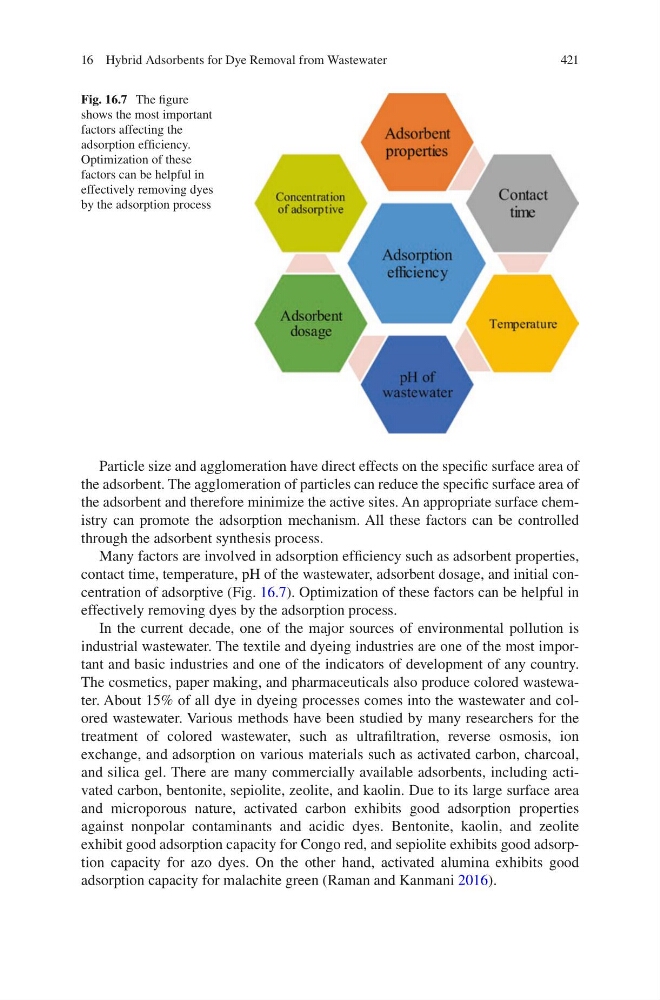
Many factors are involved in adsorption efficiency such as adsorbent properties,
contact time, temperature, pH of the wastewater, adsorbent dosage, and initial concentration of adsorptive (Fig. 16.7). Optimization of these factors can be helpful in
effectively removing dyes by the adsorption process.
In the current decade, one of the major sources of environmental pollution is
industrial wastewater. The textile and dyeing industries are one of the most important and basic industries and one of the indicators of development of any country.
The cosmetics, paper making, and pharmaceuticals also produce colored wastewater. About 15% of all dye in dyeing processes comes into the wastewater and colored wastewater. Various methods have been studied by many researchers for the
treatment of colored wastewater, such as ultrafiltration, reverse osmosis, ion
exchange, and adsorption on various materials such as activated carbon, charcoal,
and silica gel. There are many commercially available adsorbents, including activated carbon, bentonite, sepiolite, zeolite, and kaolin. Due to its large surface area
and microporous nature, activated carbon exhibits good adsorption properties
against nonpolar contaminants and acidic dyes. Bentonite, kaolin, and zeolite
exhibit good adsorption capacity for Congo red, and sepiolite exhibits good adsorption capacity for azo dyes. On the other hand, activated alumina exhibits good
adsorption capacity for malachite green (Raman and Kanmani 2016).
Fig. 16.7 The figure
shows the most important
factors affecting the
adsorption efficiency.
Optimization of these
factors can be helpful in
effectively removing dyes
by the adsorption process
16 Hybrid Adsorbents for Dye Removal from Wastewater
Particle size and agglomeration have direct effects on the specific surface area of
the adsorbent. The agglomeration of particles can reduce the specific surface area of
the adsorbent and therefore minimize the active sites. An appropriate surface chemistry can promote the adsorption mechanism. All these factors can be controlled
through the adsorbent synthesis process.
Many factors are involved in adsorption efficiency such as adsorbent properties,
contact time, temperature, pH of the wastewater, adsorbent dosage, and initial concentration of adsorptive (Fig. 16.7). Optimization of these factors can be helpful in
effectively removing dyes by the adsorption process.
In the current decade, one of the major sources of environmental pollution is
industrial wastewater. The textile and dyeing industries are one of the most important and basic industries and one of the indicators of development of any country.
The cosmetics, paper making, and pharmaceuticals also produce colored wastewater. About 15% of all dye in dyeing processes comes into the wastewater and colored wastewater. Various methods have been studied by many researchers for the
treatment of colored wastewater, such as ultrafiltration, reverse osmosis, ion
exchange, and adsorption on various materials such as activated carbon, charcoal,
and silica gel. There are many commercially available adsorbents, including activated carbon, bentonite, sepiolite, zeolite, and kaolin. Due to its large surface area
and microporous nature, activated carbon exhibits good adsorption properties
against nonpolar contaminants and acidic dyes. Bentonite, kaolin, and zeolite
exhibit good adsorption capacity for Congo red, and sepiolite exhibits good adsorption capacity for azo dyes. On the other hand, activated alumina exhibits good
adsorption capacity for malachite green (Raman and Kanmani 2016).
Fig. 16.7 The figure
shows the most important
factors affecting the
adsorption efficiency.
Optimization of these
factors can be helpful in
effectively removing dyes
by the adsorption process
16 Hybrid Adsorbents for Dye Removal from Wastewater