

414
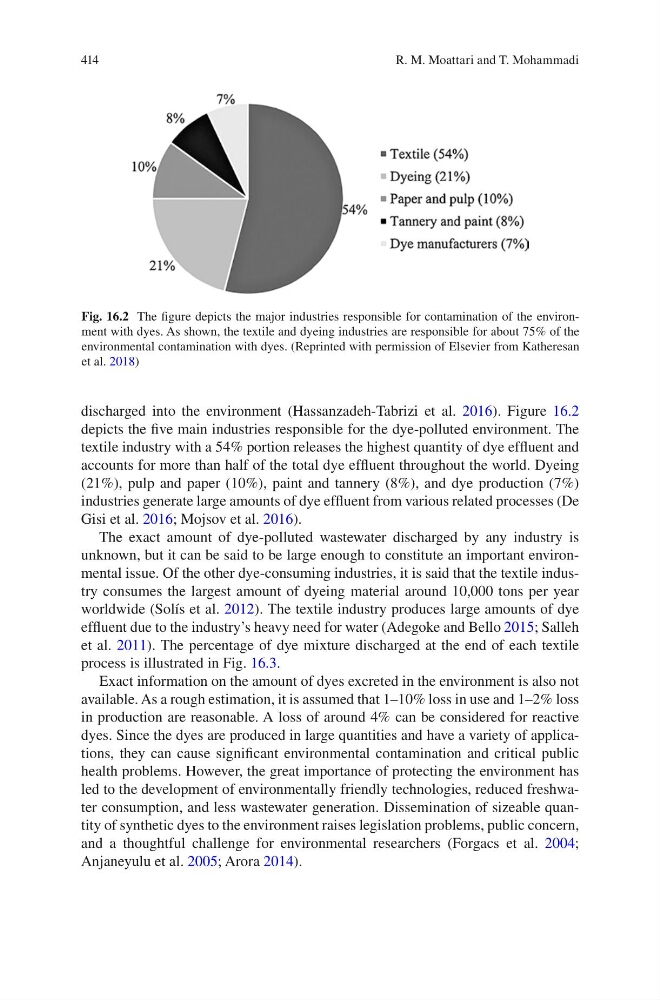
discharged into the environment (Hassanzadeh-Tabrizi et al. 2016). Figure 16.2
depicts the five main industries responsible for the dye-polluted environment. The
textile industry with a 54% portion releases the highest quantity of dye effluent and
accounts for more than half of the total dye effluent throughout the world. Dyeing
(21%), pulp and paper (10%), paint and tannery (8%), and dye production (7%)
industries generate large amounts of dye effluent from various related processes (De
Gisi et al. 2016; Mojsov et al. 2016).
The exact amount of dye-polluted wastewater discharged by any industry is
unknown, but it can be said to be large enough to constitute an important environmental issue. Of the other dye-consuming industries, it is said that the textile industry consumes the largest amount of dyeing material around 10,000 tons per year
worldwide (Solís et al. 2012). The textile industry produces large amounts of dye
effluent due to the industry’s heavy need for water (Adegoke and Bello 2015; Salleh
et al. 2011). The percentage of dye mixture discharged at the end of each textile
process is illustrated in Fig. 16.3.
Exact information on the amount of dyes excreted in the environment is also not
available. As a rough estimation, it is assumed that 1–10% loss in use and 1–2% loss
in production are reasonable. A loss of around 4% can be considered for reactive
dyes. Since the dyes are produced in large quantities and have a variety of applications, they can cause significant environmental contamination and critical public
health problems. However, the great importance of protecting the environment has
led to the development of environmentally friendly technologies, reduced freshwater consumption, and less wastewater generation. Dissemination of sizeable quantity of synthetic dyes to the environment raises legislation problems, public concern,
and a thoughtful challenge for environmental researchers (Forgacs et al. 2004;
Anjaneyulu et al. 2005; Arora 2014).
Fig. 16.2 The figure depicts the major industries responsible for contamination of the environment with dyes. As shown, the textile and dyeing industries are responsible for about 75% of the
environmental contamination with dyes. (Reprinted with permission of Elsevier from Katheresan
et al. 2018)
R. M. Moattari and T. Mohammadi
discharged into the environment (Hassanzadeh-Tabrizi et al. 2016). Figure 16.2
depicts the five main industries responsible for the dye-polluted environment. The
textile industry with a 54% portion releases the highest quantity of dye effluent and
accounts for more than half of the total dye effluent throughout the world. Dyeing
(21%), pulp and paper (10%), paint and tannery (8%), and dye production (7%)
industries generate large amounts of dye effluent from various related processes (De
Gisi et al. 2016; Mojsov et al. 2016).
The exact amount of dye-polluted wastewater discharged by any industry is
unknown, but it can be said to be large enough to constitute an important environmental issue. Of the other dye-consuming industries, it is said that the textile industry consumes the largest amount of dyeing material around 10,000 tons per year
worldwide (Solís et al. 2012). The textile industry produces large amounts of dye
effluent due to the industry’s heavy need for water (Adegoke and Bello 2015; Salleh
et al. 2011). The percentage of dye mixture discharged at the end of each textile
process is illustrated in Fig. 16.3.
Exact information on the amount of dyes excreted in the environment is also not
available. As a rough estimation, it is assumed that 1–10% loss in use and 1–2% loss
in production are reasonable. A loss of around 4% can be considered for reactive
dyes. Since the dyes are produced in large quantities and have a variety of applications, they can cause significant environmental contamination and critical public
health problems. However, the great importance of protecting the environment has
led to the development of environmentally friendly technologies, reduced freshwater consumption, and less wastewater generation. Dissemination of sizeable quantity of synthetic dyes to the environment raises legislation problems, public concern,
and a thoughtful challenge for environmental researchers (Forgacs et al. 2004;
Anjaneyulu et al. 2005; Arora 2014).
Fig. 16.2 The figure depicts the major industries responsible for contamination of the environment with dyes. As shown, the textile and dyeing industries are responsible for about 75% of the
environmental contamination with dyes. (Reprinted with permission of Elsevier from Katheresan
et al. 2018)
R. M. Moattari and T. Mohammadi