

412
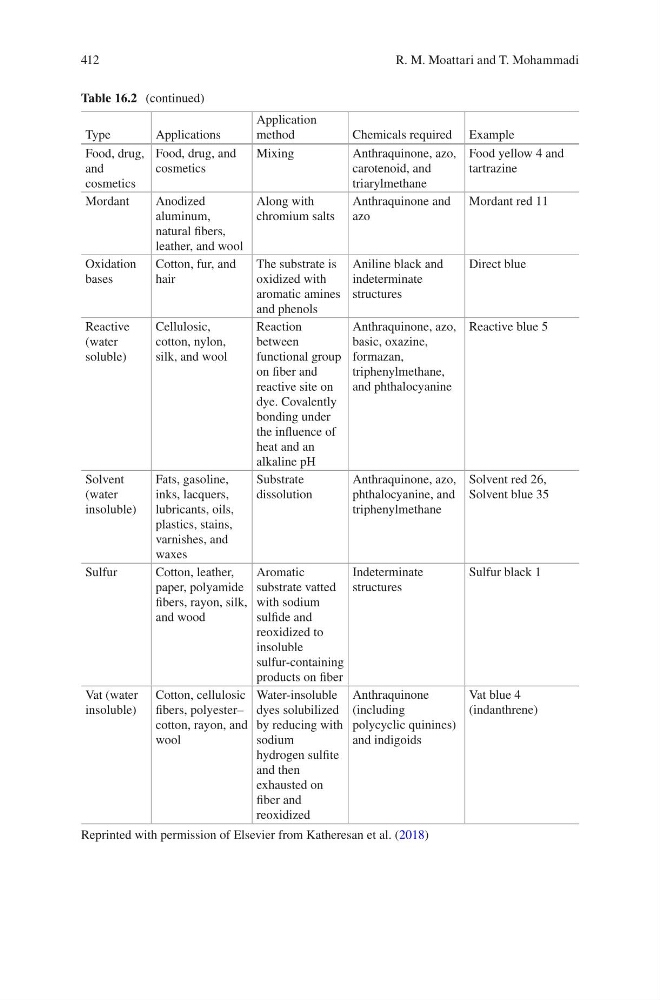
Table 16.2 (continued)
Type
Applications
Application
method
Chemicals required Example
Food, drug,
and
cosmetics
Food, drug, and
cosmetics
Mixing
Anthraquinone, azo,
carotenoid, and
triarylmethane
Food yellow 4 and
tartrazine
Mordant
Anodized
aluminum,
natural fibers,
leather, and wool
Along with
chromium salts
Anthraquinone and
azo
Mordant red 11
Oxidation
bases
Cotton, fur, and
hair
The substrate is
oxidized with
aromatic amines
and phenols
Aniline black and
indeterminate
structures
Direct blue
Reactive
(water
soluble)
Cellulosic,
cotton, nylon,
silk, and wool
Reaction
between
functional group
on fiber and
reactive site on
dye. Covalently
bonding under
the influence of
heat and an
alkaline pH
Anthraquinone, azo,
basic, oxazine,
formazan,
triphenylmethane,
and phthalocyanine
Reactive blue 5
Solvent
(water
insoluble)
Fats, gasoline,
inks, lacquers,
lubricants, oils,
plastics, stains,
varnishes, and
waxes
Substrate
dissolution
Anthraquinone, azo,
phthalocyanine, and
triphenylmethane
Solvent red 26,
Solvent blue 35
Sulfur
Cotton, leather,
paper, polyamide
fibers, rayon, silk,
and wood
Aromatic
substrate vatted
with sodium
sulfide and
reoxidized to
insoluble
sulfur- containing
products on fiber
Indeterminate
structures
Sulfur black 1
Vat (water
insoluble)
Cotton, cellulosic
fibers, polyester–
cotton, rayon, and
wool
Water- insoluble
dyes solubilized
by reducing with
sodium
hydrogen sulfite
and then
exhausted on
fiber and
reoxidized
Anthraquinone
(including
polycyclic quinines)
and indigoids
Vat blue 4
(indanthrene)
Reprinted with permission of Elsevier from Katheresan et al. (2018)
R. M. Moattari and T. Mohammadi
Table 16.2 (continued)
Type
Applications
Application
method
Chemicals required Example
Food, drug,
and
cosmetics
Food, drug, and
cosmetics
Mixing
Anthraquinone, azo,
carotenoid, and
triarylmethane
Food yellow 4 and
tartrazine
Mordant
Anodized
aluminum,
natural fibers,
leather, and wool
Along with
chromium salts
Anthraquinone and
azo
Mordant red 11
Oxidation
bases
Cotton, fur, and
hair
The substrate is
oxidized with
aromatic amines
and phenols
Aniline black and
indeterminate
structures
Direct blue
Reactive
(water
soluble)
Cellulosic,
cotton, nylon,
silk, and wool
Reaction
between
functional group
on fiber and
reactive site on
dye. Covalently
bonding under
the influence of
heat and an
alkaline pH
Anthraquinone, azo,
basic, oxazine,
formazan,
triphenylmethane,
and phthalocyanine
Reactive blue 5
Solvent
(water
insoluble)
Fats, gasoline,
inks, lacquers,
lubricants, oils,
plastics, stains,
varnishes, and
waxes
Substrate
dissolution
Anthraquinone, azo,
phthalocyanine, and
triphenylmethane
Solvent red 26,
Solvent blue 35
Sulfur
Cotton, leather,
paper, polyamide
fibers, rayon, silk,
and wood
Aromatic
substrate vatted
with sodium
sulfide and
reoxidized to
insoluble
sulfur- containing
products on fiber
Indeterminate
structures
Sulfur black 1
Vat (water
insoluble)
Cotton, cellulosic
fibers, polyester–
cotton, rayon, and
wool
Water- insoluble
dyes solubilized
by reducing with
sodium
hydrogen sulfite
and then
exhausted on
fiber and
reoxidized
Anthraquinone
(including
polycyclic quinines)
and indigoids
Vat blue 4
(indanthrene)
Reprinted with permission of Elsevier from Katheresan et al. (2018)
R. M. Moattari and T. Mohammadi