

397
capacity of methylene blue for fly ash was 2.5 × 10
−4
mol/g, whereas the adsorption
capacity for natural zeolite and fly ash was 5 × 10
−5
and 2 × 10
−5
mol/g (Wang et al.
2005). Reddy et al. (2013) developed activated carbon from biowaste materials like
rice husk and peanut shell using different physicochemical activation methods. It
has been shown that developed activated carbon effectively removes methylene blue
from aqueous solution. The hydrogen peroxide treated rice husk had the best adsorption capacity for the presence of acidic groups on surface (Reddy et al. 2013). Auta
and Hameed (2014) synthesized modified ball clay with chitosan for methylene
blue treatment. The composite material had higher adsorption capacity (above 50%)
than modified ball clay after five regeneration cycles. Modified ball clay with chitosan has the potential for removing cationic dye (Auta and Hameed 2014). Hadi et al.
(2015) reviewed that porous activated carbon can be prepared from sludge (carbonrich material) by chemical activation using different activating agents (Hadi
et al. 2015).
Li et al. (2016) prepared porous carbon by carbonization of pomelo peel followed by potassium hydroxide for removal of methyl orange. They found the
adsorption capacity was 680.2 mg/g (Li et al. 2016). Fan et al. (2017) developed
biochar from municipal sludge for removing methylene blue from industrial effluent. They found the methylene blue removal reaches 98% at optimum conditions
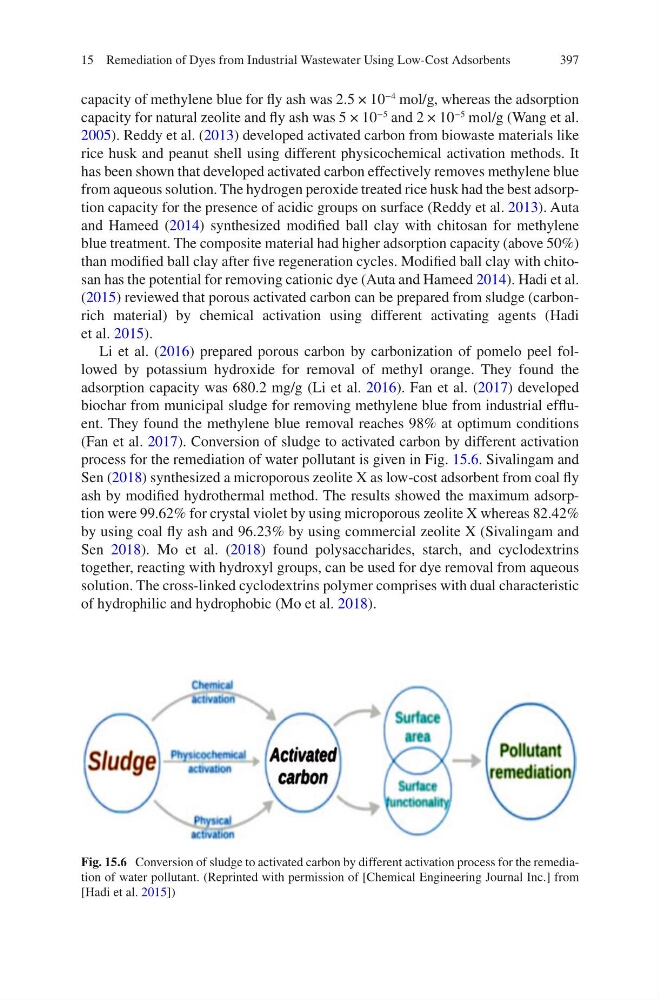
(Fan et al. 2017). Conversion of sludge to activated carbon by different activation
process for the remediation of water pollutant is given in Fig. 15.6. Sivalingam and
Sen (2018) synthesized a microporous zeolite X as low-cost adsorbent from coal fly
ash by modified hydrothermal method. The results showed the maximum adsorption were 99.62% for crystal violet by using microporous zeolite X whereas 82.42%
by using coal fly ash and 96.23% by using commercial zeolite X (Sivalingam and
Sen 2018). Mo et al. (2018) found polysaccharides, starch, and cyclodextrins
together, reacting with hydroxyl groups, can be used for dye removal from aqueous
solution. The cross-linked cyclodextrins polymer comprises with dual characteristic
of hydrophilic and hydrophobic (Mo et al. 2018).
Fig. 15.6 Conversion of sludge to activated carbon by different activation process for the remediation of water pollutant. (Reprinted with permission of [Chemical Engineering Journal Inc.] from
[Hadi et al. 2015])
15 Remediation of Dyes from Industrial Wastewater Using Low-Cost Adsorbents
capacity of methylene blue for fly ash was 2.5 × 10
−4
mol/g, whereas the adsorption
capacity for natural zeolite and fly ash was 5 × 10
−5
and 2 × 10
−5
mol/g (Wang et al.
2005). Reddy et al. (2013) developed activated carbon from biowaste materials like
rice husk and peanut shell using different physicochemical activation methods. It
has been shown that developed activated carbon effectively removes methylene blue
from aqueous solution. The hydrogen peroxide treated rice husk had the best adsorption capacity for the presence of acidic groups on surface (Reddy et al. 2013). Auta
and Hameed (2014) synthesized modified ball clay with chitosan for methylene
blue treatment. The composite material had higher adsorption capacity (above 50%)
than modified ball clay after five regeneration cycles. Modified ball clay with chitosan has the potential for removing cationic dye (Auta and Hameed 2014). Hadi et al.
(2015) reviewed that porous activated carbon can be prepared from sludge (carbonrich material) by chemical activation using different activating agents (Hadi
et al. 2015).
Li et al. (2016) prepared porous carbon by carbonization of pomelo peel followed by potassium hydroxide for removal of methyl orange. They found the
adsorption capacity was 680.2 mg/g (Li et al. 2016). Fan et al. (2017) developed
biochar from municipal sludge for removing methylene blue from industrial effluent. They found the methylene blue removal reaches 98% at optimum conditions
(Fan et al. 2017). Conversion of sludge to activated carbon by different activation
process for the remediation of water pollutant is given in Fig. 15.6. Sivalingam and
Sen (2018) synthesized a microporous zeolite X as low-cost adsorbent from coal fly
ash by modified hydrothermal method. The results showed the maximum adsorption were 99.62% for crystal violet by using microporous zeolite X whereas 82.42%
by using coal fly ash and 96.23% by using commercial zeolite X (Sivalingam and
Sen 2018). Mo et al. (2018) found polysaccharides, starch, and cyclodextrins
together, reacting with hydroxyl groups, can be used for dye removal from aqueous
solution. The cross-linked cyclodextrins polymer comprises with dual characteristic
of hydrophilic and hydrophobic (Mo et al. 2018).
Fig. 15.6 Conversion of sludge to activated carbon by different activation process for the remediation of water pollutant. (Reprinted with permission of [Chemical Engineering Journal Inc.] from
[Hadi et al. 2015])
15 Remediation of Dyes from Industrial Wastewater Using Low-Cost Adsorbents