

394
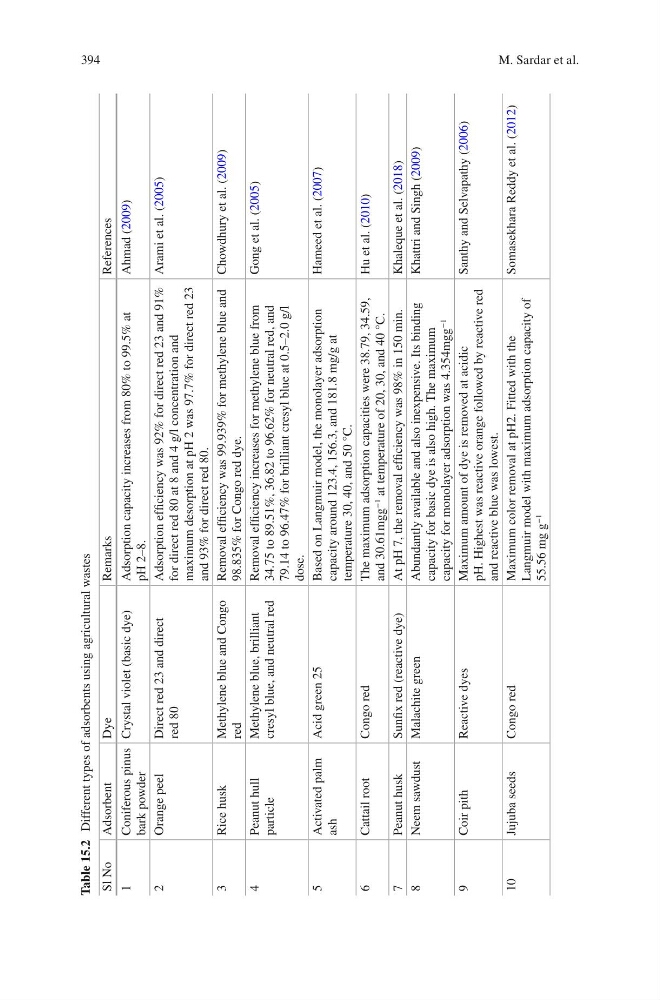
Table 15.2 Different types of adsorbents using agricultural wastes
Sl No
Adsorbent
Dye
Remarks
References
1
Coniferous pinus
bark powder
Crystal violet (basic dye)
Adsorption capacity increases from 80% to 99.5% at
pH 2–8.
Ahmad (2009)
2
Orange peel
Direct red 23 and direct
red 80
Adsorption efficiency was 92% for direct red 23 and 91%
for direct red 80 at 8 and 4 g/l concentration and
maximum desorption at pH 2 was 97.7% for direct red 23
and 93% for direct red 80.
Arami et al. (2005)
3
Rice husk
Methylene blue and Congo
red
Removal efficiency was 99.939% for methylene blue and
98.835% for Congo red dye.
Chowdhury et al. (2009)
4
Peanut hull
particle
Methylene blue, brilliant
cresyl blue, and neutral red
Removal efficiency increases for methylene blue from
34.75 to 89.51%, 36.82 to 96.62% for neutral red, and
79.14 to 96.47% for brilliant cresyl blue at 0.5–2.0 g/l
dose.
Gong et al. (2005)
5
Activated palm
ash
Acid green 25
Based on Langmuir model, the monolayer adsorption
capacity around 123.4, 156.3, and 181.8 mg/g at
temperature 30, 40, and 50 °C.
Hameed et al. (2007)
6
Cattail root
Congo red
The maximum adsorption capacities were 38.79, 34.59,
and 30.61mgg
−1
at temperature of 20, 30, and 40 °C.
Hu et al. (2010)
7
Peanut husk
Sunfix red (reactive dye)
At pH 7, the removal efficiency was 98% in 150 min.
Khaleque et al. (2018)
8
Neem sawdust
Malachite green
Abundantly available and also inexpensive. Its binding
capacity for basic dye is also high. The maximum
capacity for monolayer adsorption was 4.354mgg
−1
Khattri and Singh (2009)
9
Coir pith
Reactive dyes
Maximum amount of dye is removed at acidic
pH. Highest was reactive orange followed by reactive red
and reactive blue was lowest.
Santhy and Selvapathy (2006)
10
Jujuba seeds
Congo red
Maximum color removal at pH2. Fitted with the
Langmuir model with maximum adsorption capacity of
55.56 mg g
−1
Somasekhara Reddy et al. (2012)
M. Sardar et al.
Table 15.2 Different types of adsorbents using agricultural wastes
Sl No
Adsorbent
Dye
Remarks
References
1
Coniferous pinus
bark powder
Crystal violet (basic dye)
Adsorption capacity increases from 80% to 99.5% at
pH 2–8.
Ahmad (2009)
2
Orange peel
Direct red 23 and direct
red 80
Adsorption efficiency was 92% for direct red 23 and 91%
for direct red 80 at 8 and 4 g/l concentration and
maximum desorption at pH 2 was 97.7% for direct red 23
and 93% for direct red 80.
Arami et al. (2005)
3
Rice husk
Methylene blue and Congo
red
Removal efficiency was 99.939% for methylene blue and
98.835% for Congo red dye.
Chowdhury et al. (2009)
4
Peanut hull
particle
Methylene blue, brilliant
cresyl blue, and neutral red
Removal efficiency increases for methylene blue from
34.75 to 89.51%, 36.82 to 96.62% for neutral red, and
79.14 to 96.47% for brilliant cresyl blue at 0.5–2.0 g/l
dose.
Gong et al. (2005)
5
Activated palm
ash
Acid green 25
Based on Langmuir model, the monolayer adsorption
capacity around 123.4, 156.3, and 181.8 mg/g at
temperature 30, 40, and 50 °C.
Hameed et al. (2007)
6
Cattail root
Congo red
The maximum adsorption capacities were 38.79, 34.59,
and 30.61mgg
−1
at temperature of 20, 30, and 40 °C.
Hu et al. (2010)
7
Peanut husk
Sunfix red (reactive dye)
At pH 7, the removal efficiency was 98% in 150 min.
Khaleque et al. (2018)
8
Neem sawdust
Malachite green
Abundantly available and also inexpensive. Its binding
capacity for basic dye is also high. The maximum
capacity for monolayer adsorption was 4.354mgg
−1
Khattri and Singh (2009)
9
Coir pith
Reactive dyes
Maximum amount of dye is removed at acidic
pH. Highest was reactive orange followed by reactive red
and reactive blue was lowest.
Santhy and Selvapathy (2006)
10
Jujuba seeds
Congo red
Maximum color removal at pH2. Fitted with the
Langmuir model with maximum adsorption capacity of
55.56 mg g
−1
Somasekhara Reddy et al. (2012)
M. Sardar et al.