

365
14.7 Regeneration of Biosorbents
Desorption of metal ions from adsorbent has an important significance for the reuse
of the adsorbent. Regeneration study is required to check the economical feasibility
of the biosorbent. Now, in recent trend, regeneration of the adsorbents is carried out
by elution processes where acids, bases, and other chemicals are utilized. Elutent is
an important factor in regeneration study, and the selection of the elutent is done
based on its high efficiency, low cost, and environmentally friendly nature.
Regeneration efficiencies of different biosorbents were investigated by various
researchers as described in Table 14.14. Scientists (Bai and Abraham 2003) reported
the regeneration of immobilized fungal biomass by using 0.01 N NaOH and Na 2 CO 3
where 78% and 91.91 ± 3.9% regeneration were achieved. Others (Saeed et al.
2005a, b) utilized 0.1 N HCl for desorption of copper, cadmium, and zinc ions from
the papaya wood and obtained the efficiency of 99.4%, 98.5%, and 99.3% after fifth
cycle. Some researchers (Gupta and Nayak 2012) utilized nitric acid for the regeneration of orange peel powder with Fe 3 O 4 and got the regeneration efficiency of
98.28% even after fifth cycle. Furthermore, it can be concluded that regeneration of
the biosorbent makes bisorption process more effective and efficient.
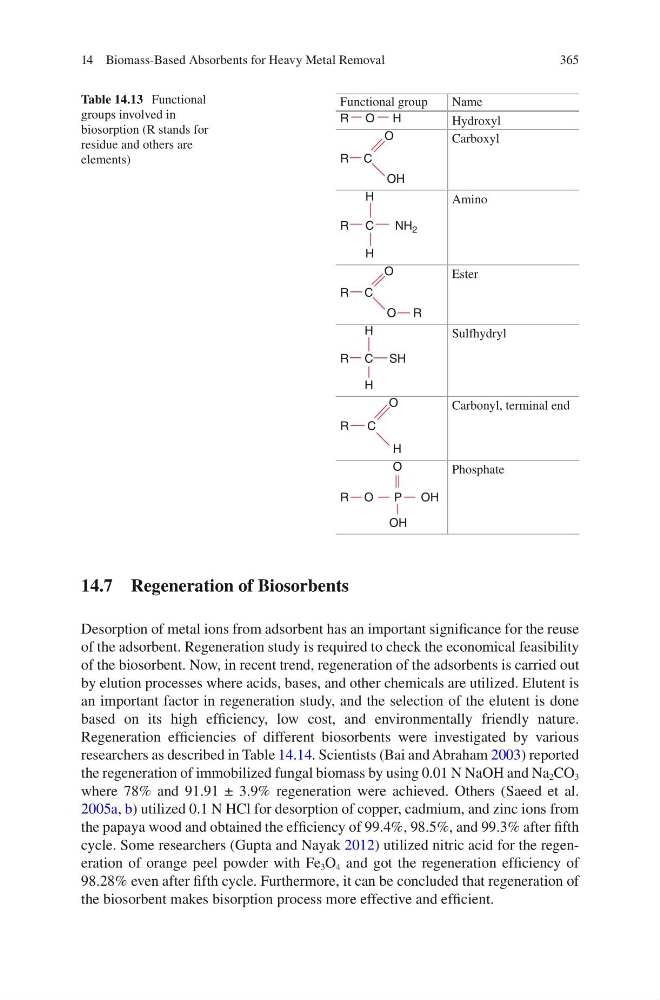
Table 14.13 Functional
groups involved in
biosorption (R stands for
residue and others are
elements)
Functional group
Name
R O H
Hydroxyl
O
R C
OH
Carboxyl
H
H
C
R
N H 2
Amino
O
O
R C
R
Ester
H
H
R C SH
Sulfhydryl
O
R
C
H
Carbonyl, terminal end
O
P
OH
OH
O
R
Phosphate
14 Biomass-Based Absorbents for Heavy Metal Removal
14.7 Regeneration of Biosorbents
Desorption of metal ions from adsorbent has an important significance for the reuse
of the adsorbent. Regeneration study is required to check the economical feasibility
of the biosorbent. Now, in recent trend, regeneration of the adsorbents is carried out
by elution processes where acids, bases, and other chemicals are utilized. Elutent is
an important factor in regeneration study, and the selection of the elutent is done
based on its high efficiency, low cost, and environmentally friendly nature.
Regeneration efficiencies of different biosorbents were investigated by various
researchers as described in Table 14.14. Scientists (Bai and Abraham 2003) reported
the regeneration of immobilized fungal biomass by using 0.01 N NaOH and Na 2 CO 3
where 78% and 91.91 ± 3.9% regeneration were achieved. Others (Saeed et al.
2005a, b) utilized 0.1 N HCl for desorption of copper, cadmium, and zinc ions from
the papaya wood and obtained the efficiency of 99.4%, 98.5%, and 99.3% after fifth
cycle. Some researchers (Gupta and Nayak 2012) utilized nitric acid for the regeneration of orange peel powder with Fe 3 O 4 and got the regeneration efficiency of
98.28% even after fifth cycle. Furthermore, it can be concluded that regeneration of
the biosorbent makes bisorption process more effective and efficient.
Table 14.13 Functional
groups involved in
biosorption (R stands for
residue and others are
elements)
Functional group
Name
R O H
Hydroxyl
O
R C
OH
Carboxyl
H
H
C
R
N H 2
Amino
O
O
R C
R
Ester
H
H
R C SH
Sulfhydryl
O
R
C
H
Carbonyl, terminal end
O
P
OH
OH
O
R
Phosphate
14 Biomass-Based Absorbents for Heavy Metal Removal