

366
14.8 Conclusion
To combat the environmental degradation in a sustainable way, many technologies
have been developed. Among them, biosorption in considered as an efficient and
economical process for its easy operation, local availability, and low cost. Some of
the waste biomasses which are locally available in abundant quantities are utilized
as biosorbents. Natural biosorbents such as activated carbon, wood sawdust, leaf
powder, bacterial biomass, algal biomass, and fungal biomass were utilized for
treatment of metal-tainted effluent. As most of the natural biosorbents have low
adsorption capacity, researchers attempted to increase the adsorption capacity by a
number of pretreatment techniques. These pretreatment includes physical and
chemical activation where in physical treatment, the adsorbents are heated at high
temperature with controlled rate of heating. In chemical treatment, various acids,
bases, and other chemicals are utilized. Chemical modification increases the binding sites and modifies the functional groups of the adsorbent resulting enhancement
of the adsorption capacity as well as their mechanical strength. Literature review
suggests utilization of various biosorbents for the removal of heavy metals and their
adsorption capacity were investigated at laboratory scale. The results are promising,
but the real application of those bioadsorbent is very limited. So to increase the
industrial applications of the biosorbents, more pilot-scale studies are required.
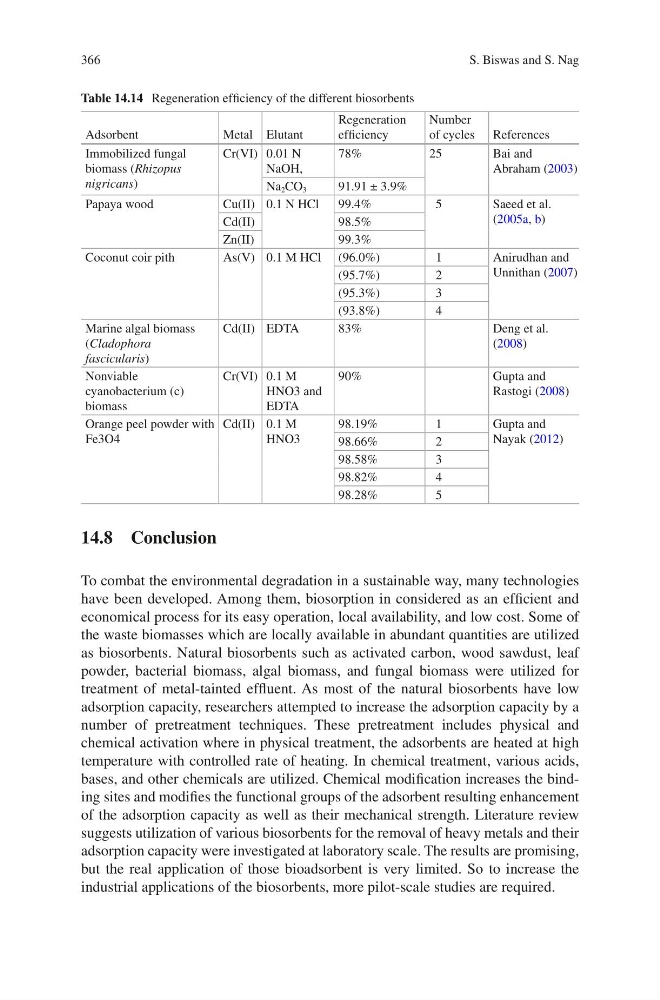
Table 14.14 Regeneration efficiency of the different biosorbents
Adsorbent
Metal Elutant
Regeneration
efficiency
Number
of cycles References
Immobilized fungal
biomass (Rhizopus
nigricans)
Cr(VI) 0.01 N
NaOH,
78%
25
Bai and
Abraham (2003)
Na 2 CO 3
91.91 ± 3.9%
Papaya wood
Cu(II) 0.1 N HCl
99.4%
5
Saeed et al.
(2005a, b)
Cd(II)
98.5%
Zn(II)
99.3%
Coconut coir pith
As(V) 0.1 M HCl (96.0%)
1
Anirudhan and
Unnithan (2007)
(95.7%)
2
(95.3%)
3
(93.8%)
4
Marine algal biomass
(Cladophora
fascicularis)
Cd(II) EDTA
83%
Deng et al.
(2008)
Nonviable
cyanobacterium (c)
biomass
Cr(VI) 0.1 M
HNO3 and
EDTA
90%
Gupta and
Rastogi (2008)
Orange peel powder with
Fe3O4
Cd(II) 0.1 M
HNO3
98.19%
1
Gupta and
Nayak (2012)
98.66%
2
98.58%
3
98.82%
4
98.28%
5
S. Biswas and S. Nag
14.8 Conclusion
To combat the environmental degradation in a sustainable way, many technologies
have been developed. Among them, biosorption in considered as an efficient and
economical process for its easy operation, local availability, and low cost. Some of
the waste biomasses which are locally available in abundant quantities are utilized
as biosorbents. Natural biosorbents such as activated carbon, wood sawdust, leaf
powder, bacterial biomass, algal biomass, and fungal biomass were utilized for
treatment of metal-tainted effluent. As most of the natural biosorbents have low
adsorption capacity, researchers attempted to increase the adsorption capacity by a
number of pretreatment techniques. These pretreatment includes physical and
chemical activation where in physical treatment, the adsorbents are heated at high
temperature with controlled rate of heating. In chemical treatment, various acids,
bases, and other chemicals are utilized. Chemical modification increases the binding sites and modifies the functional groups of the adsorbent resulting enhancement
of the adsorption capacity as well as their mechanical strength. Literature review
suggests utilization of various biosorbents for the removal of heavy metals and their
adsorption capacity were investigated at laboratory scale. The results are promising,
but the real application of those bioadsorbent is very limited. So to increase the
industrial applications of the biosorbents, more pilot-scale studies are required.
Table 14.14 Regeneration efficiency of the different biosorbents
Adsorbent
Metal Elutant
Regeneration
efficiency
Number
of cycles References
Immobilized fungal
biomass (Rhizopus
nigricans)
Cr(VI) 0.01 N
NaOH,
78%
25
Bai and
Abraham (2003)
Na 2 CO 3
91.91 ± 3.9%
Papaya wood
Cu(II) 0.1 N HCl
99.4%
5
Saeed et al.
(2005a, b)
Cd(II)
98.5%
Zn(II)
99.3%
Coconut coir pith
As(V) 0.1 M HCl (96.0%)
1
Anirudhan and
Unnithan (2007)
(95.7%)
2
(95.3%)
3
(93.8%)
4
Marine algal biomass
(Cladophora
fascicularis)
Cd(II) EDTA
83%
Deng et al.
(2008)
Nonviable
cyanobacterium (c)
biomass
Cr(VI) 0.1 M
HNO3 and
EDTA
90%
Gupta and
Rastogi (2008)
Orange peel powder with
Fe3O4
Cd(II) 0.1 M
HNO3
98.19%
1
Gupta and
Nayak (2012)
98.66%
2
98.58%
3
98.82%
4
98.28%
5
S. Biswas and S. Nag