

363
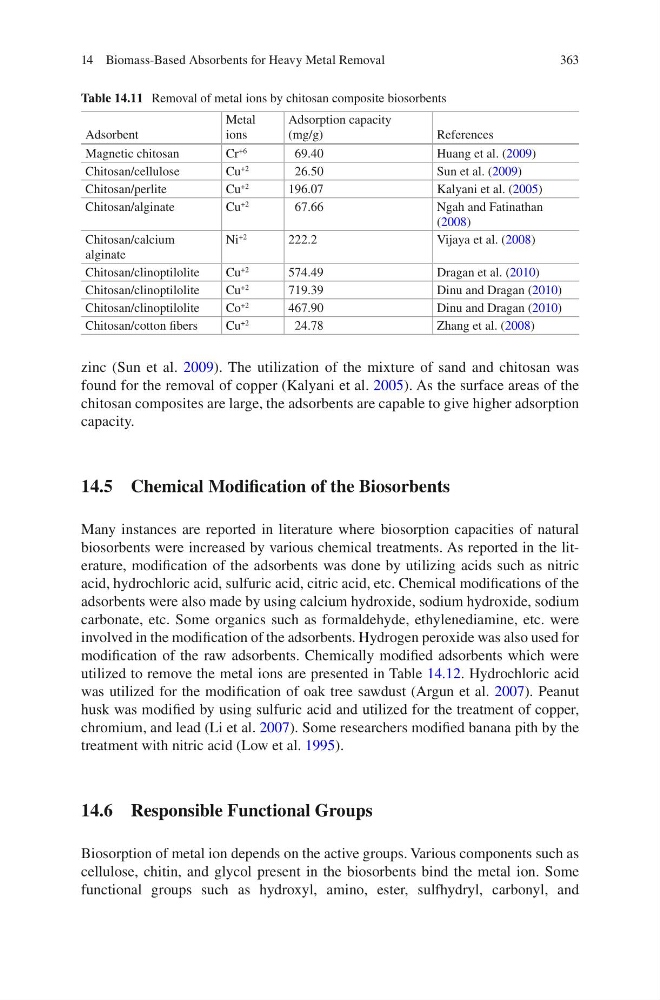
zinc (Sun et al. 2009). The utilization of the mixture of sand and chitosan was
found for the removal of copper (Kalyani et al. 2005). As the surface areas of the
chitosan composites are large, the adsorbents are capable to give higher adsorption
capacity.
14.5 Chemical Modification of the Biosorbents
Many instances are reported in literature where biosorption capacities of natural
biosorbents were increased by various chemical treatments. As reported in the literature, modification of the adsorbents was done by utilizing acids such as nitric
acid, hydrochloric acid, sulfuric acid, citric acid, etc. Chemical modifications of the
adsorbents were also made by using calcium hydroxide, sodium hydroxide, sodium
carbonate, etc. Some organics such as formaldehyde, ethylenediamine, etc. were
involved in the modification of the adsorbents. Hydrogen peroxide was also used for
modification of the raw adsorbents. Chemically modified adsorbents which were
utilized to remove the metal ions are presented in Table 14.12. Hydrochloric acid
was utilized for the modification of oak tree sawdust (Argun et al. 2007). Peanut
husk was modified by using sulfuric acid and utilized for the treatment of copper,
chromium, and lead (Li et al. 2007). Some researchers modified banana pith by the
treatment with nitric acid (Low et al. 1995).
14.6 Responsible Functional Groups
Biosorption of metal ion depends on the active groups. Various components such as
cellulose, chitin, and glycol present in the biosorbents bind the metal ion. Some
functional groups such as hydroxyl, amino, ester, sulfhydryl, carbonyl, and
Table 14.11 Removal of metal ions by chitosan composite biosorbents
Adsorbent
Metal
ions
Adsorption capacity
(mg/g)
References
Magnetic chitosan
Cr
+6
69.40
Huang et al. (2009)
Chitosan/cellulose
Cu
+2
26.50
Sun et al. (2009)
Chitosan/perlite
Cu
+2
196.07
Kalyani et al. (2005)
Chitosan/alginate
Cu
+2
67.66
Ngah and Fatinathan
(2008)
Chitosan/calcium
alginate
Ni
+2
222.2
Vijaya et al. (2008)
Chitosan/clinoptilolite
Cu
+2
574.49
Dragan et al. (2010)
Chitosan/clinoptilolite
Cu
+2
719.39
Dinu and Dragan (2010)
Chitosan/clinoptilolite
Co
+2
467.90
Dinu and Dragan (2010)
Chitosan/cotton fibers
Cu
+2
24.78
Zhang et al. (2008)
14 Biomass-Based Absorbents for Heavy Metal Removal
zinc (Sun et al. 2009). The utilization of the mixture of sand and chitosan was
found for the removal of copper (Kalyani et al. 2005). As the surface areas of the
chitosan composites are large, the adsorbents are capable to give higher adsorption
capacity.
14.5 Chemical Modification of the Biosorbents
Many instances are reported in literature where biosorption capacities of natural
biosorbents were increased by various chemical treatments. As reported in the literature, modification of the adsorbents was done by utilizing acids such as nitric
acid, hydrochloric acid, sulfuric acid, citric acid, etc. Chemical modifications of the
adsorbents were also made by using calcium hydroxide, sodium hydroxide, sodium
carbonate, etc. Some organics such as formaldehyde, ethylenediamine, etc. were
involved in the modification of the adsorbents. Hydrogen peroxide was also used for
modification of the raw adsorbents. Chemically modified adsorbents which were
utilized to remove the metal ions are presented in Table 14.12. Hydrochloric acid
was utilized for the modification of oak tree sawdust (Argun et al. 2007). Peanut
husk was modified by using sulfuric acid and utilized for the treatment of copper,
chromium, and lead (Li et al. 2007). Some researchers modified banana pith by the
treatment with nitric acid (Low et al. 1995).
14.6 Responsible Functional Groups
Biosorption of metal ion depends on the active groups. Various components such as
cellulose, chitin, and glycol present in the biosorbents bind the metal ion. Some
functional groups such as hydroxyl, amino, ester, sulfhydryl, carbonyl, and
Table 14.11 Removal of metal ions by chitosan composite biosorbents
Adsorbent
Metal
ions
Adsorption capacity
(mg/g)
References
Magnetic chitosan
Cr
+6
69.40
Huang et al. (2009)
Chitosan/cellulose
Cu
+2
26.50
Sun et al. (2009)
Chitosan/perlite
Cu
+2
196.07
Kalyani et al. (2005)
Chitosan/alginate
Cu
+2
67.66
Ngah and Fatinathan
(2008)
Chitosan/calcium
alginate
Ni
+2
222.2
Vijaya et al. (2008)
Chitosan/clinoptilolite
Cu
+2
574.49
Dragan et al. (2010)
Chitosan/clinoptilolite
Cu
+2
719.39
Dinu and Dragan (2010)
Chitosan/clinoptilolite
Co
+2
467.90
Dinu and Dragan (2010)
Chitosan/cotton fibers
Cu
+2
24.78
Zhang et al. (2008)
14 Biomass-Based Absorbents for Heavy Metal Removal