

338
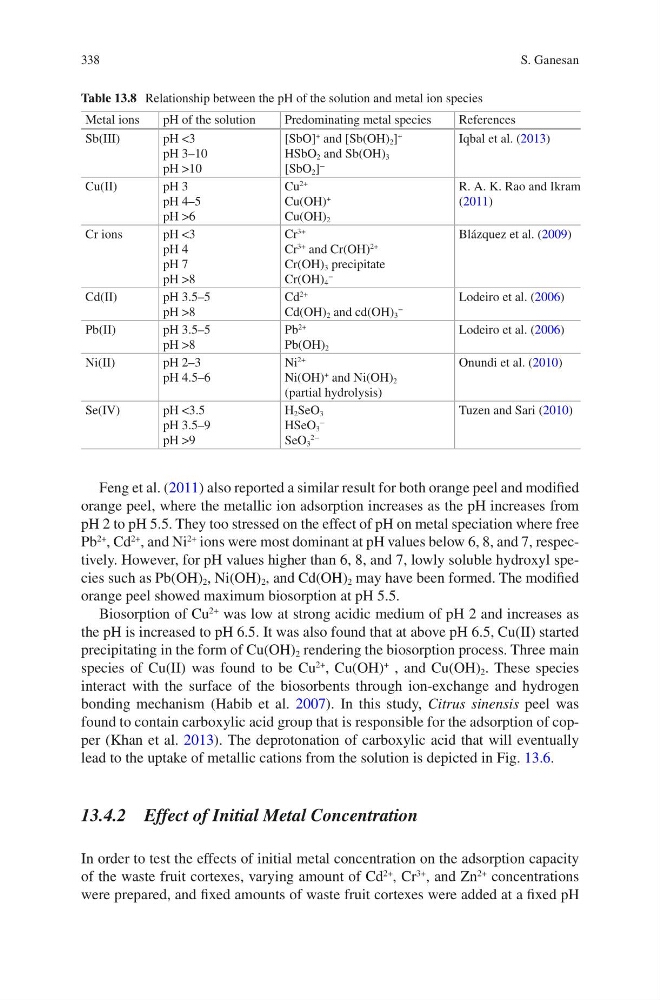
Feng et al. (2011) also reported a similar result for both orange peel and modified
orange peel, where the metallic ion adsorption increases as the pH increases from
pH 2 to pH 5.5. They too stressed on the effect of pH on metal speciation where free
Pb
2+
, Cd
2+
, and Ni
2+
ions were most dominant at pH values below 6, 8, and 7, respectively. However, for pH values higher than 6, 8, and 7, lowly soluble hydroxyl species such as Pb(OH) 2 , Ni(OH) 2 , and Cd(OH) 2 may have been formed. The modified
orange peel showed maximum biosorption at pH 5.5.
Biosorption of Cu
2+
was low at strong acidic medium of pH 2 and increases as
the pH is increased to pH 6.5. It was also found that at above pH 6.5, Cu(II) started
precipitating in the form of Cu(OH) 2 rendering the biosorption process. Three main
species of Cu(II) was found to be Cu
2+
, Cu(OH)
+
, and Cu(OH) 2 . These species
interact with the surface of the biosorbents through ion-exchange and hydrogen
bonding mechanism (Habib et al. 2007). In this study, Citrus sinensis peel was
found to contain carboxylic acid group that is responsible for the adsorption of copper (Khan et al. 2013). The deprotonation of carboxylic acid that will eventually
lead to the uptake of metallic cations from the solution is depicted in Fig. 13.6.
13.4.2 Effect of Initial Metal Concentration
In order to test the effects of initial metal concentration on the adsorption capacity
of the waste fruit cortexes, varying amount of Cd
2+
, Cr
3+
, and Zn
2+
concentrations
were prepared, and fixed amounts of waste fruit cortexes were added at a fixed pH
Table 13.8 Relationship between the pH of the solution and metal ion species
Metal ions
pH of the solution
Predominating metal species
References
Sb(III)
pH <3
pH 3–10
pH >10
[SbO]
+ and [Sb(OH) 2 ]
+
HSbO 2 and Sb(OH) 3
[SbO 2 ]
−
Iqbal et al. (2013)
Cu(II)
pH 3
pH 4–5
pH >6
Cu
2+
Cu(OH)
+
Cu(OH) 2
R. A. K. Rao and Ikram
(2011)
Cr ions
pH <3
pH 4
pH 7
pH >8
Cr
3+
Cr
3+ and Cr(OH)
2+
Cr(OH) 3 precipitate
Cr(OH) 4
−
Blázquez et al. (2009)
Cd(II)
pH 3.5–5
pH >8
Cd
2+
Cd(OH) 2 and cd(OH) 3
−
Lodeiro et al. (2006)
Pb(II)
pH 3.5–5
pH >8
Pb
2+
Pb(OH) 2
Lodeiro et al. (2006)
Ni(II)
pH 2–3
pH 4.5–6
Ni
2+
Ni(OH)
+ and Ni(OH) 2
(partial hydrolysis)
Onundi et al. (2010)
Se(IV)
pH <3.5
pH 3.5–9
pH >9
H 2 SeO 3
HSeO 3
−
SeO 3
2−
Tuzen and Sari (2010)
S. Ganesan
Feng et al. (2011) also reported a similar result for both orange peel and modified
orange peel, where the metallic ion adsorption increases as the pH increases from
pH 2 to pH 5.5. They too stressed on the effect of pH on metal speciation where free
Pb
2+
, Cd
2+
, and Ni
2+
ions were most dominant at pH values below 6, 8, and 7, respectively. However, for pH values higher than 6, 8, and 7, lowly soluble hydroxyl species such as Pb(OH) 2 , Ni(OH) 2 , and Cd(OH) 2 may have been formed. The modified
orange peel showed maximum biosorption at pH 5.5.
Biosorption of Cu
2+
was low at strong acidic medium of pH 2 and increases as
the pH is increased to pH 6.5. It was also found that at above pH 6.5, Cu(II) started
precipitating in the form of Cu(OH) 2 rendering the biosorption process. Three main
species of Cu(II) was found to be Cu
2+
, Cu(OH)
+
, and Cu(OH) 2 . These species
interact with the surface of the biosorbents through ion-exchange and hydrogen
bonding mechanism (Habib et al. 2007). In this study, Citrus sinensis peel was
found to contain carboxylic acid group that is responsible for the adsorption of copper (Khan et al. 2013). The deprotonation of carboxylic acid that will eventually
lead to the uptake of metallic cations from the solution is depicted in Fig. 13.6.
13.4.2 Effect of Initial Metal Concentration
In order to test the effects of initial metal concentration on the adsorption capacity
of the waste fruit cortexes, varying amount of Cd
2+
, Cr
3+
, and Zn
2+
concentrations
were prepared, and fixed amounts of waste fruit cortexes were added at a fixed pH
Table 13.8 Relationship between the pH of the solution and metal ion species
Metal ions
pH of the solution
Predominating metal species
References
Sb(III)
pH <3
pH 3–10
pH >10
[SbO]
+ and [Sb(OH) 2 ]
+
HSbO 2 and Sb(OH) 3
[SbO 2 ]
−
Iqbal et al. (2013)
Cu(II)
pH 3
pH 4–5
pH >6
Cu
2+
Cu(OH)
+
Cu(OH) 2
R. A. K. Rao and Ikram
(2011)
Cr ions
pH <3
pH 4
pH 7
pH >8
Cr
3+
Cr
3+ and Cr(OH)
2+
Cr(OH) 3 precipitate
Cr(OH) 4
−
Blázquez et al. (2009)
Cd(II)
pH 3.5–5
pH >8
Cd
2+
Cd(OH) 2 and cd(OH) 3
−
Lodeiro et al. (2006)
Pb(II)
pH 3.5–5
pH >8
Pb
2+
Pb(OH) 2
Lodeiro et al. (2006)
Ni(II)
pH 2–3
pH 4.5–6
Ni
2+
Ni(OH)
+ and Ni(OH) 2
(partial hydrolysis)
Onundi et al. (2010)
Se(IV)
pH <3.5
pH 3.5–9
pH >9
H 2 SeO 3
HSeO 3
−
SeO 3
2−
Tuzen and Sari (2010)
S. Ganesan