

337
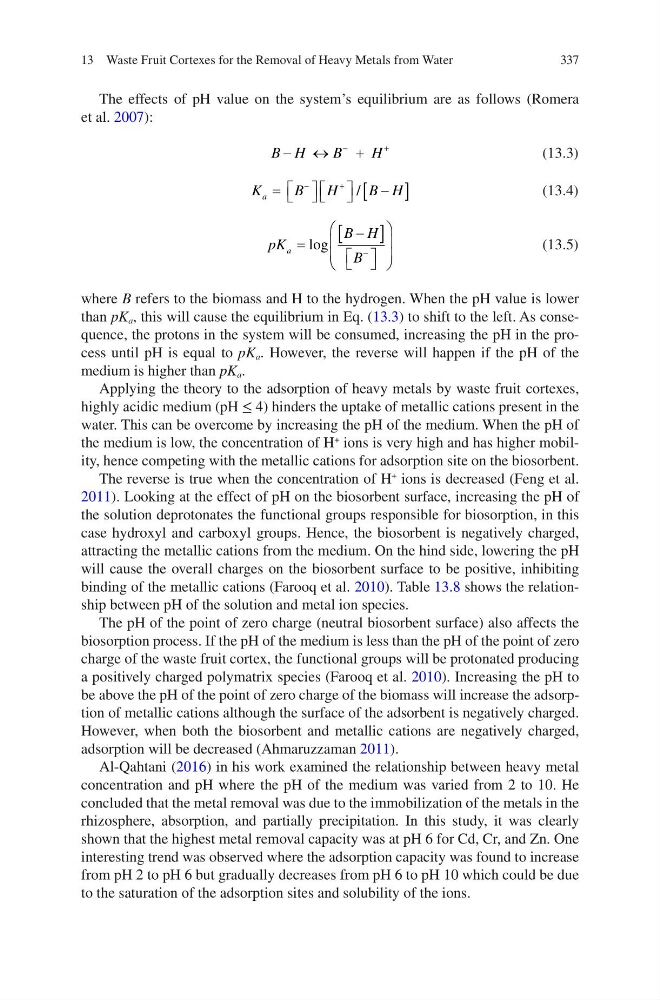
The effects of pH value on the system’s equilibrium are as follows (Romera
et al. 2007):
B H
B
H
- «
+
-
+
(13.3)
K
B
H
B H
a = é ë ù û é ë ù û
-
[
]
-
+ /
(13.4)
pK
B H
B
a =
-
[
]
é ë ù û
æ
è
ç
ç
ö
ø
÷
÷
-
log
(13.5)
where B refers to the biomass and H to the hydrogen. When the pH value is lower
than pK a , this will cause the equilibrium in Eq. (13.3) to shift to the left. As consequence, the protons in the system will be consumed, increasing the pH in the process until pH is equal to pK a . However, the reverse will happen if the pH of the
medium is higher than pK a .
Applying the theory to the adsorption of heavy metals by waste fruit cortexes,
highly acidic medium (pH ≤ 4) hinders the uptake of metallic cations present in the
water. This can be overcome by increasing the pH of the medium. When the pH of
the medium is low, the concentration of H
+
ions is very high and has higher mobility, hence competing with the metallic cations for adsorption site on the biosorbent.
The reverse is true when the concentration of H
+
ions is decreased (Feng et al.
2011). Looking at the effect of pH on the biosorbent surface, increasing the pH of
the solution deprotonates the functional groups responsible for biosorption, in this
case hydroxyl and carboxyl groups. Hence, the biosorbent is negatively charged,
attracting the metallic cations from the medium. On the hind side, lowering the pH
will cause the overall charges on the biosorbent surface to be positive, inhibiting
binding of the metallic cations (Farooq et al. 2010). Table 13.8 shows the relationship between pH of the solution and metal ion species.
The pH of the point of zero charge (neutral biosorbent surface) also affects the
biosorption process. If the pH of the medium is less than the pH of the point of zero
charge of the waste fruit cortex, the functional groups will be protonated producing
a positively charged polymatrix species (Farooq et al. 2010). Increasing the pH to
be above the pH of the point of zero charge of the biomass will increase the adsorption of metallic cations although the surface of the adsorbent is negatively charged.
However, when both the biosorbent and metallic cations are negatively charged,
adsorption will be decreased (Ahmaruzzaman 2011).
Al-Qahtani (2016) in his work examined the relationship between heavy metal
concentration and pH where the pH of the medium was varied from 2 to 10. He
concluded that the metal removal was due to the immobilization of the metals in the
rhizosphere, absorption, and partially precipitation. In this study, it was clearly
shown that the highest metal removal capacity was at pH 6 for Cd, Cr, and Zn. One
interesting trend was observed where the adsorption capacity was found to increase
from pH 2 to pH 6 but gradually decreases from pH 6 to pH 10 which could be due
to the saturation of the adsorption sites and solubility of the ions.
13 Waste Fruit Cortexes for the Removal of Heavy Metals from Water
The effects of pH value on the system’s equilibrium are as follows (Romera
et al. 2007):
B H
B
H
- «
+
-
+
(13.3)
K
B
H
B H
a = é ë ù û é ë ù û
-
[
]
-
+ /
(13.4)
pK
B H
B
a =
-
[
]
é ë ù û
æ
è
ç
ç
ö
ø
÷
÷
-
log
(13.5)
where B refers to the biomass and H to the hydrogen. When the pH value is lower
than pK a , this will cause the equilibrium in Eq. (13.3) to shift to the left. As consequence, the protons in the system will be consumed, increasing the pH in the process until pH is equal to pK a . However, the reverse will happen if the pH of the
medium is higher than pK a .
Applying the theory to the adsorption of heavy metals by waste fruit cortexes,
highly acidic medium (pH ≤ 4) hinders the uptake of metallic cations present in the
water. This can be overcome by increasing the pH of the medium. When the pH of
the medium is low, the concentration of H
+
ions is very high and has higher mobility, hence competing with the metallic cations for adsorption site on the biosorbent.
The reverse is true when the concentration of H
+
ions is decreased (Feng et al.
2011). Looking at the effect of pH on the biosorbent surface, increasing the pH of
the solution deprotonates the functional groups responsible for biosorption, in this
case hydroxyl and carboxyl groups. Hence, the biosorbent is negatively charged,
attracting the metallic cations from the medium. On the hind side, lowering the pH
will cause the overall charges on the biosorbent surface to be positive, inhibiting
binding of the metallic cations (Farooq et al. 2010). Table 13.8 shows the relationship between pH of the solution and metal ion species.
The pH of the point of zero charge (neutral biosorbent surface) also affects the
biosorption process. If the pH of the medium is less than the pH of the point of zero
charge of the waste fruit cortex, the functional groups will be protonated producing
a positively charged polymatrix species (Farooq et al. 2010). Increasing the pH to
be above the pH of the point of zero charge of the biomass will increase the adsorption of metallic cations although the surface of the adsorbent is negatively charged.
However, when both the biosorbent and metallic cations are negatively charged,
adsorption will be decreased (Ahmaruzzaman 2011).
Al-Qahtani (2016) in his work examined the relationship between heavy metal
concentration and pH where the pH of the medium was varied from 2 to 10. He
concluded that the metal removal was due to the immobilization of the metals in the
rhizosphere, absorption, and partially precipitation. In this study, it was clearly
shown that the highest metal removal capacity was at pH 6 for Cd, Cr, and Zn. One
interesting trend was observed where the adsorption capacity was found to increase
from pH 2 to pH 6 but gradually decreases from pH 6 to pH 10 which could be due
to the saturation of the adsorption sites and solubility of the ions.
13 Waste Fruit Cortexes for the Removal of Heavy Metals from Water