

334
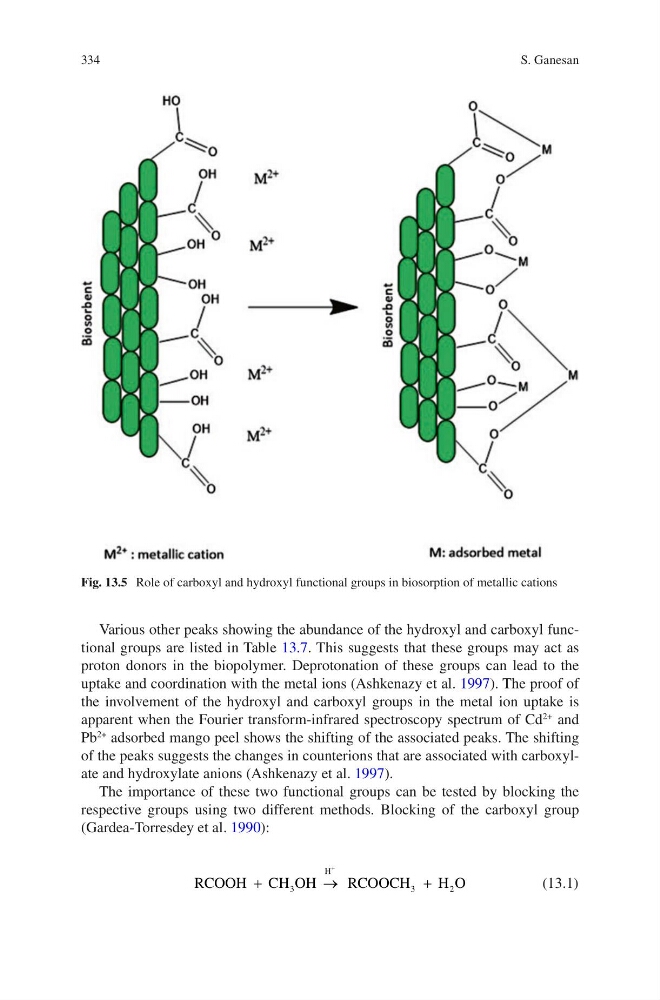
Various other peaks showing the abundance of the hydroxyl and carboxyl functional groups are listed in Table 13.7. This suggests that these groups may act as
proton donors in the biopolymer. Deprotonation of these groups can lead to the
uptake and coordination with the metal ions (Ashkenazy et al. 1997). The proof of
the involvement of the hydroxyl and carboxyl groups in the metal ion uptake is
apparent when the Fourier transform-infrared spectroscopy spectrum of Cd
2+
and
Pb
2+
adsorbed mango peel shows the shifting of the associated peaks. The shifting
of the peaks suggests the changes in counterions that are associated with carboxylate and hydroxylate anions (Ashkenazy et al. 1997).
The importance of these two functional groups can be tested by blocking the
respective groups using two different methods. Blocking of the carboxyl group
(Gardea-Torresdey et al. 1990):
RCOOH CH OH
RCOOCH
H O
H
+
®
+
+
3
3
2
(13.1)
Fig. 13.5 Role of carboxyl and hydroxyl functional groups in biosorption of metallic cations
S. Ganesan
Various other peaks showing the abundance of the hydroxyl and carboxyl functional groups are listed in Table 13.7. This suggests that these groups may act as
proton donors in the biopolymer. Deprotonation of these groups can lead to the
uptake and coordination with the metal ions (Ashkenazy et al. 1997). The proof of
the involvement of the hydroxyl and carboxyl groups in the metal ion uptake is
apparent when the Fourier transform-infrared spectroscopy spectrum of Cd
2+
and
Pb
2+
adsorbed mango peel shows the shifting of the associated peaks. The shifting
of the peaks suggests the changes in counterions that are associated with carboxylate and hydroxylate anions (Ashkenazy et al. 1997).
The importance of these two functional groups can be tested by blocking the
respective groups using two different methods. Blocking of the carboxyl group
(Gardea-Torresdey et al. 1990):
RCOOH CH OH
RCOOCH
H O
H
+
®
+
+
3
3
2
(13.1)
Fig. 13.5 Role of carboxyl and hydroxyl functional groups in biosorption of metallic cations
S. Ganesan