

335
In this method, biomass is suspended in anhydrous methanol and concentrated
hydrochloric acid and agitated continuously for 6 h. After the biomass residue is
separated by centrifugation and washed thoroughly, the residue is freeze-dried and
stored for future use.
Blocking of hydroxyl group (Chen and Yang 2006):
2
2
2
2
R OH HCHO
R O CH
H O
-
+
®
-
(
)
+
(13.2)
As for this method, the biomass is suspended in HCHO and continuously agitated for 6 h before separation by centrifugation and washing and drying similarly
to the method for carboxyl.
When carboxyl groups were blocked, the adsorption capacities of the biosorbent
plummeted to 72.46% for Cd
2+
and 76.26% for Pb
2+
. However, when hydroxyl
groups were blocked, a decrease of 26.64% for Cd
2+
and 23.57% for Pb
2+
were
observed. The metals may have interacted with the vicinal hydroxyl groups that are
present in pectins and cellulose (Li et al. 2007a). The data suggests the importance
of the carboxyl and hydroxyl groups that are present on the waste fruit cortexes in
the removal of heavy metals from water.
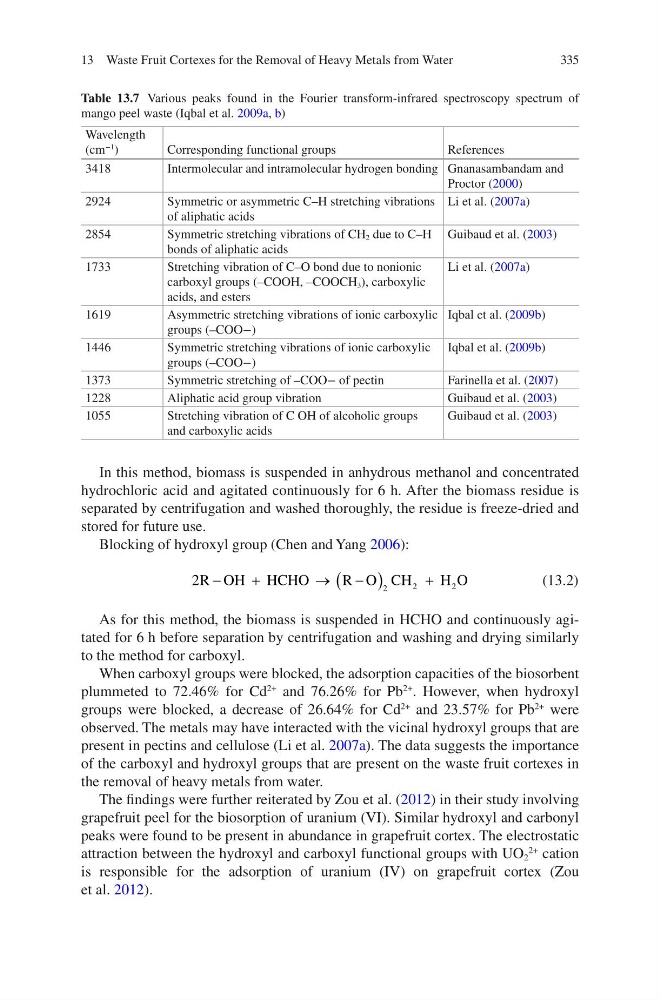
The findings were further reiterated by Zou et al. (2012) in their study involving
grapefruit peel for the biosorption of uranium (VI). Similar hydroxyl and carbonyl
peaks were found to be present in abundance in grapefruit cortex. The electrostatic
attraction between the hydroxyl and carboxyl functional groups with UO 2
2+
cation
is responsible for the adsorption of uranium (IV) on grapefruit cortex (Zou
et al. 2012).
Table 13.7 Various peaks found in the Fourier transform-infrared spectroscopy spectrum of
mango peel waste (Iqbal et al. 2009a, b)
Wavelength
(cm
−1
)
Corresponding functional groups
References
3418
Intermolecular and intramolecular hydrogen bonding Gnanasambandam and
Proctor (2000)
2924
Symmetric or asymmetric C–H stretching vibrations
of aliphatic acids
Li et al. (2007a)
2854
Symmetric stretching vibrations of CH 2 due to C–H
bonds of aliphatic acids
Guibaud et al. (2003)
1733
Stretching vibration of C–O bond due to nonionic
carboxyl groups (–COOH, –COOCH 3 ), carboxylic
acids, and esters
Li et al. (2007a)
1619
Asymmetric stretching vibrations of ionic carboxylic
groups (–COO−)
Iqbal et al. (2009b)
1446
Symmetric stretching vibrations of ionic carboxylic
groups (–COO−)
Iqbal et al. (2009b)
1373
Symmetric stretching of –COO− of pectin
Farinella et al. (2007)
1228
Aliphatic acid group vibration
Guibaud et al. (2003)
1055
Stretching vibration of C OH of alcoholic groups
and carboxylic acids
Guibaud et al. (2003)
13 Waste Fruit Cortexes for the Removal of Heavy Metals from Water
In this method, biomass is suspended in anhydrous methanol and concentrated
hydrochloric acid and agitated continuously for 6 h. After the biomass residue is
separated by centrifugation and washed thoroughly, the residue is freeze-dried and
stored for future use.
Blocking of hydroxyl group (Chen and Yang 2006):
2
2
2
2
R OH HCHO
R O CH
H O
-
+
®
-
(
)
+
(13.2)
As for this method, the biomass is suspended in HCHO and continuously agitated for 6 h before separation by centrifugation and washing and drying similarly
to the method for carboxyl.
When carboxyl groups were blocked, the adsorption capacities of the biosorbent
plummeted to 72.46% for Cd
2+
and 76.26% for Pb
2+
. However, when hydroxyl
groups were blocked, a decrease of 26.64% for Cd
2+
and 23.57% for Pb
2+
were
observed. The metals may have interacted with the vicinal hydroxyl groups that are
present in pectins and cellulose (Li et al. 2007a). The data suggests the importance
of the carboxyl and hydroxyl groups that are present on the waste fruit cortexes in
the removal of heavy metals from water.
The findings were further reiterated by Zou et al. (2012) in their study involving
grapefruit peel for the biosorption of uranium (VI). Similar hydroxyl and carbonyl
peaks were found to be present in abundance in grapefruit cortex. The electrostatic
attraction between the hydroxyl and carboxyl functional groups with UO 2
2+
cation
is responsible for the adsorption of uranium (IV) on grapefruit cortex (Zou
et al. 2012).
Table 13.7 Various peaks found in the Fourier transform-infrared spectroscopy spectrum of
mango peel waste (Iqbal et al. 2009a, b)
Wavelength
(cm
−1
)
Corresponding functional groups
References
3418
Intermolecular and intramolecular hydrogen bonding Gnanasambandam and
Proctor (2000)
2924
Symmetric or asymmetric C–H stretching vibrations
of aliphatic acids
Li et al. (2007a)
2854
Symmetric stretching vibrations of CH 2 due to C–H
bonds of aliphatic acids
Guibaud et al. (2003)
1733
Stretching vibration of C–O bond due to nonionic
carboxyl groups (–COOH, –COOCH 3 ), carboxylic
acids, and esters
Li et al. (2007a)
1619
Asymmetric stretching vibrations of ionic carboxylic
groups (–COO−)
Iqbal et al. (2009b)
1446
Symmetric stretching vibrations of ionic carboxylic
groups (–COO−)
Iqbal et al. (2009b)
1373
Symmetric stretching of –COO− of pectin
Farinella et al. (2007)
1228
Aliphatic acid group vibration
Guibaud et al. (2003)
1055
Stretching vibration of C OH of alcoholic groups
and carboxylic acids
Guibaud et al. (2003)
13 Waste Fruit Cortexes for the Removal of Heavy Metals from Water