

333
mechanism is through complexation of the heavy metal by the treated fruit cortexes
(Al-Qahtani 2016).
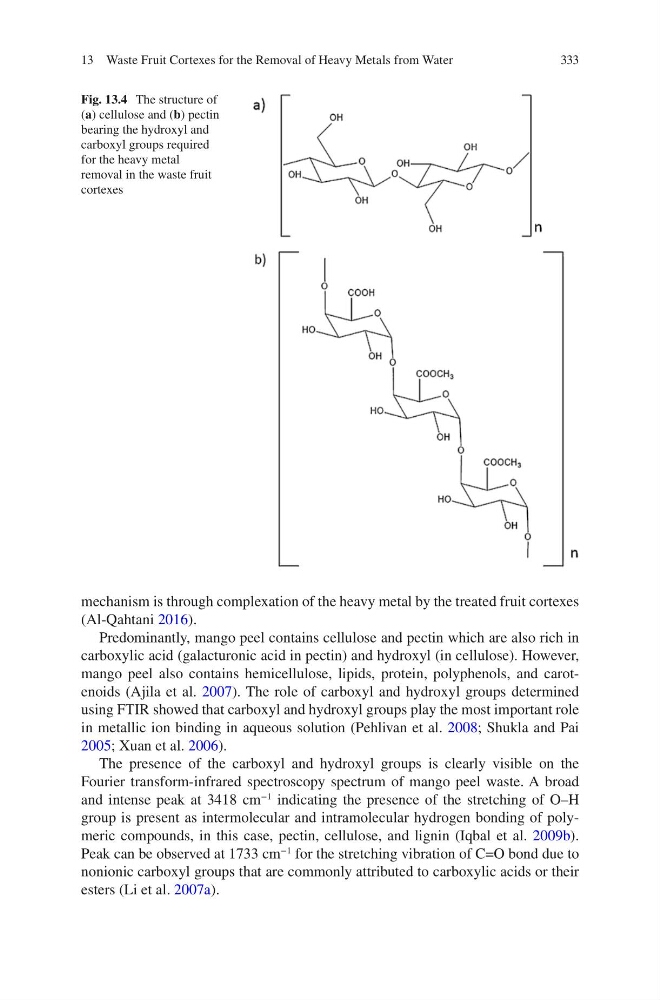
Predominantly, mango peel contains cellulose and pectin which are also rich in
carboxylic acid (galacturonic acid in pectin) and hydroxyl (in cellulose). However,
mango peel also contains hemicellulose, lipids, protein, polyphenols, and carotenoids (Ajila et al. 2007). The role of carboxyl and hydroxyl groups determined
using FTIR showed that carboxyl and hydroxyl groups play the most important role
in metallic ion binding in aqueous solution (Pehlivan et al. 2008; Shukla and Pai
2005; Xuan et al. 2006).
The presence of the carboxyl and hydroxyl groups is clearly visible on the
Fourier transform-infrared spectroscopy spectrum of mango peel waste. A broad
and intense peak at 3418 cm
−1
indicating the presence of the stretching of O–H
group is present as intermolecular and intramolecular hydrogen bonding of polymeric compounds, in this case, pectin, cellulose, and lignin (Iqbal et al. 2009b).
Peak can be observed at 1733 cm
−1
for the stretching vibration of C=O bond due to
nonionic carboxyl groups that are commonly attributed to carboxylic acids or their
esters (Li et al. 2007a).
Fig. 13.4 The structure of
(a) cellulose and (b) pectin
bearing the hydroxyl and
carboxyl groups required
for the heavy metal
removal in the waste fruit
cortexes
13 Waste Fruit Cortexes for the Removal of Heavy Metals from Water
mechanism is through complexation of the heavy metal by the treated fruit cortexes
(Al-Qahtani 2016).
Predominantly, mango peel contains cellulose and pectin which are also rich in
carboxylic acid (galacturonic acid in pectin) and hydroxyl (in cellulose). However,
mango peel also contains hemicellulose, lipids, protein, polyphenols, and carotenoids (Ajila et al. 2007). The role of carboxyl and hydroxyl groups determined
using FTIR showed that carboxyl and hydroxyl groups play the most important role
in metallic ion binding in aqueous solution (Pehlivan et al. 2008; Shukla and Pai
2005; Xuan et al. 2006).
The presence of the carboxyl and hydroxyl groups is clearly visible on the
Fourier transform-infrared spectroscopy spectrum of mango peel waste. A broad
and intense peak at 3418 cm
−1
indicating the presence of the stretching of O–H
group is present as intermolecular and intramolecular hydrogen bonding of polymeric compounds, in this case, pectin, cellulose, and lignin (Iqbal et al. 2009b).
Peak can be observed at 1733 cm
−1
for the stretching vibration of C=O bond due to
nonionic carboxyl groups that are commonly attributed to carboxylic acids or their
esters (Li et al. 2007a).
Fig. 13.4 The structure of
(a) cellulose and (b) pectin
bearing the hydroxyl and
carboxyl groups required
for the heavy metal
removal in the waste fruit
cortexes
13 Waste Fruit Cortexes for the Removal of Heavy Metals from Water