

21
As a way of investigating adsorption mechanism with its possible rate- controlling
steps, kinetic models developed have been used to evaluate the observations made
from various works. Adsorption kinetics are expressed as the rate of solute that
controls the residence time of the adsorbate in the solid–liquid boundary (Zhao
et al. 2010). Kinetic studies have been mainly performed in batch reactions by
investigating different variables, e.g., initial adsorbate concentration, particle size,
adsorbent amount, pH values, and temperature with various adsorbent and adsorbate forms (Zhao et al. 2010). Mostly, the uptake of heavy metal ions via adsorption
increases with time until equilibrium is attained between the quantity of adsorbates
adsorbed on the adsorbents and the quantity of adsorbates remaining in solution.
Adsorption reactions happened very fast at the early period and steadily slow down
when approaching equilibrium. However, the time to attain equilibrium varies with
the absorbate, adsorbent, initial concentration, and the nature of the solution. Based
on solution concentrations, different models have been applied to understand the
reaction order of adsorption systems. Examples of such models are the first-order
and second-order reversible models, first-order and second-order irreversible models, pseudo-first, and pseudo-second order rate models, Weber and Morris adsorption kinetic model, Adam-Bohart-Thomas correlation, Bhattacharya and
Venkobachar equation, Elovich’s model, and Ritchie’s relation (Foo and Hameed
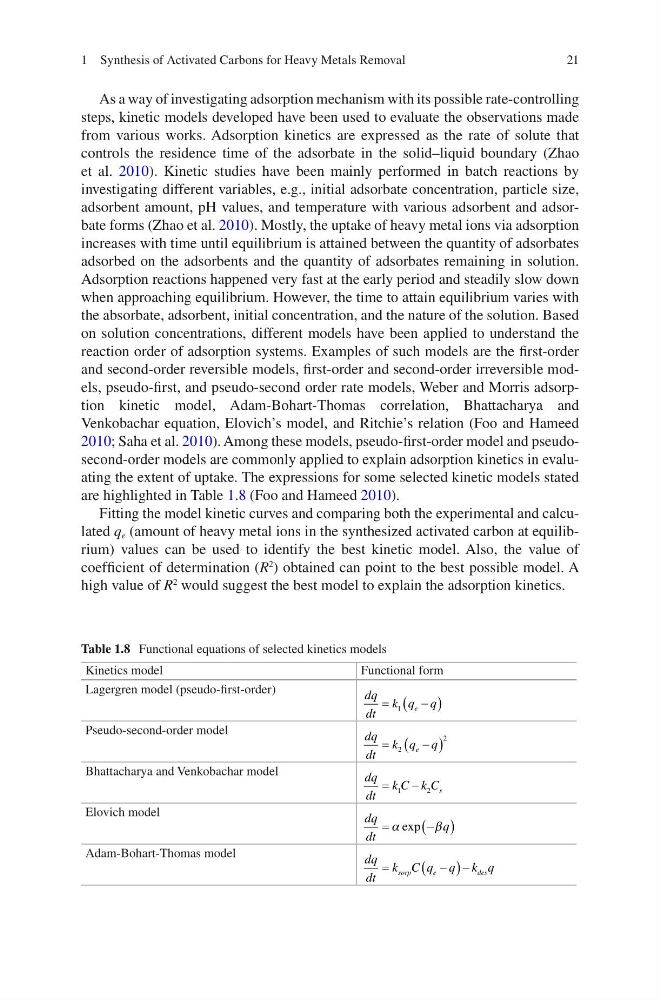
2010; Saha et al. 2010). Among these models, pseudo-first-order model and pseudosecond- order models are commonly applied to explain adsorption kinetics in evaluating the extent of uptake. The expressions for some selected kinetic models stated
are highlighted in Table 1.8 (Foo and Hameed 2010).
Fitting the model kinetic curves and comparing both the experimental and calculated q e (amount of heavy metal ions in the synthesized activated carbon at equilibrium) values can be used to identify the best kinetic model. Also, the value of
coefficient of determination (R
2
) obtained can point to the best possible model. A
high value of R
2
would suggest the best model to explain the adsorption kinetics.
Table 1.8 Functional equations of selected kinetics models
Kinetics model
Functional form
Lagergren model (pseudo-first-order)
dq
dt
k q q
e
=
-
(
)
1
Pseudo-second-order model
dq
dt
k q q
e
=
-
(
)
2
2
Bhattacharya and Venkobachar model
dq
dt
k C k C s
=
-
1
2
Elovich model
dq
dt
q
=
-
( )
a
b
exp
Adam-Bohart-Thomas model
dq
dt
k C q q k q
sorp
e
d es
=
-
(
)1 Synthesis of Activated Carbons for Heavy Metals Removal
As a way of investigating adsorption mechanism with its possible rate- controlling
steps, kinetic models developed have been used to evaluate the observations made
from various works. Adsorption kinetics are expressed as the rate of solute that
controls the residence time of the adsorbate in the solid–liquid boundary (Zhao
et al. 2010). Kinetic studies have been mainly performed in batch reactions by
investigating different variables, e.g., initial adsorbate concentration, particle size,
adsorbent amount, pH values, and temperature with various adsorbent and adsorbate forms (Zhao et al. 2010). Mostly, the uptake of heavy metal ions via adsorption
increases with time until equilibrium is attained between the quantity of adsorbates
adsorbed on the adsorbents and the quantity of adsorbates remaining in solution.
Adsorption reactions happened very fast at the early period and steadily slow down
when approaching equilibrium. However, the time to attain equilibrium varies with
the absorbate, adsorbent, initial concentration, and the nature of the solution. Based
on solution concentrations, different models have been applied to understand the
reaction order of adsorption systems. Examples of such models are the first-order
and second-order reversible models, first-order and second-order irreversible models, pseudo-first, and pseudo-second order rate models, Weber and Morris adsorption kinetic model, Adam-Bohart-Thomas correlation, Bhattacharya and
Venkobachar equation, Elovich’s model, and Ritchie’s relation (Foo and Hameed
2010; Saha et al. 2010). Among these models, pseudo-first-order model and pseudosecond- order models are commonly applied to explain adsorption kinetics in evaluating the extent of uptake. The expressions for some selected kinetic models stated
are highlighted in Table 1.8 (Foo and Hameed 2010).
Fitting the model kinetic curves and comparing both the experimental and calculated q e (amount of heavy metal ions in the synthesized activated carbon at equilibrium) values can be used to identify the best kinetic model. Also, the value of
coefficient of determination (R
2
) obtained can point to the best possible model. A
high value of R
2
would suggest the best model to explain the adsorption kinetics.
Table 1.8 Functional equations of selected kinetics models
Kinetics model
Functional form
Lagergren model (pseudo-first-order)
dq
dt
k q q
e
=
-
(
)
1
Pseudo-second-order model
dq
dt
k q q
e
=
-
(
)
2
2
Bhattacharya and Venkobachar model
dq
dt
k C k C s
=
-
1
2
Elovich model
dq
dt
q
=
-
( )
a
b
exp
Adam-Bohart-Thomas model
dq
dt
k C q q k q
sorp
e
d es
=
-
(
)1 Synthesis of Activated Carbons for Heavy Metals Removal