

20
of the uptake quantity portrayed at very high concentration by this model, a notable
drawback is its inability to obey Henry’s law at low concentration (Hadi et al. 2015).
Over the years, several other isotherm models have been developed and proposed to
describe the adsorption process. Generally, these models can be grouped into the
two- and three-parameter models (Foo and Hameed 2010). Examples of the twoparameter isotherms are Langmuir, Freundlich, Dubinin–Radushkevich, Temkin,
Flory–Huggins, and the Hill isotherm models, whereas the Redlich–Peterson, Sips,
Toth, Koble–Corrigan, Khan, and the Radke–Prausnitz isotherm models are examples of the three-parameter isotherm models. The Brunauer–Emmett–Teller isotherm model is a multilayer physisorption theoretical expression commonly
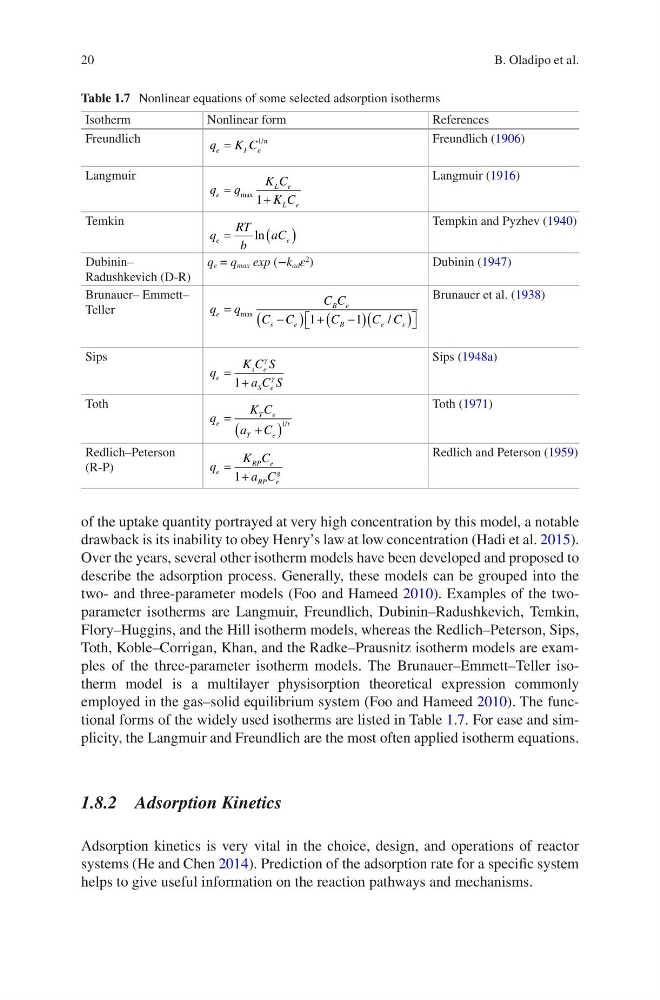
employed in the gas–solid equilibrium system (Foo and Hameed 2010). The functional forms of the widely used isotherms are listed in Table 1.7. For ease and simplicity, the Langmuir and Freundlich are the most often applied isotherm equations.
1.8.2 Adsorption Kinetics
Adsorption kinetics is very vital in the choice, design, and operations of reactor
systems (He and Chen 2014). Prediction of the adsorption rate for a specific system
helps to give useful information on the reaction pathways and mechanisms.
Table 1.7 Nonlinear equations of some selected adsorption isotherms
Isotherm
Nonlinear form
References
Freundlich
q K C
e
F e
n
=
1/
Freundlich (1906)
Langmuir
q q
K C
K C
e
L e
L e
=
+
max 1
Langmuir (1916)
Temkin
q
RT
b
aC
e
e
=
( )
ln
Tempkin and Pyzhev (1940)
Dubinin–
Radushkevich (D-R)
q e = q max exp (−k ad ε
2 )
Dubinin (1947)
Brunauer– Emmett–
Teller
q q
C C
C C
C
C C
e
B e
s
e
B
e
s
=
-
(
) + -
(
)(
)
é ë
ù û
max
1
1
/
Brunauer et al. (1938)
Sips
q
K C S
a C S
e
s e
S e
= +
g
g
1
Sips (1948a)
Toth
q
K C
a C
e
T e
T
e
t
=
+
(
)
1/
Toth (1971)
Redlich–Peterson
(R-P)
q
K C
a C
e
RP e
RP e
g
= +
1
Redlich and Peterson (1959)
B. Oladipo et al.
of the uptake quantity portrayed at very high concentration by this model, a notable
drawback is its inability to obey Henry’s law at low concentration (Hadi et al. 2015).
Over the years, several other isotherm models have been developed and proposed to
describe the adsorption process. Generally, these models can be grouped into the
two- and three-parameter models (Foo and Hameed 2010). Examples of the twoparameter isotherms are Langmuir, Freundlich, Dubinin–Radushkevich, Temkin,
Flory–Huggins, and the Hill isotherm models, whereas the Redlich–Peterson, Sips,
Toth, Koble–Corrigan, Khan, and the Radke–Prausnitz isotherm models are examples of the three-parameter isotherm models. The Brunauer–Emmett–Teller isotherm model is a multilayer physisorption theoretical expression commonly
employed in the gas–solid equilibrium system (Foo and Hameed 2010). The functional forms of the widely used isotherms are listed in Table 1.7. For ease and simplicity, the Langmuir and Freundlich are the most often applied isotherm equations.
1.8.2 Adsorption Kinetics
Adsorption kinetics is very vital in the choice, design, and operations of reactor
systems (He and Chen 2014). Prediction of the adsorption rate for a specific system
helps to give useful information on the reaction pathways and mechanisms.
Table 1.7 Nonlinear equations of some selected adsorption isotherms
Isotherm
Nonlinear form
References
Freundlich
q K C
e
F e
n
=
1/
Freundlich (1906)
Langmuir
q q
K C
K C
e
L e
L e
=
+
max 1
Langmuir (1916)
Temkin
q
RT
b
aC
e
e
=
( )
ln
Tempkin and Pyzhev (1940)
Dubinin–
Radushkevich (D-R)
q e = q max exp (−k ad ε
2 )
Dubinin (1947)
Brunauer– Emmett–
Teller
q q
C C
C C
C
C C
e
B e
s
e
B
e
s
=
-
(
) + -
(
)(
)
é ë
ù û
max
1
1
/
Brunauer et al. (1938)
Sips
q
K C S
a C S
e
s e
S e
= +
g
g
1
Sips (1948a)
Toth
q
K C
a C
e
T e
T
e
t
=
+
(
)
1/
Toth (1971)
Redlich–Peterson
(R-P)
q
K C
a C
e
RP e
RP e
g
= +
1
Redlich and Peterson (1959)
B. Oladipo et al.