

22
1.8.3 Adsorption Thermodynamics
Extensive studies on the thermodynamics of metal ion adsorption have been broadly
reported in literature. From some of these reports, two major adsorption processes
as regards the thermodynamics of the system have been identified, namely, endothermic and exothermic adsorption systems.
An increase in adsorption as temperature increases connotes that the adsorption
undergoes an endothermic process, whereas a decrease in adsorption as the temperature increases shows the exothermic nature of the adsorption system.
Thermodynamic parameters such as the Gibb’s free energy change (∆G°), enthalpy
change (∆H°), and entropy change (∆S°) have been evaluated in many studies to
check the feasibility and nature of the adsorption process. The parameters were
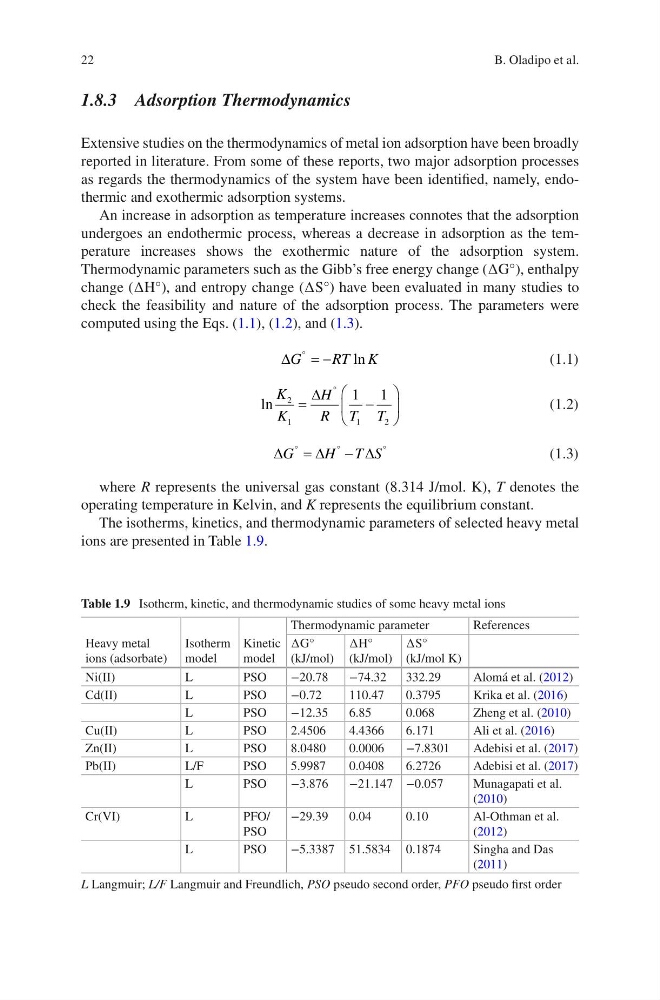
computed using the Eqs. (1.1), (1.2), and (1.3).
DG
RT K
°
= - ln
(1.1)
ln
K
K
H
R T T
2
1
1
2
1 1
=
-
æ
è
ç
ö
ø
÷
°
D
(1.2)
D
D
D
G
H T S
°
°
°
=
-
(1.3)
where R represents the universal gas constant (8.314 J/mol. K), T denotes the
operating temperature in Kelvin, and K represents the equilibrium constant.
The isotherms, kinetics, and thermodynamic parameters of selected heavy metal
ions are presented in Table 1.9.
Table 1.9 Isotherm, kinetic, and thermodynamic studies of some heavy metal ions
Heavy metal
ions (adsorbate)
Isotherm
model
Kinetic
model
Thermodynamic parameter
References
∆G°
(kJ/mol)
∆H°
(kJ/mol)
∆S°
(kJ/mol K)
Ni(II)
L
PSO
−20.78
−74.32
332.29
Alomá et al. (2012)
Cd(II)
L
PSO
−0.72
110.47
0.3795
Krika et al. (2016)
L
PSO
−12.35
6.85
0.068
Zheng et al. (2010)
Cu(II)
L
PSO
2.4506
4.4366
6.171
Ali et al. (2016)
Zn(II)
L
PSO
8.0480
0.0006
−7.8301
Adebisi et al. (2017)
Pb(II)
L/F
PSO
5.9987
0.0408
6.2726
Adebisi et al. (2017)
L
PSO
−3.876
−21.147 −0.057
Munagapati et al.
(2010)
Cr(VI)
L
PFO/
PSO
−29.39
0.04
0.10
Al-Othman et al.
(2012)
L
PSO
−5.3387 51.5834 0.1874
Singha and Das
(2011)
L Langmuir; L/F Langmuir and Freundlich, PSO pseudo second order, PFO pseudo first order
B. Oladipo et al.
1.8.3 Adsorption Thermodynamics
Extensive studies on the thermodynamics of metal ion adsorption have been broadly
reported in literature. From some of these reports, two major adsorption processes
as regards the thermodynamics of the system have been identified, namely, endothermic and exothermic adsorption systems.
An increase in adsorption as temperature increases connotes that the adsorption
undergoes an endothermic process, whereas a decrease in adsorption as the temperature increases shows the exothermic nature of the adsorption system.
Thermodynamic parameters such as the Gibb’s free energy change (∆G°), enthalpy
change (∆H°), and entropy change (∆S°) have been evaluated in many studies to
check the feasibility and nature of the adsorption process. The parameters were
computed using the Eqs. (1.1), (1.2), and (1.3).
DG
RT K
°
= - ln
(1.1)
ln
K
K
H
R T T
2
1
1
2
1 1
=
-
æ
è
ç
ö
ø
÷
°
D
(1.2)
D
D
D
G
H T S
°
°
°
=
-
(1.3)
where R represents the universal gas constant (8.314 J/mol. K), T denotes the
operating temperature in Kelvin, and K represents the equilibrium constant.
The isotherms, kinetics, and thermodynamic parameters of selected heavy metal
ions are presented in Table 1.9.
Table 1.9 Isotherm, kinetic, and thermodynamic studies of some heavy metal ions
Heavy metal
ions (adsorbate)
Isotherm
model
Kinetic
model
Thermodynamic parameter
References
∆G°
(kJ/mol)
∆H°
(kJ/mol)
∆S°
(kJ/mol K)
Ni(II)
L
PSO
−20.78
−74.32
332.29
Alomá et al. (2012)
Cd(II)
L
PSO
−0.72
110.47
0.3795
Krika et al. (2016)
L
PSO
−12.35
6.85
0.068
Zheng et al. (2010)
Cu(II)
L
PSO
2.4506
4.4366
6.171
Ali et al. (2016)
Zn(II)
L
PSO
8.0480
0.0006
−7.8301
Adebisi et al. (2017)
Pb(II)
L/F
PSO
5.9987
0.0408
6.2726
Adebisi et al. (2017)
L
PSO
−3.876
−21.147 −0.057
Munagapati et al.
(2010)
Cr(VI)
L
PFO/
PSO
−29.39
0.04
0.10
Al-Othman et al.
(2012)
L
PSO
−5.3387 51.5834 0.1874
Singha and Das
(2011)
L Langmuir; L/F Langmuir and Freundlich, PSO pseudo second order, PFO pseudo first order
B. Oladipo et al.