

329
parts of the world, the whole banana tree is used for various applications, for example, the leaves are used as plates and food wrappers. Bananas are highly sought
after as an energy food for the high sugar and potassium. In fact, bananas are one
of the largest consumed fruits around the world and, hence, become one of the
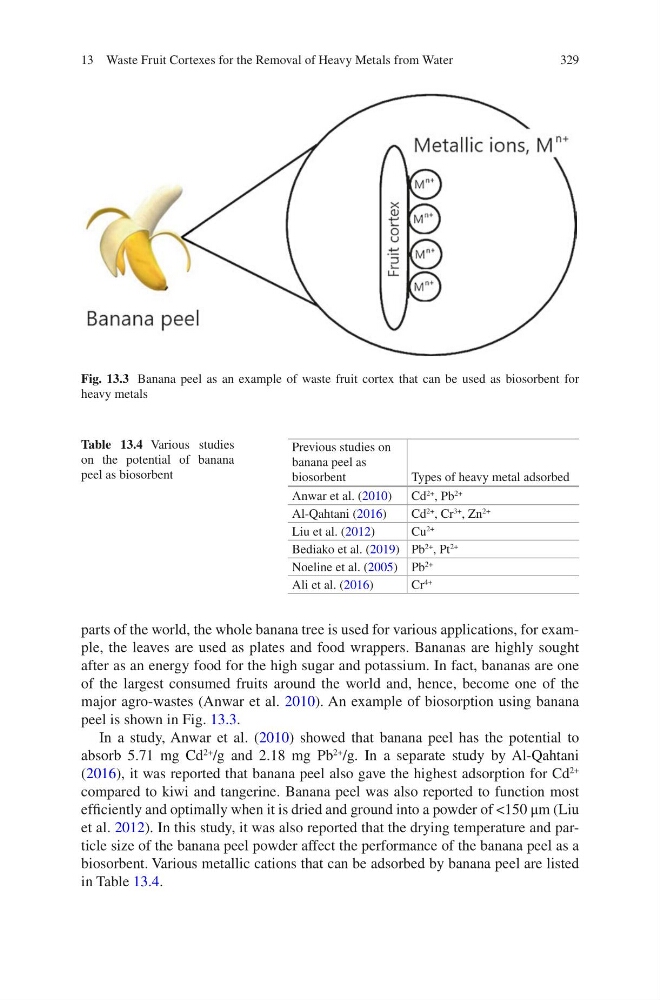
major agro-wastes (Anwar et al. 2010). An example of biosorption using banana
peel is shown in Fig. 13.3.
In a study, Anwar et al. (2010) showed that banana peel has the potential to
absorb 5.71 mg Cd
2+
/g and 2.18 mg Pb
2+
/g. In a separate study by Al-Qahtani
(2016), it was reported that banana peel also gave the highest adsorption for Cd
2+
compared to kiwi and tangerine. Banana peel was also reported to function most
efficiently and optimally when it is dried and ground into a powder of <150 μm (Liu
et al. 2012). In this study, it was also reported that the drying temperature and particle size of the banana peel powder affect the performance of the banana peel as a
biosorbent. Various metallic cations that can be adsorbed by banana peel are listed
in Table 13.4.
Fig. 13.3 Banana peel as an example of waste fruit cortex that can be used as biosorbent for
heavy metals
Table 13.4 Various studies
on the potential of banana
peel as biosorbent
Previous studies on
banana peel as
biosorbent
Types of heavy metal adsorbed
Anwar et al. (2010)
Cd
2+
, Pb
2+
Al-Qahtani (2016)
Cd
2+
, Cr
3+
, Zn
2+
Liu et al. (2012)
Cu
2+
Bediako et al. (2019) Pb
2+
, Pt
2+
Noeline et al. (2005) Pb
2+
Ali et al. (2016)
Cr
4+
13 Waste Fruit Cortexes for the Removal of Heavy Metals from Water
parts of the world, the whole banana tree is used for various applications, for example, the leaves are used as plates and food wrappers. Bananas are highly sought
after as an energy food for the high sugar and potassium. In fact, bananas are one
of the largest consumed fruits around the world and, hence, become one of the
major agro-wastes (Anwar et al. 2010). An example of biosorption using banana
peel is shown in Fig. 13.3.
In a study, Anwar et al. (2010) showed that banana peel has the potential to
absorb 5.71 mg Cd
2+
/g and 2.18 mg Pb
2+
/g. In a separate study by Al-Qahtani
(2016), it was reported that banana peel also gave the highest adsorption for Cd
2+
compared to kiwi and tangerine. Banana peel was also reported to function most
efficiently and optimally when it is dried and ground into a powder of <150 μm (Liu
et al. 2012). In this study, it was also reported that the drying temperature and particle size of the banana peel powder affect the performance of the banana peel as a
biosorbent. Various metallic cations that can be adsorbed by banana peel are listed
in Table 13.4.
Fig. 13.3 Banana peel as an example of waste fruit cortex that can be used as biosorbent for
heavy metals
Table 13.4 Various studies
on the potential of banana
peel as biosorbent
Previous studies on
banana peel as
biosorbent
Types of heavy metal adsorbed
Anwar et al. (2010)
Cd
2+
, Pb
2+
Al-Qahtani (2016)
Cd
2+
, Cr
3+
, Zn
2+
Liu et al. (2012)
Cu
2+
Bediako et al. (2019) Pb
2+
, Pt
2+
Noeline et al. (2005) Pb
2+
Ali et al. (2016)
Cr
4+
13 Waste Fruit Cortexes for the Removal of Heavy Metals from Water