

330
13.2.2 Citrus Peel as Biosorbent
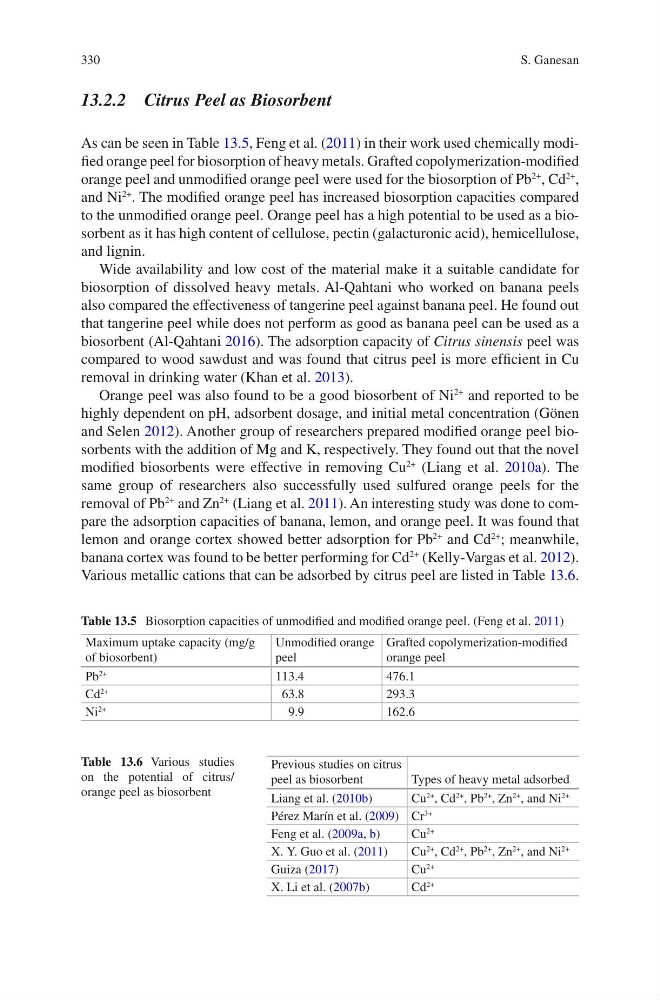
As can be seen in Table 13.5, Feng et al. (2011) in their work used chemically modified orange peel for biosorption of heavy metals. Grafted copolymerization- modified
orange peel and unmodified orange peel were used for the biosorption of Pb
2+
, Cd
2+
,
and Ni
2+
. The modified orange peel has increased biosorption capacities compared
to the unmodified orange peel. Orange peel has a high potential to be used as a biosorbent as it has high content of cellulose, pectin (galacturonic acid), hemicellulose,
and lignin.
Wide availability and low cost of the material make it a suitable candidate for
biosorption of dissolved heavy metals. Al-Qahtani who worked on banana peels
also compared the effectiveness of tangerine peel against banana peel. He found out
that tangerine peel while does not perform as good as banana peel can be used as a
biosorbent (Al-Qahtani 2016). The adsorption capacity of Citrus sinensis peel was
compared to wood sawdust and was found that citrus peel is more efficient in Cu
removal in drinking water (Khan et al. 2013).
Orange peel was also found to be a good biosorbent of Ni
2+
and reported to be
highly dependent on pH, adsorbent dosage, and initial metal concentration (Gönen
and Selen 2012). Another group of researchers prepared modified orange peel biosorbents with the addition of Mg and K, respectively. They found out that the novel
modified biosorbents were effective in removing Cu
2+
(Liang et al. 2010a). The
same group of researchers also successfully used sulfured orange peels for the
removal of Pb
2+
and Zn
2+
(Liang et al. 2011). An interesting study was done to compare the adsorption capacities of banana, lemon, and orange peel. It was found that
lemon and orange cortex showed better adsorption for Pb
2+
and Cd
2+
; meanwhile,
banana cortex was found to be better performing for Cd
2+
(Kelly-Vargas et al. 2012).
Various metallic cations that can be adsorbed by citrus peel are listed in Table 13.6.
Table 13.5 Biosorption capacities of unmodified and modified orange peel. (Feng et al. 2011)
Maximum uptake capacity (mg/g
of biosorbent)
Unmodified orange
peel
Grafted copolymerization-modified
orange peel
Pb
2+
113.4
476.1
Cd
2+
63.8
293.3
Ni
2+
9.9
162.6
Table 13.6 Various studies
on the potential of citrus/
orange peel as biosorbent
Previous studies on citrus
peel as biosorbent
Types of heavy metal adsorbed
Liang et al. (2010b)
Cu
2+
, Cd
2+
, Pb
2+
, Zn
2+
, and Ni
2+
Pérez Marín et al. (2009) Cr
3+
Feng et al. (2009a, b)
Cu
2+
X. Y. Guo et al. (2011)
Cu
2+
, Cd
2+
, Pb
2+
, Zn
2+
, and Ni
2+
Guiza (2017)
Cu
2+
X. Li et al. (2007b)
Cd
2+
S. Ganesan
13.2.2 Citrus Peel as Biosorbent
As can be seen in Table 13.5, Feng et al. (2011) in their work used chemically modified orange peel for biosorption of heavy metals. Grafted copolymerization- modified
orange peel and unmodified orange peel were used for the biosorption of Pb
2+
, Cd
2+
,
and Ni
2+
. The modified orange peel has increased biosorption capacities compared
to the unmodified orange peel. Orange peel has a high potential to be used as a biosorbent as it has high content of cellulose, pectin (galacturonic acid), hemicellulose,
and lignin.
Wide availability and low cost of the material make it a suitable candidate for
biosorption of dissolved heavy metals. Al-Qahtani who worked on banana peels
also compared the effectiveness of tangerine peel against banana peel. He found out
that tangerine peel while does not perform as good as banana peel can be used as a
biosorbent (Al-Qahtani 2016). The adsorption capacity of Citrus sinensis peel was
compared to wood sawdust and was found that citrus peel is more efficient in Cu
removal in drinking water (Khan et al. 2013).
Orange peel was also found to be a good biosorbent of Ni
2+
and reported to be
highly dependent on pH, adsorbent dosage, and initial metal concentration (Gönen
and Selen 2012). Another group of researchers prepared modified orange peel biosorbents with the addition of Mg and K, respectively. They found out that the novel
modified biosorbents were effective in removing Cu
2+
(Liang et al. 2010a). The
same group of researchers also successfully used sulfured orange peels for the
removal of Pb
2+
and Zn
2+
(Liang et al. 2011). An interesting study was done to compare the adsorption capacities of banana, lemon, and orange peel. It was found that
lemon and orange cortex showed better adsorption for Pb
2+
and Cd
2+
; meanwhile,
banana cortex was found to be better performing for Cd
2+
(Kelly-Vargas et al. 2012).
Various metallic cations that can be adsorbed by citrus peel are listed in Table 13.6.
Table 13.5 Biosorption capacities of unmodified and modified orange peel. (Feng et al. 2011)
Maximum uptake capacity (mg/g
of biosorbent)
Unmodified orange
peel
Grafted copolymerization-modified
orange peel
Pb
2+
113.4
476.1
Cd
2+
63.8
293.3
Ni
2+
9.9
162.6
Table 13.6 Various studies
on the potential of citrus/
orange peel as biosorbent
Previous studies on citrus
peel as biosorbent
Types of heavy metal adsorbed
Liang et al. (2010b)
Cu
2+
, Cd
2+
, Pb
2+
, Zn
2+
, and Ni
2+
Pérez Marín et al. (2009) Cr
3+
Feng et al. (2009a, b)
Cu
2+
X. Y. Guo et al. (2011)
Cu
2+
, Cd
2+
, Pb
2+
, Zn
2+
, and Ni
2+
Guiza (2017)
Cu
2+
X. Li et al. (2007b)
Cd
2+
S. Ganesan