

328
sorbate–biosorbent interface and effectively reducing the sorbate concentration in
the original solution (Gadd 2009). Ease of availability in large quantities and regeneration makes the potential adsorbent more attractive to the industries. Hence, biosorbents have recently attracted the attention of researchers to work on the many
types of biosorbents available in nature.
Some of the agricultural waste biosorbents reported are pomelo peel (Tasaso
2013), banana peel (Annadurai et al. 2002; Kelly-Vargas et al. 2012; Liu et al.
2012), (Alencar et al. 2012; Iqbal et al. 2013; Iqbal et al. 2009a, b), peat (Brown
et al. 2000a Henryk et al. 2016; B. Sen Gupta et al. 2009), coconut fiber (Babel and
Kurniawan 2004; Bhatnagar et al. 2010a, b; Guo et al. 2010), sunflower stalk
(Benaïssa and Elouchdi 2007; Jain et al. 2013; Jalali and Aboulghazi 2013; WitekKrowiak 2012), and kiwi (Al-Qahtani 2016). Many more waste fruit cortexes have
been investigated and found to work as biosorbent for heavy metal in water.
The agricultural waste materials contain the basic components such as hemicellulose, lignin, lipids, proteins, simple sugars, water, hydrocarbons, and starch that
may contain functional groups suitable for adsorption of the heavy metals (Demirbas
2008; Hossain et al. 2012). The adsorbents can be used in the original or modified
form. Cortexes of plants often refer to a plant bark/rind or the typical parenchymatous
layer of tissue external to the vascular tissue and internal to the corky or epidermal
tissues of a green plant. It can also be applied to the outer/investing layer of various
algae, lichen, or fungi. Waste fruit peels can also work in other ways such as diffusion
and ion transport, coprecipitation, ion exchange, and complexation to remove heavy
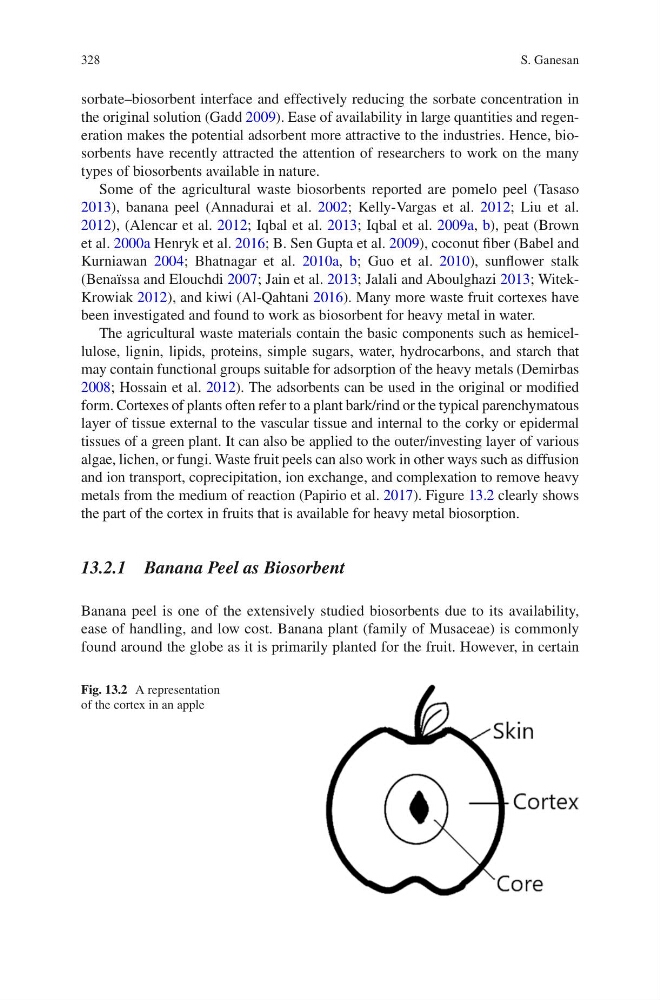
metals from the medium of reaction (Papirio et al. 2017). Figure 13.2 clearly shows
the part of the cortex in fruits that is available for heavy metal biosorption.
13.2.1 Banana Peel as Biosorbent
Banana peel is one of the extensively studied biosorbents due to its availability,
ease of handling, and low cost. Banana plant (family of Musaceae) is commonly
found around the globe as it is primarily planted for the fruit. However, in certain
Fig. 13.2 A representation
of the cortex in an apple
S. Ganesan
sorbate–biosorbent interface and effectively reducing the sorbate concentration in
the original solution (Gadd 2009). Ease of availability in large quantities and regeneration makes the potential adsorbent more attractive to the industries. Hence, biosorbents have recently attracted the attention of researchers to work on the many
types of biosorbents available in nature.
Some of the agricultural waste biosorbents reported are pomelo peel (Tasaso
2013), banana peel (Annadurai et al. 2002; Kelly-Vargas et al. 2012; Liu et al.
2012), (Alencar et al. 2012; Iqbal et al. 2013; Iqbal et al. 2009a, b), peat (Brown
et al. 2000a Henryk et al. 2016; B. Sen Gupta et al. 2009), coconut fiber (Babel and
Kurniawan 2004; Bhatnagar et al. 2010a, b; Guo et al. 2010), sunflower stalk
(Benaïssa and Elouchdi 2007; Jain et al. 2013; Jalali and Aboulghazi 2013; WitekKrowiak 2012), and kiwi (Al-Qahtani 2016). Many more waste fruit cortexes have
been investigated and found to work as biosorbent for heavy metal in water.
The agricultural waste materials contain the basic components such as hemicellulose, lignin, lipids, proteins, simple sugars, water, hydrocarbons, and starch that
may contain functional groups suitable for adsorption of the heavy metals (Demirbas
2008; Hossain et al. 2012). The adsorbents can be used in the original or modified
form. Cortexes of plants often refer to a plant bark/rind or the typical parenchymatous
layer of tissue external to the vascular tissue and internal to the corky or epidermal
tissues of a green plant. It can also be applied to the outer/investing layer of various
algae, lichen, or fungi. Waste fruit peels can also work in other ways such as diffusion
and ion transport, coprecipitation, ion exchange, and complexation to remove heavy
metals from the medium of reaction (Papirio et al. 2017). Figure 13.2 clearly shows
the part of the cortex in fruits that is available for heavy metal biosorption.
13.2.1 Banana Peel as Biosorbent
Banana peel is one of the extensively studied biosorbents due to its availability,
ease of handling, and low cost. Banana plant (family of Musaceae) is commonly
found around the globe as it is primarily planted for the fruit. However, in certain
Fig. 13.2 A representation
of the cortex in an apple
S. Ganesan