

327
This chapter reviews extensively the different kinds of waste fruit cortexes that
are available for the removal of heavy metals from water, the mechanisms involved,
the kinetics and adsorption models, as well as the various factors that affect the
adsorption of heavy metals. The thorough review serves to gather as much information as possible about the usage and research on potentials of waste fruit cortexes in
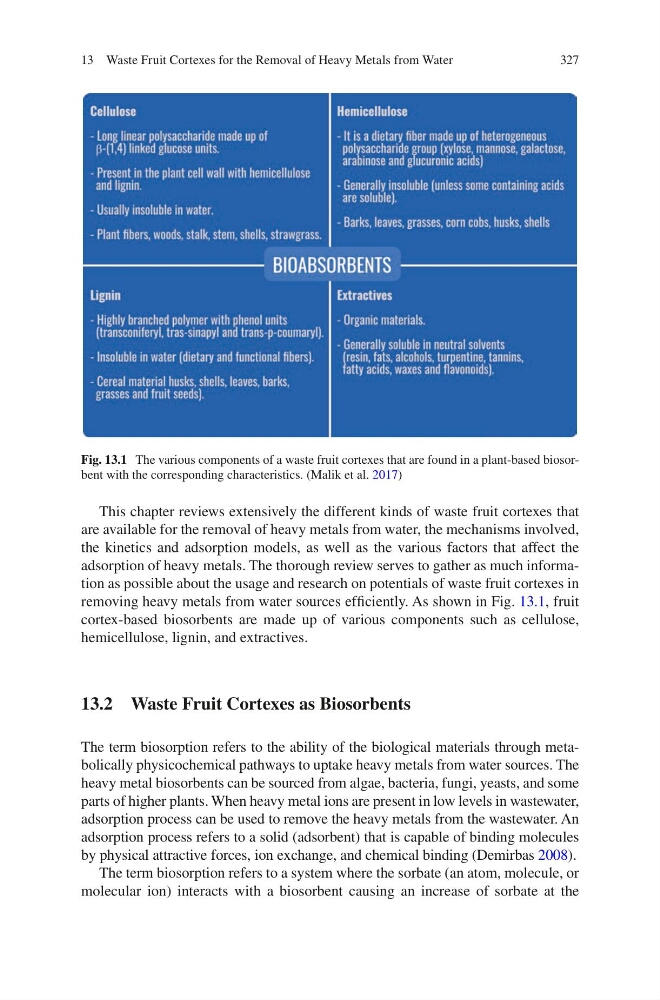
removing heavy metals from water sources efficiently. As shown in Fig. 13.1, fruit
cortex-based biosorbents are made up of various components such as cellulose,
hemicellulose, lignin, and extractives.
13.2 Waste Fruit Cortexes as Biosorbents
The term biosorption refers to the ability of the biological materials through metabolically physicochemical pathways to uptake heavy metals from water sources. The
heavy metal biosorbents can be sourced from algae, bacteria, fungi, yeasts, and some
parts of higher plants. When heavy metal ions are present in low levels in wastewater,
adsorption process can be used to remove the heavy metals from the wastewater. An
adsorption process refers to a solid (adsorbent) that is capable of binding molecules
by physical attractive forces, ion exchange, and chemical binding (Demirbas 2008).
The term biosorption refers to a system where the sorbate (an atom, molecule, or
molecular ion) interacts with a biosorbent causing an increase of sorbate at the
Fig. 13.1 The various components of a waste fruit cortexes that are found in a plant-based biosorbent with the corresponding characteristics. (Malik et al. 2017)
13 Waste Fruit Cortexes for the Removal of Heavy Metals from Water
This chapter reviews extensively the different kinds of waste fruit cortexes that
are available for the removal of heavy metals from water, the mechanisms involved,
the kinetics and adsorption models, as well as the various factors that affect the
adsorption of heavy metals. The thorough review serves to gather as much information as possible about the usage and research on potentials of waste fruit cortexes in
removing heavy metals from water sources efficiently. As shown in Fig. 13.1, fruit
cortex-based biosorbents are made up of various components such as cellulose,
hemicellulose, lignin, and extractives.
13.2 Waste Fruit Cortexes as Biosorbents
The term biosorption refers to the ability of the biological materials through metabolically physicochemical pathways to uptake heavy metals from water sources. The
heavy metal biosorbents can be sourced from algae, bacteria, fungi, yeasts, and some
parts of higher plants. When heavy metal ions are present in low levels in wastewater,
adsorption process can be used to remove the heavy metals from the wastewater. An
adsorption process refers to a solid (adsorbent) that is capable of binding molecules
by physical attractive forces, ion exchange, and chemical binding (Demirbas 2008).
The term biosorption refers to a system where the sorbate (an atom, molecule, or
molecular ion) interacts with a biosorbent causing an increase of sorbate at the
Fig. 13.1 The various components of a waste fruit cortexes that are found in a plant-based biosorbent with the corresponding characteristics. (Malik et al. 2017)
13 Waste Fruit Cortexes for the Removal of Heavy Metals from Water