

326
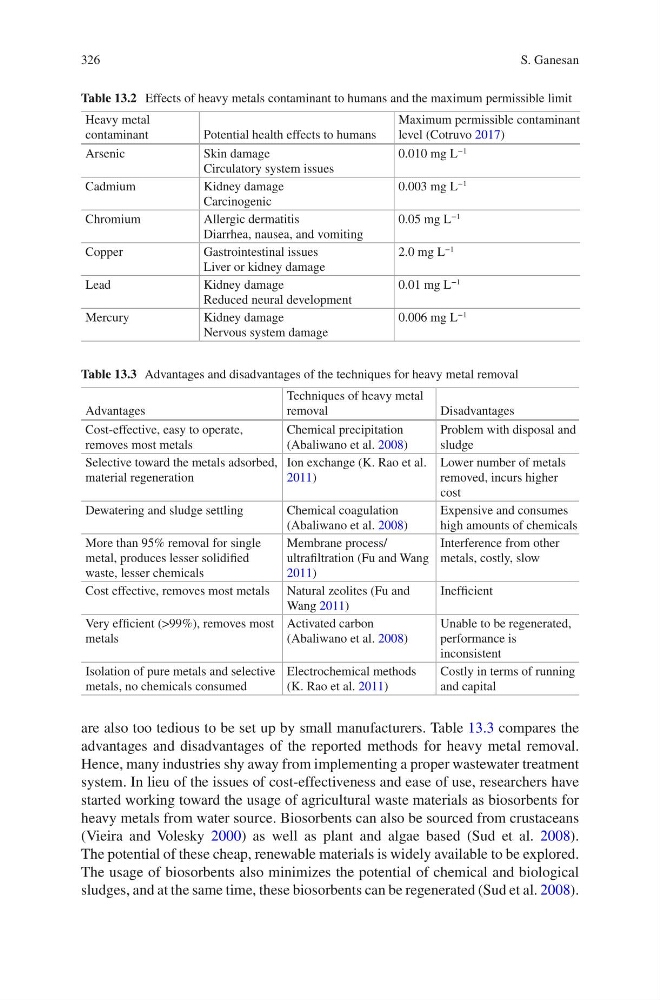
are also too tedious to be set up by small manufacturers. Table 13.3 compares the
advantages and disadvantages of the reported methods for heavy metal removal.
Hence, many industries shy away from implementing a proper wastewater treatment
system. In lieu of the issues of cost-effectiveness and ease of use, researchers have
started working toward the usage of agricultural waste materials as biosorbents for
heavy metals from water source. Biosorbents can also be sourced from crustaceans
(Vieira and Volesky 2000) as well as plant and algae based (Sud et al. 2008).
The potential of these cheap, renewable materials is widely available to be explored.
The usage of biosorbents also minimizes the potential of chemical and biological
sludges, and at the same time, these biosorbents can be regenerated (Sud et al. 2008).
Table 13.2 Effects of heavy metals contaminant to humans and the maximum permissible limit
Heavy metal
contaminant
Potential health effects to humans
Maximum permissible contaminant
level (Cotruvo 2017)
Arsenic
Skin damage
Circulatory system issues
0.010 mg L
−1
Cadmium
Kidney damage
Carcinogenic
0.003 mg L
−1
Chromium
Allergic dermatitis
Diarrhea, nausea, and vomiting
0.05 mg L
−1
Copper
Gastrointestinal issues
Liver or kidney damage
2.0 mg L
−1
Lead
Kidney damage
Reduced neural development
0.01 mg L
−1
Mercury
Kidney damage
Nervous system damage
0.006 mg L
−1
Table 13.3 Advantages and disadvantages of the techniques for heavy metal removal
Advantages
Techniques of heavy metal
removal
Disadvantages
Cost-effective, easy to operate,
removes most metals
Chemical precipitation
(Abaliwano et al. 2008)
Problem with disposal and
sludge
Selective toward the metals adsorbed,
material regeneration
Ion exchange (K. Rao et al.
2011)
Lower number of metals
removed, incurs higher
cost
Dewatering and sludge settling
Chemical coagulation
(Abaliwano et al. 2008)
Expensive and consumes
high amounts of chemicals
More than 95% removal for single
metal, produces lesser solidified
waste, lesser chemicals
Membrane process/
ultrafiltration (Fu and Wang
2011)
Interference from other
metals, costly, slow
Cost effective, removes most metals Natural zeolites (Fu and
Wang 2011)
Inefficient
Very efficient (>99%), removes most
metals
Activated carbon
(Abaliwano et al. 2008)
Unable to be regenerated,
performance is
inconsistent
Isolation of pure metals and selective
metals, no chemicals consumed
Electrochemical methods
(K. Rao et al. 2011)
Costly in terms of running
and capital
S. Ganesan
are also too tedious to be set up by small manufacturers. Table 13.3 compares the
advantages and disadvantages of the reported methods for heavy metal removal.
Hence, many industries shy away from implementing a proper wastewater treatment
system. In lieu of the issues of cost-effectiveness and ease of use, researchers have
started working toward the usage of agricultural waste materials as biosorbents for
heavy metals from water source. Biosorbents can also be sourced from crustaceans
(Vieira and Volesky 2000) as well as plant and algae based (Sud et al. 2008).
The potential of these cheap, renewable materials is widely available to be explored.
The usage of biosorbents also minimizes the potential of chemical and biological
sludges, and at the same time, these biosorbents can be regenerated (Sud et al. 2008).
Table 13.2 Effects of heavy metals contaminant to humans and the maximum permissible limit
Heavy metal
contaminant
Potential health effects to humans
Maximum permissible contaminant
level (Cotruvo 2017)
Arsenic
Skin damage
Circulatory system issues
0.010 mg L
−1
Cadmium
Kidney damage
Carcinogenic
0.003 mg L
−1
Chromium
Allergic dermatitis
Diarrhea, nausea, and vomiting
0.05 mg L
−1
Copper
Gastrointestinal issues
Liver or kidney damage
2.0 mg L
−1
Lead
Kidney damage
Reduced neural development
0.01 mg L
−1
Mercury
Kidney damage
Nervous system damage
0.006 mg L
−1
Table 13.3 Advantages and disadvantages of the techniques for heavy metal removal
Advantages
Techniques of heavy metal
removal
Disadvantages
Cost-effective, easy to operate,
removes most metals
Chemical precipitation
(Abaliwano et al. 2008)
Problem with disposal and
sludge
Selective toward the metals adsorbed,
material regeneration
Ion exchange (K. Rao et al.
2011)
Lower number of metals
removed, incurs higher
cost
Dewatering and sludge settling
Chemical coagulation
(Abaliwano et al. 2008)
Expensive and consumes
high amounts of chemicals
More than 95% removal for single
metal, produces lesser solidified
waste, lesser chemicals
Membrane process/
ultrafiltration (Fu and Wang
2011)
Interference from other
metals, costly, slow
Cost effective, removes most metals Natural zeolites (Fu and
Wang 2011)
Inefficient
Very efficient (>99%), removes most
metals
Activated carbon
(Abaliwano et al. 2008)
Unable to be regenerated,
performance is
inconsistent
Isolation of pure metals and selective
metals, no chemicals consumed
Electrochemical methods
(K. Rao et al. 2011)
Costly in terms of running
and capital
S. Ganesan