

275
The former are responsible for selective absorption of light from visible region
and the latter for affinity for being colored materials. Other substituents which
impart specific properties of dyes affecting their solubility or stability improvement
can also be present (Hunger 2002). Dyes could be divided into few classes taking
into consideration their chemical structure (chemical classification) or their usage
and application methods (technical classification). The most popular groups of dyes
based on chemical classification are azo/azomethine, anthraquinone, polymethine,
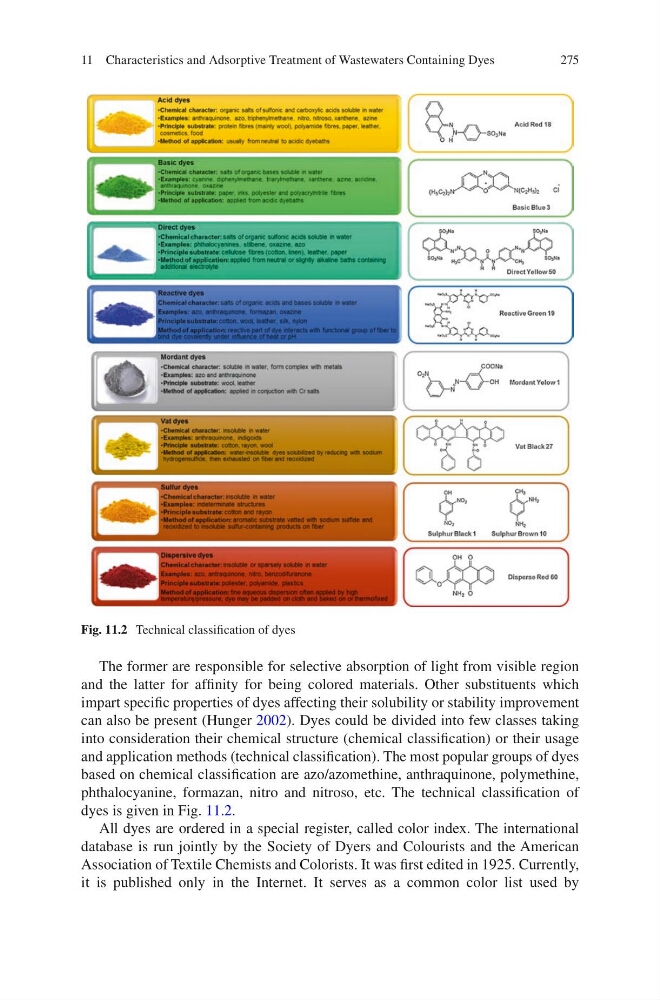
phthalocyanine, formazan, nitro and nitroso, etc. The technical classification of
dyes is given in Fig. 11.2.
All dyes are ordered in a special register, called color index. The international
database is run jointly by the Society of Dyers and Colourists and the American
Association of Textile Chemists and Colorists. It was first edited in 1925. Currently,
it is published only in the Internet. It serves as a common color list used by
Fig. 11.2 Technical classification of dyes
11 Characteristics and Adsorptive Treatment of Wastewaters Containing Dyes
The former are responsible for selective absorption of light from visible region
and the latter for affinity for being colored materials. Other substituents which
impart specific properties of dyes affecting their solubility or stability improvement
can also be present (Hunger 2002). Dyes could be divided into few classes taking
into consideration their chemical structure (chemical classification) or their usage
and application methods (technical classification). The most popular groups of dyes
based on chemical classification are azo/azomethine, anthraquinone, polymethine,
phthalocyanine, formazan, nitro and nitroso, etc. The technical classification of
dyes is given in Fig. 11.2.
All dyes are ordered in a special register, called color index. The international
database is run jointly by the Society of Dyers and Colourists and the American
Association of Textile Chemists and Colorists. It was first edited in 1925. Currently,
it is published only in the Internet. It serves as a common color list used by
Fig. 11.2 Technical classification of dyes
11 Characteristics and Adsorptive Treatment of Wastewaters Containing Dyes