

274
such as living or dead biomass, e.g., algae, yeast, bacteria, fungi), composites and
nanocomposites, nanomaterials, as well as ion-exchange resins. The physicochemical
properties of the above mentioned sorbents and their sorption capacities were compared toward different types of dyes based on a literature review.
Keywords Dyes · Adsorption · Activated carbons · Low-cost adsorbents ·
Composites · Anion exchangers · Textile wastewaters · Dyes removal
11.1 Introduction
11.1.1 Dyes: Definition and Classification
The definition of dyes as chemical substances taken from a popular science encyclopedia states that they are organic substances of natural or synthetic origin which are
able to have selective absorption of light within visible region (400–700 nm) and
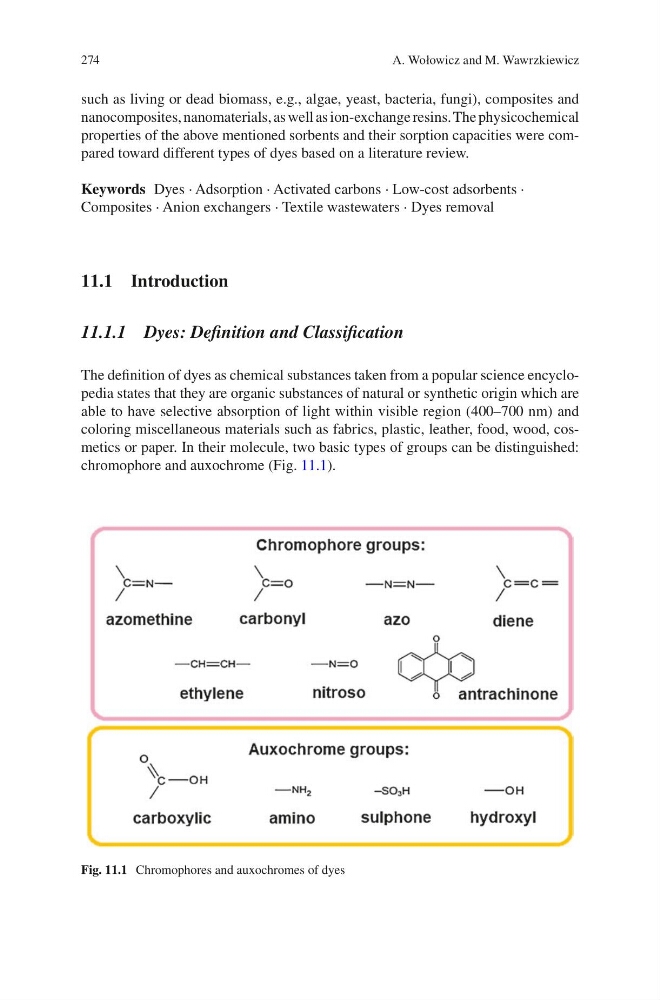
coloring miscellaneous materials such as fabrics, plastic, leather, food, wood, cosmetics or paper. In their molecule, two basic types of groups can be distinguished:
chromophore and auxochrome (Fig. 11.1).
Fig. 11.1 Chromophores and auxochromes of dyes
A. Wołowicz and M. Wawrzkiewicz
such as living or dead biomass, e.g., algae, yeast, bacteria, fungi), composites and
nanocomposites, nanomaterials, as well as ion-exchange resins. The physicochemical
properties of the above mentioned sorbents and their sorption capacities were compared toward different types of dyes based on a literature review.
Keywords Dyes · Adsorption · Activated carbons · Low-cost adsorbents ·
Composites · Anion exchangers · Textile wastewaters · Dyes removal
11.1 Introduction
11.1.1 Dyes: Definition and Classification
The definition of dyes as chemical substances taken from a popular science encyclopedia states that they are organic substances of natural or synthetic origin which are
able to have selective absorption of light within visible region (400–700 nm) and
coloring miscellaneous materials such as fabrics, plastic, leather, food, wood, cosmetics or paper. In their molecule, two basic types of groups can be distinguished:
chromophore and auxochrome (Fig. 11.1).
Fig. 11.1 Chromophores and auxochromes of dyes
A. Wołowicz and M. Wawrzkiewicz